
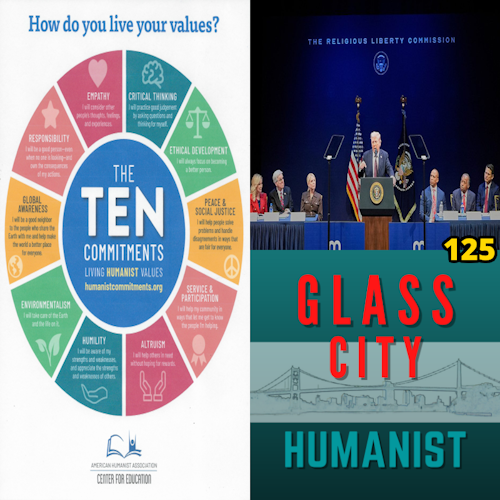
Episode 125: Why Our Best Defense Is a Bold, Joyful Positive Humanism
Even with all the struggles in protecting our religious liberty, we need to remind ourselves how progressive and positive Humanism is. We do have to focus on negative aspects of the world in order to highlight how Humanism is a better, bold, and joyful way.
We highlight a book by Roy Speckhardt and and essay by Fred Edwards to define humanism as a philosophy grounded in reason, science, empathy, compassion, fairness, civil liberties, and human rights. We also note that humanism is open-ended, forward-looking, and focused on life in the present rather than supernatural authority.
We then look at three current religious liberty issues. One is the end of the biased Trump Religious Liberty Commission and a lawsuit filed by progressive groups. We talk about Pete Hegseth removing many religions off the official Department of Defense list and Douglas points out how an agency of the Federal government shouldn’t be passing judgement on what is and what isn’t an approved religion.
Finally, we mention a Supreme Court decision the pushed aside a lawsuit involving a Rastafarian prisoner and the violation of his religious liberty. Religious liberty seems to only apply to Christian Nationalists





Extras:
Creating Change Through Humanism
Why we sued Trump’s biased ‘Religious Liberty’ Commission
In final meeting, Trump’s “Religious Liberty” chair calls church/state separation a “lie”
Hegseth must stop using the government to promote his own religion
At SCOTUS, Once Again, Religious Rights Are Only for Conservative Christians
Transcript:
Click Here to Read Full Transcript
[0:05] This is Glass City Humanist, a show about humanism, humanist values, by a humanist. Here is your host, Douglas Berger. We have to deal with a lot of negativity as we scramble to protect our religious liberty. But at heart, humanism is a progressive, positive life stance. Then we look at some of the religious liberty dumpster fires we have to manage before the midterm elections come in November. Glass City Humanist is an outreach project of the secular humanists of Western Lake Erie, building community through compassion and reason for a better tomorrow.
[1:00] One of the things that I do to be a good leader for my humanist group here in Toledo is I talk to my members. And I ask them what kind of programming that they want to see and, you know, what other topics can we talk about? What interests them? Do they know any speakers that maybe we could invite to them? Because, you know, I’ve always I always felt that this group is for the members. It’s not for me. I have a particular set of ideas about how I see my humanism, and.
[1:40] That doesn’t always mesh with what other people have. And so we were having this discussion with a member. I was talking to a member, the other day asking about programming. And one of the things that they mentioned to me was they were wondering why, our programs were so negative, that we talked about negative stuff so much. It took me back a little bit, but it didn’t surprise me because I’ve heard that argument before. I have been part of the humanist movement for over 30 years. I’ve been a leader of a couple of humanist groups, and that seems to always come up. Another part of that argument is, you know, why don’t we spend more time telling people what we’re about instead of what we’re against. And that’s a very valid argument. And this member that I was talking to, and she complained about being too negative, that’s a perfectly valid thing as well.
[2:46] I disagree slightly, but I get the point.
[2:51] And so basically what I’m going to talk about is the positive aspects of humanism. And the reason why we don’t focus on this more in our meetings is because it’s more, I’ve always felt it’s a given. If you decide that you’re a humanist or anything, if you’ve decided to get involved in any kind of philosophical entity or club or whatever, you’re going to do your due diligence. You’re going to find out what they’re all about. And so when people come in and they join our group and they’re humanists, I’m assuming that they’ve already checked us out and know what we’re about and why we exist. And our tagline, of course, is building community with reason and compassion for a better tomorrow. And that is about as positive as I think we can get with a tagline. And so, you know, sometimes I lose focus and I don’t get that we’ve got to touch base on that occasionally.
[4:05] Religious people do it constantly. they talk about the positive aspects of religion constantly. They don’t talk about, they very rarely talk about any negative parts about it.
[4:18] And the reason why I said I disagree a little bit is because in order for us to differentiate ourselves, to show people that humanism is a better way, we have to point out where we differ from other philosophies like religion, in particular, especially when we’re in the kind of situation that we’re in the country today, where the Christian nationalists, are creating an existential danger for those of us who believe in religious freedom, real religious liberty.
[4:58] And so we have to be against that, against everything that they stand for, and we have to point that out. You know, we have to say that, you know, we support social justice. We support the LGBT community. We try to be inclusive as we can. But there’s other things that we can also point out that we’re positive about, that are positive about humanism. And there’s a book that Roy Speckhardt, he’s a former executive director of the AHA, wrote a couple years ago, a few years ago, called Creating the Change Through Humanism, or Creating Change Through Humanism is the name of the book. And I’ll have a link to it up in the show notes so you can check it out if you want to. And he’s got a section here in chapter one. It says, is humanism right for me? And there’s a subhead it says what does it mean to be a humanist.
[5:59] And he starts out, he says, Humanism isn’t a religion in the traditional sense, as there is no unchanging rules, no set beliefs one must follow, no higher power one must give over to, and no requirement to attend services or pray at bedtime. It’s not just a philosophy and the common sense as it informs beyond the boundaries of the pursuit of knowledge and wisdom into aesthetics and daily applications. It’s not a political dogma because it’s more focused on the individual level and doesn’t dictate a specific platform of positions. Some call it a worldview or a life stance because it’s intended to address all the realms traditionally associated with philosophy, religion, and simply living a good life. Humanism is the not-so-radical idea that you can be good without a belief in God. It’s the discovery that you not only don’t need outdated techs or God experts, to make good choices, but that those are frequently poor resources for decision-making. Humanists affirm our ability and responsibility to lead ethical lives of personal fulfillment that aspire to the greater good of humanity. We ground that pursuit not in theism or other supernatural beliefs, but in the best of modern knowledge determined from trial and error in the scientific process.
[7:23] And so basically what he’s saying in here, and I totally agree with how he states it, is humanism is a progress, a progressive philosophy of life for people to follow that’s not based on old, outdated ideas like religion. And so that’s a positive. He goes on here. Humanism is a foundation for strong convictions with a basis that includes scientific reasoning, compassion born of empathy and an egalitarian sense of justice for the rights of minorities. Humanism is forward looking reality based worldview.
[8:06] And so we have the scientific method. That’s how we determine the truth in our world, the truth in nature. Then we have empathy, which links science with what distinguishes humanism as a positive philosophy. Empathy is the capacity to recognize and share feelings experienced by others. Our human history of moving away from violence can be explained in part by this virtue. For as people came to know each other better with the advent of cities, transportation opportunities, and online communications, we empathetically realized that we will all strive to avoid suffering and seek happiness. And then, because we have empathy, we develop deep-seated compassion for humankind. Nobody wants to see other people suffer. You know, and humans in general don’t want to see other humans suffer. We have the courage to act compassionately. Instigating such action is a natural result, both logically and emotionally.
[9:15] And then we have the egalitarian-based sense of fairness. It says, Compassion without egalitarianism is hollow. Such compassion is reminiscent of the compassion of Hindu societies, which undid any interest they had in compassion by stratifying society into caste that allowed many to be excluded. Similarly, a number of pre-Civil War Christian leaders urged slave owners to be kind to their slaves, But such compassion was worthless within the confines of slavery. And when conservative Christians or Muslims say the husband should be the head of the household, but use his power kindly, they fool themselves if they think that this is a meaningful compassion.
[10:00] And despite the problems of religion, humanism is marked by its positive approach. And and then of course Roy goes on to say that nearly every humanist holds some anti-religious notions as there is much wrong and even scarily dangerous about traditional religion, and so you know we get that occasionally we get people say why are you bashing religion so much And we bash the thought, the religious thought. We don’t particularly bash the adherents unless they are causing the issue. And again, humanism does have a modest religious component with our like-minded friends at the Unitarians. And so they have Sunday services. They go to church, they sing hymns, but they do it all based on a secular, non-religious creed.
[11:06] And then we have another writer, Fred Edwards. He’s somebody that I’ve met personally on a few occasions. He is also a former executive director of the AHA, and he has an essay up at the American Humanist Association’s website that he wrote quite a while ago called What is Humanism? And again, I’ll have a link to this up in the show notes. And he goes through pretty much detailed what humanism is, according to his, the way that he looks at humanism. He wrote this in the late 80s and updated it to 2008. And he used to give this talk to different groups. And so that’s why, I’m familiar with it. And so he goes through some things here uh it says uh.
[12:10] It says, once we leave the areas of confusion, and this is Fred writing, once we leave the areas of confusion, it is possible to explain in straightforward terms exactly what the modern humanist philosophy is about. It is easy to summarize the basic ideas held in common by both religious and secular humanists, and that’s what many Unitarians are, they’re religious humanists. Really check that part out. It says, these ideas are as follows.
[12:47] First, humanism is one of those philosophies for people who think for themselves. There is no area of thought that a humanist is afraid to challenge and explore. Humanism is a philosophy focused on human means of comprehending reality. Humanists make no claims to possess or have access to supposed transcendent knowledge.
[13:10] Humanism is a philosophy of reason and science in the pursuit of knowledge. Therefore, when it comes to the question of the most valid means for acquiring knowledge of the world, humanists reject arbitrary faith, authority, revelation, and altered states of consciousness. Humanism is a philosophy of imagination. Humanists recognize that intuitive feelings, hunches, speculation, flashes of inspiration, emotion altered states of conscience, and even religious experience while not valid means to acquire knowledge remain useful sources of ideas that can lead us to new ways of looking at the world, these ideas after they have been assessed rationally for their usefulness could be then put to work often as alternative approaches for solving problems, i kind of i kind of quibble with that, but anyway. Anyway, so Fred continues. He says, humanism is a philosophy of the here and now, regard values as making sense only in the context of human life rather than in the promises of supposed life after death. Again, just like Roy Speckhardt in his book, Fred in his essay says, humanism is a philosophy of compassion. Humanist ethics is solely concerned with meeting human needs and answering human problems for both the individual and society. Humanism is a realistic philosophy.
[14:40] Humanists recognize the existence of moral dilemmas and the need for careful consideration of immediate and future consequences of moral decision-making. So basically, for example, the way I feel about nuclear weapons was the scientists knew that they could make them, but ethically they should not have done that.
[15:03] That, to me, is a humanist look at nuclear weapons. I know some people will probably argue with me on that Humanism is in tune with the science of today Humanists therefore recognize we live in a natural universe A great size and age, Humanism is in tune with today’s enlightened social thought, Humanists are committed to civil liberties Human rights, church-state separation The extension of participatory democracy Not only in government, but in the workplace and education and expansion of global consciousness and exchange of products and ideas internationally and an open-ended approach to solving social problems, an approach that allows for the testing of new alternatives. And so humanism has been on the forefront of that for a long time, enlightened social thought. For many years, like I said, this essay was originally written in the 80s. You could see it in the manifestos. And so, you know, we’ve been there. That’s where we’re, you know, if you’re looking for positivity of humanism, that is one positive part of humanism.
[16:18] Humanism is in tune with new technological developments. We’re willing to take part in, emerging scientific and technological discoveries in order to exercise their moral influence on these revolutions as they come about, especially in the interest of protecting the environment. And humanism is, in sum, a philosophy for those in love with life. Humanists take responsibility for their own lives And relish the adventure of being part of new discoveries Seeking new knowledge, exploring new options, Instead of finding solace and prefabricated answers To the great questions of life Humanists enjoy the open-endedness of a quest And the freedom of discovery that this entails, And so again, that was Fred Edwards.
[17:09] Somebody that I’ve met in person. He wrote that essay starting in the 90s. But, that proves, not proves, but that shows that humanism is a positive and forward-thinking philosophy for people who don’t want to be part of religion, who don’t believe that religion is important in their lives. It doesn’t mean that you have to be an atheist. You can be an agnostic. You can be a believer of the supernatural. Just if it doesn’t play a significant role in your life, you can be a humanist.
[17:49] As we say, as I tell people when they’re asking, when I’m talking to potential members that, you know, we’re not asking people for 100% agreement on our philosophy. We’re asking for a consensus. A consensus is less than 100% always. And many people find.
[18:13] Parts of the philosophy that they focus on and some that they ignore. Like, you know, I had that thing about the alternative ways of knowing. I’ve had discussions in the past about that. That’s one of my parts that I kind of don’t really go for. So, you know, we do, we try to keep things positive. And in our group, we do positive things. We did the meal kit, the Empathy Project Meal Kit. We’ve helped at food banks, the local food banks. We’ve had our info booth at community festivals, and we talked to people. And so we still, though, we still have to consider the negative side of life.
[18:59] Such as the Christian nationalists and the church and state separation battle and supporting women’s rights to abortion And so we have to do that. We have to differentiate ourselves from people that don’t believe like we do, like the Christian nationalists. In order for us to market ourselves, believe it or not, in order for us to grow and to continue to get bigger and continue to build our community, we have to market ourselves. We have to tell people what we have available and why you should be part of this group. And I think Roy Speckhardt and Fred Edwards pretty much sums up why you should be part of humanism and part of our group, the Secular Humanists of Western Lake Erie. So you know if you have a if you have internet access check out our website.
[19:59] Humanistwle.org and get all the information that you want and help us build a community with reason and compassion for a better tomorrow, For more information about the topics in this episode, including links used, please visit the episode page at glasscityhumanist.show.
[20:40] Last year, one of the things that the Trump administration did in order to attempt to privilege more Christian nationalism was they formed a task force through the Department of Justice, called the Religious Liberty Commission or something like that. That was the name. And unfortunately, it wasn’t anything about religious liberty for everybody. It was about religious liberty for Christian nationalists. And it was, what young people call a bitch session. Basically, they had this commission that they appointed people to, and they had these meetings where they would talk to people, have a couple people come in and be witnesses. And they would talk about, oh, how much trouble it was to be a Christian in America today and all the persecution that they suffer, and stuff like that, which isn’t true, but that’s the whole point of it. And the Religious Liberty Commission was headed up by Dan Patrick. I think that’s his name. He’s the lieutenant governor of Texas.
[22:04] And it also had Dr. Phil for some reason. Nobody’s sure what way Dr. Phil was part of it. And probably the biggest takeaway that commission members came up with was that, the separation of church and state is the problem. With religious liberty, believe it or not.
[22:27] Hemet Mehta, over at Friendly Atheist, wrote some good articles about the commission. And so I would advise you to check that out. I’ll have one of the articles in the show notes. But he writes, nobody is scared. Pastors routinely endorse candidates from the pulpit and often brag about it because they know damn well the Trump administration doesn’t care about justice or the law. But Shackelford’s point here is that the commission should use its power to force the president’s weirdly discolored hand. The reason all this matters is because this group only has two jobs, producing a report on the state of religious liberty in America and advising the White House and connected agencies on policies it should adopt. We can now be assured that the report and advice will be built on the faulty assumption that church and state separation is unnecessary, and that churches, by which they mean white evangelical ones, should be allowed to endorse Republicans from the pulpit, further contributing to the idea that this is a Christian nation.
[23:30] In some ways, this was already a foregone conclusion. This committee and its meetings have always been just for show. If Republicans want to pass pro-Christian executive orders or resolutions, they already have the numbers to do it, whether or not their desires are legal. It’s not like GOP officials are sitting around reading white papers and thinking, wait a minute, maybe we should protect religious freedom for Muslims. Hell, Dan Patrick didn’t even realize that Trump extended the life of this commission through 2027. Patrick is treating this body as if it’s about to be disbanded while Trump wants to keep it going past the midterms for no apparent reason.
[24:11] So that’s the commission, the Religious Liberty Commission. A couple of progressive groups, including Americans United for separation of church and state.
[24:23] Earlier this year sued the Trump administration about that commission because they claim, and they make a very good point in claiming, that it violates federal law. The commission violates federal law, where you have to be inclusive and have more than just one voice on a commission when you’re trying to advise government agencies on policy. Trump’s commission only had evangelical Christians and a token Jewish member. And that’s it. That’s all they had on there. They filed this lawsuit back in February, and it’s working its way through the federal courts. And so when the Trump administration found out about it, originally the commission was going to last until 2027 after the midterms, but it just recently closed up shop suddenly, unexpectedly, probably because of the lawsuit. And they’re going to issue their, they want to issue their report. So Americans United and the groups that they’re working on collaborating with on this lawsuit went back to court to prevent that report from being released. Because if that report gets released, then the lawsuit that they filed against the commission would be moot because the commission would no longer exist. See how that works.
[25:51] But I mean, we know what the report’s going to say, as Hemet pretty much makes the points about what it’s going to say. It’s just a continuation of Project 2025, or going to be one. And at Church and the State is the problem, which we know is not the case. And so that’s going to be interesting to find out how that turns out.
[26:12] Now, on a related issue, we have, the Department of Defense and Pete Hegseth recently put out a policy statement where they reduced the number of recognized religions that the military recognizes, from over 100, I think it was from over 100, down to like 31. And, of course, they excluded atheists and agnostics and Unitarians.
[26:51] And some other ones. One that they excluded that they got some flack for was Mormons, the Church of Latter-day Saints, which is hilarious. Because the Mormons are an.
[27:08] Evangelical-adjacent ally. They’ve been pairing up with the evangelicals for the church-state stuff, the anti-abortion stuff, and just until recently, they helped run the Boy Scouts and things like that, and they’re anti-LGBTQ. But here, the Christians, the white Christian nationalists like Hegseth, excluded Mormons. And we know why, because many evangelicals don’t believe that Mormons are Christians. And so that’s why they got excluded from this list, from this list of recognized religions that the military recognizes. And so they had a list of Christian religions and Mormons was not listed on there. Mormonism wasn’t even listed on there at all, but especially not in Christian. So Senator Mike Lee, who was a senator from Utah and a Mormon, complained. He even called President Trump personally, he claims, and complained. And so the Department of Defense backtracked a little bit.
[28:27] And what they did was they returned Mormonism to the list of officially recognized religions. But in a kind of ironic twist that is a whole sixth level of pettiness.
[28:46] Is that they then excluded the Christian label from the list. So they have a list of religions that in the previous list was Christian and Mormons were not on it. Then they put Mormons back on the list and removed the label Christian.
[29:08] So now you just have a list of religions that are acknowledged by the military. Of course, the whole thing is just dumb in itself, that they would take the time, the military, the Department of Defense would take the time to go back to do that. But of course, they’ve done other stuff, too. They’ve stopped promotions for black soldiers and Navy personnel. They’ve forced out women out of leadership positions. Uh, Hegseth actually fired the commandant of the Coast Guard because, uh, the commandant was a woman. They, he talks about being manly men and being lethal and all that stuff, like, uh, like a frat boy version of the military. And it, and it shows, but this whole, uh, list that they have recognized religions and humanism used to be on it. And so humanism isn’t on it either, but neither is atheism or anything like that. And…
[30:25] Personally, I didn’t care if the military recognized religions. I know there are some people that religion is very important to them and that they should have the resources that they need. Like if they’re Catholic, they should have access to a priest or at least somebody who’s familiar with Catholic theology, if that’s what they want to do. I don’t think they should be doing that. I think there’s too much religiousness, in the military nowadays. There’s just way too much.
[31:06] They had a big problem with the U.S. Air Force Academy and forcing airmen, cadet airmen, to go to church services and things like that. That I don’t agree with. I think they should have it available for service people that want to do that, but people should not be forced to do it. I mean, that is part of, you know, the military is a branch of the government. And I don’t believe that the government should force military people to go to church or to believe in a religion or to punish them or promote them based on their religious beliefs. I think that’s just wrong. And so many people that I talked to that are in the free thought movement were just outraged by the playing around with this recognized religious list. Me, I just it wasn’t a big deal for me, but I understand why people were concerned about it. But that’s how we go. That’s how we go right now. Now, that’s what we’re all about, it seems, here under the Trump administration, that there isn’t anything that they can’t do to privilege white Christian nationalism. And everything that they’ll do, they will try. They will try to do, whether it’s legal or not.
[32:32] It just came out just this week. There was a Supreme Court decision, a 6-3 Supreme Court decision, where a Rastafarian could not sue the federal prison that shaved his head. Um, he had a, he even had a judge’s order that they weren’t allowed to shave his head, but they shaved his head anyway. And the U.S. Supreme Court said that he couldn’t sue for the violation of his religious beliefs. And the funny thing is, the reasoning that they did, the pretzel twist that they said was because the prison guards didn’t agree to the protection of his religious rights.
[33:17] And I’ll throw a link up for that court case. So that’s what we’re dealing with currently in this country. And I’m telling you, the midterm elections can’t come soon enough, that hopefully we can get some checks on some of this more severe, and outlandish violations of the First Amendment and privileging of the white Christian nationalism. I just hope we’re able to mitigate that and check that a little bit better going forward, hopefully after the elections this November. We can only hope. For more information about the topics in this episode, including links used, please visit the episode page at glasscityhumanist.show.
[34:33] Glass City Humanist is hosted, written, and produced by Douglas Berger, and he’s solely responsible for the content.
Transcript is machine generated, lightly edited, and approximate to what was recorded. If you would like perfect transcripts, please donate to the show.
Credits
Written, produced, and edited by Douglas Berger and he is entirely responsible for the content. Incidental voice overs by Sasha C.
The GCH theme is “Glass City Jam” composed using Ampify Studio
This episode by Glass City Humanist is licensed under CC BY-NC-ND 4.0.

