
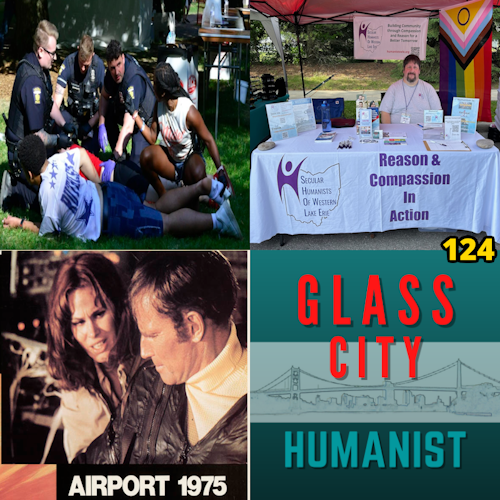
Episode 124: We Were There When the Shots Rang Out: More Guns, Same Excuses
We start off talking about an informational booth we staffed at the Old West End Festival in Toledo and how the event was affected by gun violence. The festival is an important outreach opportunity for our small humanist group. All our volunteers were safe, and we were glad with the festival’s decision to cancel the Sunday schedule. We discuss our concerns about desperation of young people in the city, the limits of police response, and the broader problem of easy access to guns.
Next we reflect on changing cultural norms by looking back at older films and music we enjoyed in our youth. We discuss how some works now feel dated or offensive, including films Airport 75, Valley Girl, Gone with the Wind, Birth of a Nation, and some early Eddie Murphy comedy material. Culture does change over time and people should be treated with basic worth and dignity.
01:00 Under the Gun at the Old West End Festival
21:01 Changing Morals in Pop Culture





Extras:
New details in Old West End Festival shooting: What we learned from Tuesday’s press conference
‘Bullets were flying everywhere’: Toledo nurse practitioner assists victims after shooting near Old West End Festival
The Birth of a Nation: The most racist movie ever made?
Some Hit Films that Haven’t Aged Well
Sixteen Candles (1984): Contains racist stereotypes and jokes about sexual consent that don’t hold up today.
Revenge of the Nerds (1984): Includes scenes that normalize sexual assault and misogyny, often played for laughs.
Ace Ventura: Pet Detective (1994): Features over-the-top transphobic humor that can be confusing or hurtful.
Indiana Jones and the Temple of Doom (1984): Relies heavily on racial stereotypes and caricatures of non-Western cultures.
Grease (1978): Romanticizes unhealthy relationship dynamics and problematic gender norms.
Breakfast at Tiffany’s (1961): Mickey Rooney’s portrayal of Mr. Yunioshi is a wildly offensive caricature.
Gone With the Wind (1939): A testament to its time, the film has been critiqued for glossing over the harsh realities of slavery and romanticizing the Confederacy.
Transcript:
Click Here to Read Full Transcript
[0:05] This is Glass City Humanist, a show about humanism, humanist values, by a humanist. Here is your host, Douglas Berger. A community event we regularly attend was rocked by gun violence. Luckily, none of our group were victims, but we heard the same empty statements from local leaders when the real problem is too many guns. Then we discussed the evolution of culture when looking at film and music of our youth when times were definitely different. That’s why they call it evolution. Glass City Humanist is an outreach project of the secular humanists of Western Lake Erie, building community through compassion and reason for a better tomorrow.
[1:00] Our group, the Secular Humanists of Western Lake Erie, we are a small group. We don’t have a lot of money. We don’t have billionaires cutting us checks every day. But hey, if you’re a billionaire and you’re hearing us and you want to cut us a check, please do so. We greatly appreciate it. And so we can’t do like some of the churches do and advertise. You know, like the Catholic Church, they have TV commercials and radio commercials and other churches advertising newspapers and on billboards. We can’t do any of that. So, When we are able to be out in the community and attend like community events and we have a booth, that is our main way that we advertise. And one of the main activities that we’ve done in the past few years is the Old West End Festival. And that is in the Old West End neighborhood of Toledo, which is.
[2:00] I guess, northwest of the downtown core. It is where all of the who’s who of Toledo back in the day, that’s where they all had their mansions. And I know Collingwood Avenue is a main thoroughfare and they have dozens of churches along the street. There’s a lot of Victorian style houses. And back in the 60s and 70s, when the economic situation was really bad, the neighborhood was going down. A lot of the more wealthier people had moved to the suburbs. And there was people with less money. So houses weren’t being taken care of. And then you had a group of people that got together and they said, we’re going to save this neighborhood. And it was the old West End Association. And they’ve been restoring houses and.
[3:04] Promoting the neighborhood and making sure it keeps clean. And at one point, they even hired their own security force to patrol the neighborhood, so that they didn’t have to depend on the police. And so it’s a jewel It’s a jewel of the city, It’s a Tony section You know, if you have the money And you can afford the house, It’s where people want to live People, the cool people, the arts people Has a very artsy arts.
[3:38] History to it, And so one of the reasons why our group wanted to have a booth at the Old West End Festival is because that is essentially the kind of people we want to market to. The people that are art, creative, they tend to be less conservative, very liberal. They support separation of church and state. They support social justice issues that we support. And those are the potential new members. And then, of course, the festival then brings in all kinds of people from around the city. So it’s like a one-point area. And so I think our booth this year was probably the fifth, the fifth year that we’ve had a booth, at least the fourth year. I can’t remember too much. I don’t remember the details.
[4:36] It’s kind of pricey. It was for the booth that we had, which was a standard 10 by 10 space, it was $200. And that was an increase from the previous year. A lot of things have gone up.
[4:54] But we were surrounded. We had a jewelry person on one side and another jewelry person on the other side. We had the Phoenix co-op store. They had a booth across from us. Had a cat related or dog related. I think it was a pet related booth. They had treats and a water bowl on one, on one part there. And then we had, um, uh, a vendor who was selling roofing, roofing things at the, uh, trying to get people to replace the roof on their house. So, you know, it always has a good mix. And, and of course we weren’t lumped together with anybody and, and we were kind of towards the middle of the merchant’s area. So we had a lot of good foot traffic. I think this time we got about four signups for our mailing list, which was decent. I wasn’t about that. I wasn’t put off by that. But it is a lot of work to do. We have the booth is supposed to be open from 10 in the morning to 5 p.m. So we have to find volunteers in our group to staff the booth and basically sit there and greet people and hand out flyers and talk about humanism.
[6:19] And it’s always, it’s always a crapshoot to make sure that we have enough people. I know I worked Saturday. I was probably there for four hours before I got to go home, but I was able to go home. And then I was due to come back the next day, which was Sunday. It’s a two day event. Come back Sunday in the afternoon to help close it out. Cause I, you know, set it up cause I had all the equipment help set up with one of our members. And then I’d come back Sunday afternoon and work till the end. It would close at five o’clock on Sunday and then tear everything down, take it home and get some help on that as well.
[7:04] And so I’d go home. I went home probably about three o’clock Saturday and probably around six o’clock, quarter to six, started getting, alerts that there was an incident at the old West End Festival and that it was possibly a shooting nearby. The initial points, reports were there was possibly a shooting nearby. And so, and they said it happened approximately 5.30, 7 p.m. Well, I still had two members that were working our booth till five o’clock. And so I texted them to see if they were okay, if they had gotten home. I didn’t hear from them for a while. Got a little bit worried. Then as the details on the shooting incident came out, it was two people shooting at each other and that they shot and wounded 12 people in total. It was a mass shooting, and it happened on the segment. It’s called the Agnes Jackson Memorial Arboretum. It has a gazebo, and they had bands. There was a beer tent, food trucks, and it was about a mile from where our booth was.
[8:24] Because, again, this is the old West End neighborhood, so it’s a large area. It goes all the way from Detroit and Glenwood, all the way down to the art museum. And, but, but where this shooting innocent took place was at least a mile away, but I couldn’t get ahold of my people and I was getting worried. So finally, after about 15 minutes, I get a text back that the people that were working happened to be a husband and wife, uh, that they were on their way home. And when I told them what was going on, they didn’t even know something had happened. So they were all right. All our Sholi people were OK. I felt better about it. And so, you know, keeping my board informed about the news and and things, because, I suspected that either they were going to do some really heavy duty security on Sunday or they might just cancel it, especially after the number of people went up. It was originally thought to be eight, and then there was 12, and a couple people were seriously injured. So I was thinking that it was probably they weren’t going to continue the festival out of respect for the victims, which is a smart thing to do.
[9:45] And so probably about 10 o’clock that night, after they had an initial official press conference, the city had a press conference about it. Then about 10 o’clock, the officials with the festival sent an email out that they were canceling Sunday. So the Sunday edition of the festival was canceled. and they said that we could come and pick up our belongings from our booth after 8 a.m. Sunday and that they would have police available to make sure we could do it safely and efficiently. So I contacted my members that were helping with set up and tear down and they agreed to go get the stuff and we had our booth back in my garage about 9 30 a.m. on Sunday.
[10:36] But yeah, it’s a pretty scary thing. Pretty scary thing that happened. It’s common. It’s a common thing. And the thing is, I’ve been doing this event for several years, and that was the least of my worries. I just didn’t worry about that part. What concerned me was a car driving through the booths, you know, down the street because we’re on a street. It’s blocked off that maybe somebody has a medical emergency and crashes through the barriers because there’s only wooden barriers put up. Contrast that with someplace like New York City where they’ve had terrorists try to run people over and they’ll put dump trucks to block the street. Thank you.
[11:24] I’m thinking they probably should have had dump trucks blocking the street because that was my biggest fear before this past weekend. And so it was pretty scary. I don’t know of anybody in our group or anybody associated with any groups that I am associated with that that they got hurt. I do know that one of the food truck vendors reported that there was roving bands of teenagers causing trouble that day as well. That seems to be a thing that’s happening lately around here. They call it a teen takeover. They arrange it online and they all show up like dozens and dozens of teenagers and then they just cause problems. They start fights, they get loud, they cause chaos, especially people trying to enjoy, let’s say, a music program. And this food vendor was talking about that there was a couple people that were fighting in front of his food truck at one point before the shooting.
[12:30] Came out today, this is recording this on a Tuesday, that the police had an update today. And they think that it was a rival, two rival groups that were involved in the shootout. And they also think that several of the victims were also part of that, what the kids call a beef. The way I look at it is teenagers have had, not teenagers themselves, but younger people have had beefs with other younger people for a millennia. You know, there’s whole movies from Hollywood that have been written about that, you know, like Rebel Without a Cause and West Side Story and things like that. So that’s nothing new. What’s different is that when people fall back on using guns to solve problems, that’s never a good thing because you can’t, if you make a mistake with that, you can’t take it back. You know, if you punch somebody out and it was a mistake, more than likely they’re going to be okay, they’re going to probably have a black eye or a bruise, but it’s going to go away. If you shoot somebody that you didn’t mean to shoot and they die, they’re dead. You can’t take that back.
[13:58] And I think it’s just too easy to get a gun these days. It’s just way too easy. And it’s also way too easy to fall back on it to solve problems. And so I was just, that was the sad part about it was, you know, the people having beefs with each other. I get that. You’re going to have that. That could be, you know, you can manage that. Now, the other thing about some of the official remarks that I disagree with is that they had some people about, well, we got to have more police. We got to have more security. Police are reactionary. They are never going to stop something from happening before it happens unless somebody calls them up. Like if they see, you know, John getting guns and he’s like, I’m going to go take care of business. And then they call the cops. Possibly they can stop John before he shoots the place up. But if they don’t know about it, if nobody knows about it, they’re not going to stop them before something happens. Somebody is going to get hurt. You’re just hoping that it’s going to be few and far between. Now, they had 17, I believe they said 17 officers in that area, and they had at least 30 police officers in the district at the time of the shooting. And so they were actually happy that only 12 people got injured and nobody was killed.
[15:25] And if their officers were able to stop it or intervene quickly within a minute or two so that it didn’t get out of hand. And it sounds like the shooters dropped their guns or one took a gun and one dropped a gun and then they ran off. They weren’t even injured. According to the police. But having more cops is not going to do it. And then, of course, then today would be in Toledo. And this is not the first time that there’s been a shooting. They trot out this guy, his name’s Earl Mack, and he’s a leader of the Buffalo Soldiers Group here in Toledo. And any time that there’s violence involving kids and teenagers, they always trot him out. And he talks about how parents need to do better and keep on their kids and that there needs to be more things for kids to do. Because if you keep them busy, they’re not going to be violent, which they’ve been saying this for years. ever since I moved to Toledo six or seven years ago, they’ve been talking about it. They’ve been talking about it before that. They always talk about it. Every time one of these events happens, that’s the first thing they start talking about. And my idea is, well, if you’re going to talk that way and you’re going to do that, why isn’t it working?
[16:42] You know, there’s been plenty of, the city government was talking about how they were spending, I don’t know, I think it was, It might have been a million dollars or seven million dollars on youth programs, summer youth programs. But yet we still had a violent shooting. There was several shootings that weekend, that were unrelated to the festival.
[17:08] And that’s the thing. When people talk about these shootings and these violent tendencies for young people, they don’t address the core reasons why there’s this violence. One being that there’s a prevalence of easy to obtain guns. And the other one is you’re not dealing with the actual core issues about why kids act the way that they do. It’s not so much that they’re bored and that they need something to do. It’s just that their world, their environment, they don’t have any hope. There’s no hope. They don’t, they’re not looking forward to, oh, I’m going to grow up. I’m going to get a house. I’m going to have kids and I’m going to contribute to the, to, uh, to the community. They don’t see that. They don’t see anything positive past their young period, after they’re out of school because they don’t see it. They don’t see it in reality. You know, a lot of these kids, they see crime. They see poor poverty. They experience poverty.
[18:24] And a lack of food, food deserts, lack of opportunities. They can’t get jobs, like real jobs that pay real money. You know, a lot of times they do these youth things to give them busy work, and they’re out picking up trash for minimum wage. And most people are like, well, that’s a good job. Well, yeah, it’s a good job, but they’re not doing anything to then better them into something else. Better. And it’s just a shame. It’s a shame that all the adults, they know what the issues are. They know what the core issues are. The government knows what the core issues are. And they just give it lip service every single time. And it’s like, how many people need to die before we’ll address the core issues why this happens? The lack of hope, the lack of opportunities, and the wealth inequality, the severe wealth inequality.
[19:33] And the fact that guns are so easy to obtain. You know, you want to reduce violence in the youth, in the young people. That’s what you need to address. And you can have all these press conferences you want and say we got to do better we got to give kids something to do but unless you start doing something effective, and actually addressing the core issues and there’s, and there’s ways of doing it there’s there’s i’m sure that there’s other people, around the country that have addressed this and it’s worked and we need to find that and it needs to work and we need to not stop, trotting out Earl Mack talking about how parents need to do a better job. We can’t just always blame the parents. It’s not always their fault. Sometimes it’s the system. Sometimes it’s the government. And it’s definitely because there are just way too many guns available. For more information about the topics in this episode, including links used, please visit the episode page at glasscityhumanist.show.
[21:01] What I wanted to talk to you today about in this segment is about changing or evolving morals, as it were, or evolving cultural preferences or norms, or whatever you want to call it. I’m not sure what the word is. I didn’t look it up ahead of time. But I got to thinking about this the other day. I was looking for something to watch on TV. I’m flipping through the channels. And I have one of those streaming services. I think it’s Prime or something like that. And they were showing one of my favorite movies from when I was a kid, Airport 75. And if you’re not familiar with it, it stars Charlton Heston and I think Karen Black.
[21:47] It’s an all-star cast. Gloria Swanson is in it, playing herself as a baiting silent movie star working on her memoirs. Linda Blair plays a girl that needs a kidney transplant. There’s just all kinds of people. And this is before the airplane movie in the 80s. Basically, to give you the premise, there’s this 747 that flies from Dulles, International in Washington, D.C., and it’s flying to Los Angeles. When they get most of the way across the country, they find out that the Los Angeles airport is socked in with fog. And so they have to divert to Salt Lake City and land. It’s a red eye, what they call in the business a red eye. So you fly all at once overnight. This is an overnight flight. And as they’re making their way to Salt Lake City, this other gentleman played by Dana Andrews is flying in a little Beechcroft or Cessna type plane, small plane, also to Salt Lake City for a meeting. And he ends up having a heart attack, a massive heart attack while he’s flying. He hits the 747 in the cockpit area. It sucks out the first officer and also kills the engineer who’s played by Eric Estrada.
[23:17] And they have Ephraim Zimbalas Jr., who’s the pilot, and he’s knocked out of action. So Karen Black, who’s the head stewardess, or I’m sorry, head flight attendant. See, we’re getting into what I’m going to talk about is flying, has to fly the plane or at least try to fly the plane. It’s still on autopilot, but she’s monitoring and trying to contact the tower, all that stuff. And Charlton Heston is an executive. He’s her boyfriend. And George Kennedy is in it. And his family’s on this plane. And if you get a chance to watch, it’s one of those good disaster flicks. But the reason why I’m talking about it today in this particular segment is some of the way that people are treated.
[24:07] Particularly the women in this movie, is just not something we do today. Okay. So this, and most people, when you talk about stuff like this, you say, well, it was a product of their time. Right. But what I like to do is, even though it is what they call an acronymistic, I’m not sure what the word is. I’m terrible with words today for some reason. But it’s something we just don’t do today. I like calling them a stewardess. Throughout the whole movie, they’re called stewardess. It’s all women. Today, we have flight attendants. And the reason why we call them flight attendants is because there’s also male flight attendants these days.
[24:53] But anyway, so Karen Black, she’s doing a yeoman’s work, trying to figure out how to fly this plane and talking to the controllers in Salt Lake City. And, and so they get this weird plan to zip line a pilot into the hole in the cockpit. Cause again, this plane is flying level at like 10,000, 10,000 feet. Yeah. It’s 10,000 feet. Cause it’s below the level where you need oxygen mask. You don’t need oxygen mask through most of this movie. And they try an Air Force guy, and he doesn’t make it. So Charlton Heston, he decides to do it. So he ziplines in. He gets in the cockpit. He’s all goobered up. He hurt his hand. And she goes and gets a bandage and bandages his hand. And he’s looking at the controls and all that stuff. And she’s like, what do I do? How can I help you? He goes, go do what you do, baby.
[25:57] Go to the passengers and do what you do baby which means you be a flight stewardess again i’m the pilot and it was just crack it just cracked me up because it’s just so not of today if that movie was today uh.
[26:14] She would probably try to fly try to land the plane herself they wouldn’t have to zipline a pilot in you know especially modern planes today how the autopilot can actually land the plane, as long as it’s not damaged in any way where it might not land. So that got me thinking about other stuff, other movies, even music that I liked back when I was a kid. That I, it kind of cringy now. And, and one of, one of my favorite, uh, favorite albums is the soundtrack to the movie Valley Girl. And, and that was a movie with Nicolas Cage and Deborah Foreman. And it had a, it had a kick, a kicking soundtrack, new wave. I love new wave music. It had a great soundtrack. Well, one of the songs and they, and they used this in the movie was by an artist named Josie Cotton. It was Johnny, Are You Queer? It wasn’t a homophobic per se song, but it was kind of like, why aren’t you paying attention to me, Johnny? Are you queer? That sort of tone. And.
[27:33] I still like to listen to it occasionally, but.
[27:39] I wouldn’t put it this way. I wouldn’t play it publicly these days. I just wouldn’t because it’s kind of a homophobic… And that’s not what it was meant to be at the time that it was written. Okay. Um, another musician that I like that I’ve had to distance myself from is Morrissey. He was the lead singer for the band, the Smiths back in the eighties. Um, and they were really a progressive band. I mean, they did a, they did a song called meet his album called meet his murder, that sort of thing. So, I mean, they were all about animal rights and, and all that stuff. Well, now that Morrissey is much older, he’s kind of become a bitter old man, as many people, including friends of mine, who have become bitter old men. And he’s really come out staunchly anti-immigrant.
[28:37] England, the UK in general, has had quite a bit of backlash towards immigration and immigrants, even before the MAGA people showed up in the United States. You know, that had been going on in the UK, and Morrissey is a very anti-immigrant. And so, and he has a reliability problem. He’ll schedule concerts and then cancel. He’s pretty well known for that, too. I still like his earlier music before he turned into a bitter old man. And so it’s not like I threw him out.
[29:15] Another movie that I liked that kind of is problematic today, Gone with the Wind. Basically, the reason being is because it whitewashes Civil War history and it kind of plays up the lost cause, the Confederacy lost cause. It came out in 1939, during the height of the Lost Cause era, when you had Jim Crow laws and all that stuff. In fact, the woman that played the maid wasn’t allowed to attend the premiere in Atlanta because it was in a whites-only theater. And and the story goes that clark gable who stars in the movie put his foot down and said if she can’t attend i won’t attend, and so they made an exception for her at that particular time i recently saw well some years ago probably three or four years ago saw it again in a theater here in toledo and.
[30:20] Uh you know and there was a lot of people that love that movie it’s a good romance movie. It is. The romance part of it between Scarlet and Rhett is excellent. The movie is excellently made, but the subject matter besides the romance is problematic. Like I said, it really leans into that lost cause part, you know, where you have sympathy for Scarlet and her family and, and getting, uh, their property devastated by the war. And it’s just, it’s just something that, that, um, you have to deal with another one that I don’t. When I saw it, I didn’t particularly like it, but I’m a film buff, and I like silent movies. I’m a big silent movie fan. My favorite silent artist is Louise Brooks.
[31:17] Luckily, she didn’t do any problematic films, but one that did get made was Birth of a Nation, and that was directed by D.W. Griffith from a book from a raging racist. It was a racist book. I’m not even going to give you the title. It was a well-known, notorious racist book. He made a movie out of it. Top box office draw across the country.
[31:51] Woodrow Wilson, who was also known to be racist and segregated the federal government, showed it at the White House.
[32:01] And for those not familiar with it, basically, it is, uh.
[32:06] Uh, basically a, uh, lost cause confederacy, uh, propaganda film, pretty much, uh, all the black characters are villains. All the white characters are heroes. Um, I believe it was Lillian Gish is in it. And for years, she took a lot of heat for being in that movie that, uh, it comes up from time to time in, um, civil, uh, uh, silent movie, uh, news groups that I’m in on Facebook, it will, somebody will mention how great a movie it is. And then you get all this backlash on it and people get upset that they they’re getting backlash. It’s a good music. And so the reason why I’m mentioning all of this stuff is because we’ve had this throughout our history where, Oh, the minstrel shows. I forgot to mention the minstrel shows. They used to have some black artists. Sometimes they’d have white artists wearing blackface, doing those old timey song and dances for audiences. And they were very popular back in the day, back in the, um, Civil War times and shortly after the Civil War times. And you just wouldn’t see that today unless, unless you’re showing a, unless you’re producing a historical drama or something for that time period. Nobody does that for entertainment today.
[33:33] Yeah, the reason why I’m mentioning all that is because we’ve always had the changing culture, the changing mores of society as we’ve gone along in our history. And so what one day is entertainment and funny, the next time it’s not entertainment and it’s not funny for a large number of people. And you have to be able to identify that stuff. You know, a red flag for me is any time a comedian who is saying some stuff that really is hurtful when they say, hey, it’s just a joke. Or, you know, why are you why are you such a snowflake?
[34:15] You know, basically what you what you want to do when you’re talking about comedy or entertainment is you want to as what they call punching up. You want to punch up. So if you’re going to ridicule or satire a group of people, you want to do the people that are above everybody else, like the billionaires and the president and government officials. You don’t want to make fun of or ridicule the garbage man or or the school teacher or the mother who is just struggling trying to get by to get something on the table for their kid, for their family. Okay. You know, that’s, those are cheap laughs. That’s cheap entertainment. You don’t want to make fun of, uh, the LGBTQ community, you know, in a way to ridicule them is what I’m saying. You know, there’s plenty of people that make jokes about in the gay community. There’s a lot of people in the gay community that are comedians and they make fun of a lot of stuff. Uh, when you’re making fun of religion, again, go for the theology, not the people that practice that religion. You don’t, You want to make fun of the priest. You want to make fun of their propensity to cover up child abuse. I mean, child abuse is not funny, but the steps that they go through to do that stuff. But you don’t want to ridicule and make fun of the parishioner.
[35:41] The people that are just coming to mass or tithing their money or whatever. You don’t want to make fun of them or ridicule them. You want to do the structures, the infrastructure, the power structure, make fun of that. That’s always good. And we talked about some of that in a previous episode when we talked to Jerry.
[36:03] Jaffe about comedy after 9-11 and things like that. So check out that episode. But just be aware that, you know, stuff that you grew up, stuff that you saw when you grew up as a kid that seemed funny and entertaining might not be funny and entertaining today. You just have to realize that. And when you get cringy, if you’re watching something, you feel cringy and you’re like, you know, I used to like this as a kid. Um, another one I just thought of that comes to mind is they had Eddie Murphy’s, uh, raw, uh, comedy special. Oh, this thing was huge. It was on HBO. If you had HBO, you got to watch it came out. I believe it was an, as an album. I think I had the album on cassette. It blew up. It was huge. It was hilarious. Very problematic today. I was watching some of it and some of the homophobic jokes are just awful. I had to stop. I had to fast forward through and pick and choose what stuff I wanted to watch because, yeah, it was not good. And that’s how he performed back in the 80s when he first started out. He did homophobic jokes and made fun of Michael Jackson and Stevie Wonder and, you know, things like that.
[37:29] And he’s come out recently in the last few years and explained that if he was coming out up today in the comedy ranks, he wouldn’t do that stuff. You know, and he had a, he had a bit about Bill Cosby complaining about his filthy mouth. And that was kind of ironic watching that from the eighties and seeing how Bill Cosby turned out.
[37:53] So basically that’s what I wanted to talk about today in this segment was, you know, that we’re not in a static place in this country, in this world, in this society. It’s not static. It’s not, we shouldn’t support the status quo. We should support everybody. Everybody has, everybody is human. Everybody deserves basic worth and dignity. And so if you’re going to do comedy or, or satire or, or make fun of something, you know, be sure to punch up and not punch down. Um, and I’ll leave you with this. We had, uh, um, an incident that happened in, in Toledo. Um, a fight broke out at a kindergartner, a kindergarten, um, graduation ceremony. Some parents got into an argument and started fighting. They had to call the cops. It was on video. It went viral and people were making fun of fun of it. And yeah, it’s kind of wild to see it, but it’s not something that you should just go around and share to everybody and talk about, you know, because that’s a private thing between people, between adults, or should be. Just because it was on social media doesn’t make it public.
[39:17] Or shouldn’t make it public. And, and I’m sure that there’s a lot of those adults in that situation that had that when it happened, that feel bad that it happened, and just want to move on and forget it. And now they’re going to have to live with this video probably for the rest of their lives. And that’s really sad. So just kind of think about that the next time you watch an old movie or, uh, see something on, on, uh, in social media that outrages you or makes you laugh and, and just know that, it’s not always going to be that way forever, that we are, we do evolve. You know what I mean? That’s all part of being human is evolution.
[40:06] For more information about the topics in this episode, including links used, please visit the episode page at glasscityhumanist.show. Glass City Humanist is hosted, written, and produced by Douglas Berger. And he’s solely responsible for the content.
Transcript is machine generated, lightly edited, and approximate to what was recorded. If you would like perfect transcripts, please donate to the show.
Credits
Written, produced, and edited by Douglas Berger and he is entirely responsible for the content. Incidental voice overs by Sasha C.
The GCH theme is “Glass City Jam” composed using Ampify Studio
This episode by Glass City Humanist is licensed under CC BY-NC-ND 4.0.

