
Episode 129: Honoring Three Women Devoted to Justice and Equality
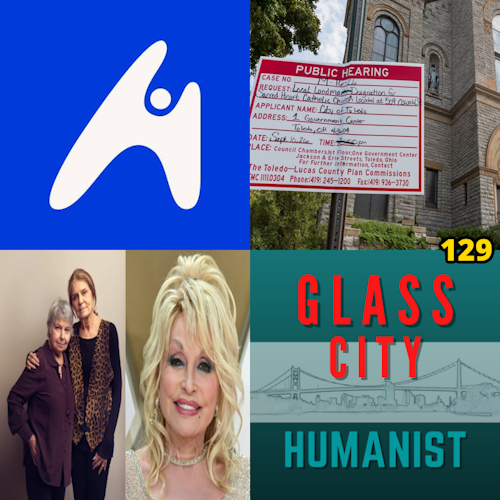
Three women whose lives were tied to humanist and feminist values: Dolly Parton, Robin Morgan, and Gloria Steinem died recently. We talk about their work, the ways they supported other people, and the public roles they played.
We talk about a Zoom conversation Gloria Steinem held with our local group, which was a highlight for our host. She encouraged people to identify potential activists and get them involved in public life and we mention her later repudiation of earlier anti-trans views and her efforts to make the feminist movement be more inclusive.
The American Humanist Association has gone through a rebrand, including an updated logo, website, and tagline. We explain the reasons for the changes, the response from members, and the effort to reach younger people through social media and creators.
Finally, we talk about the city of Toledo’s effort to landmark two closed Catholic church buildings before a demolition moratorium expires. We explain the legal and practical issues around preserving old church buildings, and we compare that situation to other reused buildings and local preservation debates.





Extras:
A ‘Magical Night’ with Gloria Steinem (12-22-2024)
Toledo Humanists You Should Know: Gloria Steinem
The Humanist Interview with Gloria Steinem
Gloria Steinem, 1934-2026: Toledo native was a potent voice of U.S. feminism
Gloria Steinem, defining symbol of women’s movement and eloquent advocate for equality, dies at 92
HUMANIST INTERVIEW: Robin Morgan, 2007 Humanist Heroine
Robin Morgan, Voice of Radical Feminism, Dies at 85
A Timeline of Dolly Parton’s Good Deeds
10 times Dolly Parton cemented her status as an LGBTQ+ icon
Toledo eyes landmark designations for more than 100 buildings
Transcript:
Click Here to Read Full Transcript
[0:01] This is Glass City Humanist, a show about humanism, humanist values, by a humanist. Here is your host, Douglas Berger. We recently lost three great women who fought against injustice and tried to build a community where everyone was equal. Two of the women were humanists, and the third was a good Christian in our book. All three lived humanist values, and they will be missed. We also take a look at the rebranding by the American Humanist Association and an attempt by the city of Toledo to landmark two closed Catholic church buildings in a fit of nostalgia. Glass City Humanist is an outreach project of the Secular Humanists of Western Lake Erie, building community through compassion and reason for a better tomorrow.
[1:00] We all know the life cycle, the biological life cycle of humans. We’re born, we live, and then we die. And our bodies are, for people that follow that particular prescription, our bodies return to the earth. Some people are cremated, et cetera, et cetera. But there’s a definite life cycle. Science has not found a way for us to live forever yet. that. I mean, it’s a lot better than it used to be, but we know once we’re born and we live, we know that we’re going to pass away eventually. And earlier this week, as I’m recording this, we, well, within the last two weeks, we’ve lost three great women, very influential women. You could call them heroes or heroines. Well, that doesn’t sound right. But they were people that were influencers, that people admired, that helped them in their lives in all sorts of ways, in all different ways. And they were greatly admired around the world, as a matter of fact.
[2:14] The first person that we lost was Dolly Parton, the country singer Dolly Parton. And she had an interesting life. You know, she grew up in the hardscrabble mountains of Appalachia, and she liked to sing. And at a young age, she started singing in public. And eventually, when she was a teenager, she performed on the Grand Ole Opry. And after that, she became world famous as a country Western star. I remember when I was a kid, I used to watch the Porter Wagner show. I think it was either on before or after Hee Haw. And she was always on because she was like his sidekick. And then eventually her fame got so much that she outgrew him and didn’t need him anymore. And she went out on her own. But Dolly did a lot of things that, you know, people, she claimed that she was.
[3:11] A Christian, but she was kind of the, like Mr. Rogers Christian type of Christian. Somebody who didn’t try to lord it over people or force you to agree with her beliefs, but that she took the teachings of Jesus and the Bible, took them literally to help other people, Which, as an atheist, I would hope that most Christians would do that. If most Christians would do that, there’d be a lot less polarization. There’d be a lot less these stupid culture war things that come up. And so she was a good Christian. She really was. And, for example, the program that she started, the Imagination Library, where she sent free books to kids and set up libraries with free books. And it was something that her father was inspired by her father. Her father was illiterate, and he thought that it would be a good thing if she would do that. And so she kind of got inspired by him and did that. The other thing that she did was when there were wildfires.
[4:29] In her home area of Tennessee, she paid money, set up a foundation to support people in that area to help them rebuild. And then the other thing that she did was during the pandemic, she donated a million dollars to research on the RNA, our DNA, vaccine that was eventually discovered for the COVID-19 virus. And she was filmed or videotaped getting one of the first injections, back then so that she could show people that it was OK to take because, you know, we had a lot of people that were vaccine avoidance people for no apparent reason. And the other thing, too, that that was OK with with me anyway, was she wasn’t overly political. She wasn’t like on the front line. She wasn’t getting arrested, things like that. But she did political stuff.
[5:35] The movie that most people remember her from that she was in was Nine to Five. And that came out in 1980 and it co-starred Lily Tomlin and Jane Fonda. And basically it was talking about how women were not equal in the workplace and what if the women were in charge and what would happen. And we saw that productivity went up. And unfortunately, the twist in the movie was that the man that they took over from ended up getting the credit for it. But that was okay because then he got a promotion where he had to leave so they could stay pretty much in charge. And I do remember the one scene, because I just watched it recently, where the president of the company tells the vice president who’s in charge of that building, he says, I love it all except that equal pay stuff. You got to get rid of that. We can’t have that. Can’t have equal pay. So that was kind of like a nod to the current times in 1980s.
[6:42] And so, you know, I, I’m not a big country Western fan. I liked some Dolly Parton music, uh, Jolene. Um, I thought, uh, I will always love you was a little bit overplayed, especially when Whitney Houston won. Uh, the other interesting thing about that was that all the money, all the royalties that Dolly got from that song after Whitney Houston covered it and it became a massive hit. She put it into, uh, helping, um, disadvantaged communities in Tennessee that needed help. And they would like set up a, an office or a foundation or something and pour some of that money in. And then they would grant it to like start businesses or pay for childcare or things like that, you know, but it wasn’t something that she like stood at a podium with, uh, doing press releases and, you know, there wasn’t photo ops or anything like that. And the other thing that a lot of people liked about Dolly was, uh, she didn’t put up with anything. You know, she, she was a very powerful woman. She owned her music, and she did things her way, the way she wanted to do it.
[8:06] The other woman that passed away in the last couple of weeks is Robin Morgan. Now, I wasn’t, I was familiar with her, but I wasn’t too familiar with her. But when I was doing some research on Humanists of the Year from the American Humanist Association, during the time that Richard Dawkins, when Richard Dawkins was stripped of his Humanists of the Year award because of his transphobic comments, I went through the list of past Humanists of the Years to check their biographies to see if there was any other people that were a problem, could be a problem. And unfortunately, Robin Morgan was one of them, sort of. She was awarded the Humanist Heroin Award in 2006 at the AHA Conference in Portland, Oregon. She was a child star in the 40s and 50s and then became a poet and a writer and an activist. She became a feminist and she worked with people like Gloria Steinem and Jane Fonda to found this women’s media group in the early aughts, the early 2000s.
[9:27] And she was anti-war, so she was against the Vietnam War. She famously protested the Miss America pageant, even came up with an icon for it for people to use. And what it was, was it was a pink symbol of female with the circle and the cross part with, a fist in the middle of it, like a raised fist, like a black power symbol. But that was supposed to be to protest the Miss America. So she did all that. But what the problem was, you know, and her bona fides with feminism and activism for women, was top-notch. I mean, she did a lot.
[10:15] She wrote a lot when she would get these books. She was a published author. Some of these books that she would write for the feminist movement, the royalties that she would receive would go, she would put back into the movement and do grants and funding for other activities and things like that. So she did that. And this was something I found when I was doing research on her. In 1973, Robin Morgan gave the keynote speech of the West Coast Lesbian Conference, in which she criticized Beth Elliott, a performer and organizer of the conference, for being a transgender woman. In this speech, she referred to Elliott as a transsexual male and used male pronouns throughout, charging her with being an opportunist, an infiltrator and a destroyer with the mentality of a rapist. Sound familiar? At the end of her speech, she called for a vote on ejecting Elliott and over two-thirds voting to allow her to remain. However, the minority threatened to disrupt the conference, and Elliott chose to leave after her performance to avoid this. The event demonstrated the high tension surrounding transgender women’s involvement in the women’s movement in the 1970s, and it still kind of exists today. You still have some, I think the term for.
[11:43] If her thoughts on this were current.
[11:48] She’d be probably called a TERF, a trans-exclusionary radical feminist. And so that troubled me. That troubled me. But although she never recanted or apologized for her remarks, she did tend to moderate her thinking by the time that she had passed away. According to her obituary in The New York Times, it has a quote here. It says, decades later, this speech earned her the label trans-exclusionary radical feminist as a 21st century gender politics brought about a rethinking of sex, gender, transgender rights. When asked about that speech in a 2024 interview for this obituary, she said, I believe that trans rights are human rights. Then she paused and sighed before adding, it’s complicated. And unfortunately, she’s right. it is, it can be complicated. But she did moderate her views by the time that she did pass away. I think it’s a serious loss for the women’s movement for her when she died. I guess she also had been diagnosed with Parkinson’s disease.
[13:08] And to get back to my point of giving the award, the Humanist Heroin Award for her lifelong contributions to secularism, rational thought, and the international feminist movement. She was an outspoken atheist and freethinker. She co-founded the Freedom from Religion Foundation with Ann Gaylor and her mother, and authored Fighting Words, a book celebrating secularism and separation of church and state. She was a feminist pioneer. She was a leader of second-wave feminism.
[13:42] And compiled the 1970 anthology Sisterhood is Powerful. She served as an editor-in-chief of Ms. Magazine and also co-founded the Women’s Media Center. She was a prolific poet and author of over 20 books. She spent decades utilizing literature to challenge religious dogma and advance global human rights. And the other thing that she challenged was having any, she was very active on the left. You know, she was an anti-war leftist and firebrand. And she had a thing about working with men on that side because there was a lot of leftist men who were sexist and she didn’t want to have anything to do with that. Like I said, she was awarded the Humanist Heroin Award in 2007. And that was about the time that they did the Women’s Media Center. They formed the Media Center.
[14:45] And then finally, the other great woman who passed away this last couple of weeks.
[14:53] Really bummed me out. It was, I didn’t realize how emotional I was going to be about it for somebody that was not a family member. But the great Gloria Steinem passed away at the age of 92. She was born in Toledo, lived on the east side of Toledo with her mother before, and she She went to Waite High School for three years before moving in with her older sister in Washington, D.C., where she finished high school. And then she attended, she graduated from Smith College and became a writer, became a journalist. And some of the things that I found out that I didn’t know before, well, there were some things I knew before.
[15:43] She was awarded the Humanist of the Year Award in 2012 for her history in the women’s movement. Her grandmother was Pauline Perlmutter Steinem, who was the chairwoman of the Educational Committee of the National Women’s Suffrage Association. She was a delegate to the 1908 International Council of Women, and she was the first woman to be elected to Toledo Board of Education. And so that was great. I also found out some things new was that during when I was reading obituaries for Ms. Steinem was that her parents met at the University of Toledo. They were students there and they both worked on the school newspaper. Her father was an editor in 1919, and her mother was the editor in 1920. And her mother then worked for the Toledo Blade as a reporter and editor before she had children, and then she retired to be a mother.
[16:45] But Gloria Steinem was a journalist, an author, feminist leader, whose books included A Thousand Indias, a guidebook for the Indian government published in 1957. Outrageous Acts and Everyday Rebellions, 1983. A book about Marilyn Monroe called Marilyn Norma Jean, 1988, Revolution from Within, 1992. She was one of the founding editors of Ms. Magazine in 1972. And again, as I mentioned, she co-founded the Women’s Media Center.
[17:18] She was born in Toledo in 1934, And, and so when we, my group, the Secular Humanists of Western Lake Erie, were having our.
[17:32] Winter banquet, I wanted to do a winter solstice banquet. I tried to do it earlier, but then we had the pandemic hit. And before that, we were, we were just getting started. So, you know, it takes a lot. When I was in my Columbus group years ago, we used to have winter solstice banquets every year, and I wanted to have one. And so when we were planning it, I was thinking, you know, we need to get a keynote speaker, somebody to come in and talk to us. Somebody important, somebody maybe not famous, but, you know, I don’t know, like the head of the Toledo Public Library System or somebody from UT, something like that. And our co-founder, Sean, suggested that I invite Gloria Steinem. And of course, I’m like, yeah, right. And they’re like, well, you know, what can you lose? All they could do is say no. So I went and looked up and she was part of, Gloria was part of a speakers bureau type deal. So you dealt with them. Sent an email saying we’d like to have Ms. Steinem speak at our banquet in Toledo for the winter solstice. And uh i said you know we can’t afford to fly her out and pay for her hotel or anything like that but we would love to do it by zoom do a video chat.
[19:01] So i’m like thinking or it’s not going to happen this is not going to happen, and, I’m getting emotional about it, sorry. Even thinking about it. I got the email back saying that she would love to chat with us at our banquet. You know, I don’t get emotional. I don’t cry very often. Usually it’s for sports stuff. Like when the U.S. Hockey team won the gold medal at the Olympics in 1980, or when the Ohio State Buckeyes wins the national championship, or when the Cleveland Browns actually pull out a win in some game, random game.
[19:53] But seeing that Gloria Steinem was going to talk to us really made me, and I’m still getting emotional about it. I don’t know why.
[20:05] So, you know, this was a speaker thing. So we had a contract. We contracted with her for the fee. The fee was reasonable because, you know, speakers require fees. We didn’t expect her to do it for free. And, you know, she’s 92 years old. She lives in New York City. She probably needs all the money she can get to afford to live there. And so we set it up, contracted for, they promised us 20 minutes of her time, which is great.
[20:40] And I won’t go into all the details about the technical problems we had trying to get that working on the day of the event. But it was just great. She talked to us. She didn’t like speak. It was more like a conversation. They had suggested, her people had suggested we come up with some questions. So we came up with some questions to ask. And one of the ones that I really remember, one of the questions I really remember, is someone asked her what we could do locally to help things, help change the world. And she said, identify people who could be activists, you know, women, men, whatever. Anybody who’s not doing anything now, identify them and get them to run for public office or run for some advocacy or do that. And she said, that’s the best way to do it is get people to participate. And I could still hear her say that in my head.
[21:46] But, uh, yeah, so it was really great that, you know, she spoke to us for more than 30 minutes, which we were surprised and, and she was, didn’t seem like she was in her nineties and her house looked really nice on the video and she had her assistant there to help out, uh, if she needed help. And, it was a great time, and we enjoyed it. And that’s why I admire her so much, is that she would help a group like mine. But she was known for that. She did that on a regular basis. She came back to Toledo many times. She talked about it. Talked about being a Toledoan and how it influenced how he, she grew up and, and treated people. And, you know, and so she, she had the, the values, the humanist values that we hold dear to our heart.
[22:59] And she was, you know, and she fought for civil rights. There’s a famous photo of her. There’s a famous picture from the late 60s, early 70s of her standing next to Dorothy Pittman Hughes and raising their fist. You know, and she was like that. She tried to include people of color in the women’s movement, even when that seemed to be a problem.
[23:31] We were talking about, I was talking about earlier about that, Robin Morgan with the transphobic stuff in 1973. Gloria Steinem wrote an essay in 1973 about the same thing, taking transgender people to task and being very hateful towards them. And their connection to the women’s movement. But the thing about Gloria is, in 2013, she repudiated that essay. It said that she had changed her views. And she tried to be as supportive as possible and be inclusive as possible, even for transgendered women. And she believed that they deserved equal rights just like all women. And that is cool in my book. So, like I said, it’s been a very kind of dark with the storm. We’ve had a lot of storms lately, kind of a dark, heavy time period where we’ve lost three great women that I’m hoping they’re not once in a lifetime. Hopefully, there’ll be other women just as good in the future. And I know there are. But it’s been a very, very trying time for humanists.
[24:59] For more information about the topics in this episode, including links used, please visit the episode page at glasscityhumanist.show.
[25:20] One of our humanist values that we believe is important is peace and social justice. And in our Ten Commandments documentation, it says, I will help people solve problems and handle disagreements in ways that are fair for everyone.
[25:39] True peace involves an intense commitment to social justice and affirms the human rights and personal autonomy of all people. Any level of injustice against groups or individuals signifies existing conflict, even if the conflict isn’t immediate or obvious. We attain peace only by consistently responding to injustice through thoughtful conflict resolution that aims to repair harms and ensure a fair and equitable society moving forward.
[26:10] This kind of conflict resolution is known as restorative justice. In order to achieve a just, peaceful society, we all must take claims of injustice seriously and ensure that those who are impacted most by rights violations determine the best course forward. And so if we remember anything about the great women who passed away recently, Dolly Parton, Robin Morgan, and Gloria Steinem, is they were at the forefront of peace and social justice. They attempted to solve problems and handle disagreements in ways that were fair for everyone.
[27:21] As you’re aware, the Secular Humanists of Western Lake Erie, we are a chapter of the American Humanists Association. And so I was privy, as a chapter leader, to partake in a webinar, as they described, were talking to us about the rebranding, the AHA rebranded. And typically what that means in a rebrand is when they decide, when a company or a group decide that they need to update their messaging, their, graphics, their colors, their messaging, some of their messaging, and update it for whatever reason. Either the previous messaging and colors and graphics aren’t working or they’ve, they’re dated, they’re tired and they needed something different. And so what they’ll do, a lot of these companies and groups will contract with a consultant and.
[28:24] Um, that will come up with some concepts and then they’ll do focus groups where they’ll bring in, uh, parts of a demographic you’re trying to reach and, Hey, what do you think about this? And what do you think about that? And, and then they’ll come together with the people that hired them and said, well, you know, this is what our focus group said, and this is what you should do. And then that company or group decides to, to make the changes. I do know that the AHA, AHA did this rebrand because one of the reasons that they got started to do it was they needed to update their website. But the AHA website hadn’t been changed or updated, not information wise, but structure wise, hadn’t been updated in like 10, 15 years, I think. I think is what they said. And so there was a lot of best practices that you should be using today for your websites that the AHA wasn’t using.
[29:24] Some of the structure to get to the information was convoluted, extra clicks, and they didn’t have any images, very many images. And what images they had were like stock images and things like that. And so they just wanted to go ahead and redo it. And so September the 1st is when they launched the rebrand officially.
[29:54] Like I said, I happened to participate in a webinar, a sneak preview, as it were. And I was impressed. I really was. I was actually a little bit nervous.
[30:08] When an organization you’ve been a part of for over 30 years decides that they need a new look, new messaging, you get a little bit nervous because you don’t know, are they pivoting to something else? Are they going somewhere in another direction that maybe now they’re not the group for me? And some of the big changes is they updated their icon, the Happy Humanist. And the Happy Humanist has been that way since they stole it from, well, they borrowed it from the British Humanist group. And that was when I got involved with humanism. So it’s probably 40, 45 years old. And they updated that. It, it’s different. It looks different. It’s got some, what they wanted to do was to show some motion, have it show some motion.
[31:10] And if you’re watching this podcast on video, I have an example of the new Happy Humanist on screen. You can check it out at the AHA website as well, AmericanHumanist.org. Um, the other thing that they did was, you know, they revamped the front page and made it easier to find some information and, and kind of updated their messaging. Um, one of the things that they did was they came up with some new taglines, and taglines are what are used for like advertising and things like that. Like the American humans association, dah, dah, dah, dah. It’s always that last part. For our group, the Secular Humanists of Western Lake Erie, our tagline is Building Community with Compassion and Reason for a Better Tomorrow. And that’s something that we came up with as our board came up with out of some examples. Actually, it was a combination of two examples we put together. And so it kind of gives what it does. Basically a tagline does is kind of gives you a summary, a quick blast of what your mission and vision are for your group.
[32:31] And so they had, they came up with some, um, different taglines and they, again, they used a focus group where they used like a subset of humanists. And I think I may have participated in one to vote on this. I don’t know. I don’t remember. But what they came up with, decided on, was the AHA is fighting for a more compassionate world and better future. And when I saw that in the webinar, I was like, hey, that’s just almost like ours. You know, great minds think alike. But I really like that. Fighting for a more compassionate world. I like that.
[33:14] Now, as you can imagine, when you ever have a stately organization that’s been around since the 1940s and you want to change anything, you’re going to have some pushback. And they’ve had some pushback. Some longtime members I think I saw one comment The guy didn’t like the new happy humanist So he’s going to use the old one And some other people Didn’t like the use of the word fighting In the tagline, And the thing about it, when we were talking to the consultant, when the consultant was doing their presentation, and the staff, the Fish Stark and.
[33:56] Jake Villa and all the other people on staff are pretty adamant that chapters, and humanists can do whatever they want. They can use the happy humanists, the old happy humanists. They can come up with their own taglines. They don’t have to use that. You know, this is just stuff that they’ve decided to use as a corporate entity. So when they’re doing their conferences or selling their books or their magazines, this messaging and new graphics and everything is going to be incorporated in that. But, you know, they were pretty, pretty adamant that if like if our group wanted to use the old American Humanist Association logo, we could do that. We weren’t going to get in trouble for that. And so, you know, and that’s how a democratically run organization should work.
[34:51] You know, they should have something that ties everything together, but, you know.
[34:56] And the other thing, the other thing that they’ve been doing along with the rebrand is they’ve really been pushing towards trying to reach younger people. And that has been a problem with my group and other groups.
[35:13] I’ve been on Zoom calls with other chapter leaders, and that’s always the main point that comes up. How do we attract younger members, younger people to participate in our meetings and as a group? And we know from the, from the studies and other things that have been done, is that younger people aren’t joiners anymore. They just, that’s not their thing. Um, they’ll do ad hoc stuff. Like, you know, if they’re trying to, I don’t know, uh, pick up litter on the highway, they’ll join a small group on social media and go and pick up the litter and that’ll be it. And then they go back out into the ether, as it were. And it’s been a struggle trying to appeal to younger people to let them know that being in a group is not that bad, especially a humanist group.
[36:12] I think that they get a little bit turned off by any dogma or hierarchy and bureaucracy. They just want to do their own thing and they have different ideas about things. And that’s great. And so one of the things that the AHA has been doing is been partnering with some content creators and influencers on the social media. I wish I was. You’re listening to this podcast. I thought I was an influencer. I’m kind of not. But these are like, you know, 20, 30-year-old people that are on TikTok and Instagram. And they’ve partnered with some of them to do some messaging and do some campaigns and things like that. And I think that that’s great. Uh, one of the problems that we have as a group is there’s a lot of people that aren’t in our circle that don’t know who we are, don’t know what we do, don’t know what humanism is. You know, we don’t have the money to have those commercials. If you’ve seen them, those Jesus commercials, like he is us, or he is him, or whatever they call it. Uh, I think it’s, he is us, uh, you know, they even had a Superbowl ad last season and, uh, And so, you know, we don’t have the money to do that. And so we have to do social media groups like mine and try to try to figure those things out.
[37:41] And so that’s the rebrand. And I believe that they were going to make that available as a video or something that people could watch where they’re talking about it. I’m very I feel very positive about the rebrand. Like I said, I thought it could be worse. You know, like I said, I thought maybe they were going to pivot somewhere else. The thing that I would be scared about is back when I was in my Columbus group and we tried to partner with the Unitarian Church and they were all about building a bigger tent. I get worried when people start talking about building a bigger tent, because usually that means that somebody in that tent has to bite their tongue.
[38:29] So as not to offend other people in the tent. And I don’t agree with that. I think we should have a group that operates based on consensus. Where we don’t agree on everything. But that we value our opinions and viewpoints on many different topics. And that we don’t have a dogma. We don’t have somebody saying, for a humanist, you must believe this. And you’re going to say, well, Doug, you’ve got the 10 commitments. Well, the 10 commitments is also based on consensus. So is the manifestos. Those are based on consensus. You can call yourself a humanist and not even mention the 10 commitments. It’s just a summary of values. When I was in my Columbus group, we had a summary of values that we used as part of our membership.
[39:25] And this was way before the Ten Commitments and I thought about doing that for my Toledo group, the Secular Humanists of Western Lake Erie. I just decided not to and then the Ten Commitments came along and again, I don’t like the name because it sounds too much like Ten Commandments but you know, it’s, it’s either that or the, you know, it’s one thing or the other. I’m pleased to be not only a member of the AHA, I’m a member of the AHA, but I’m also a customer. How’s that go, that commercial? I’m a member of AHA and I am very happy to have my chapter, or very happy to have my group as a chapter of the American Humanist Association, and I love the new take on things, and I hope it builds membership and is successful.
[40:22] I did want to close out this segment about kind of touch on change when things happen. Like I said, you know, there’s some people in the movement that don’t care for change too much. The one example I used a lot, I have used in the past is when I attended the AHA conference in Los Angeles in 2001. And they were considering the third manifesto, which is now titled the Aspirations, the really short Aspirations. At the time, it was called the Humanist Manifesto 3. And there was quite a few people, and I went to a breakout session talking about it. And so we had some of the people that were on the committee that considered the text and all that stuff. And by and large, the biggest comment was not to call it a manifesto because we didn’t want people to think we were communists.
[41:22] I was the only person in that room, I think, that was under the age of 40 at the time that didn’t think that. Everybody else did. So, you know, change, that’s what you deal with to a change. And we had that also here in Toledo.
[41:41] So the Toledo diocese, Catholic diocese, that’s just like many, many diocese around the country, have struggled with loss of membership. As the boomer generation dies off, there’s not as many people fill in the pews as there used to be. So in a lot of cases, the local diocese have closed churches and merged churches. And so they’ve got these big hulking buildings that are hundreds of years old sitting empty. And what the church wants to do is they want to sell the land, in some cases, and bulldoze the church. Well, you have former parishioners or families of parishioners who have nostalgia for their old church and they don’t want to see it bulldozed. And so they’re fighting it. And one of the things that’s happening, because here in Toledo, there’s a very large Catholic community here in Toledo. So there’s a lot of Catholic churches and there’s a lot of Catholic churches that are sitting empty. And there’s two recent ones. What was it?
[43:02] I can’t think of their names now. But there was two churches recently that were, the diocese was intent on tearing down. And one of the things was that these parishioners, these former parishioners, and community members didn’t want these buildings to be torn down. They went to the city council and complained and complained and got the council to pass an ordinance with a demolition moratorium. Now, they didn’t say you couldn’t tear down a church. They said if a building was more than 100 years old, you couldn’t tear it down without special permission, basically. You know, they secularized it. They applied it to any old building, but it was targeted to the church. Well, that moratorium is about to run out. And so one of the things that the city wants to do is designate these old churches, these old empty churches, as landmarks.
[44:05] Now, what that means is that it’s going to be very, very hard to tear them down. Very, very hard. It’s going to be very, very hard to make any drastic changes on the outside of the building. And the diocese is complaining because they claim, and they say that they’re going to file a lawsuit, that the city is interfering with their freedom of religion, because the government is coming in and telling them what to do, and they are a sovereign body that is based on their theology. Well there’s a problem with that and i and because i i’m on the diocese side i think that if they want to sell these churches and tear them down, they should be able to there shouldn’t be the city shouldn’t step in and and and stop it and and i’ll get to that point in a minute but, so i’m kind of on their side but i looked into this i i looked into what the current case studies are, current laws are. And basically, if an old church has been closed by a religious body, and it is no longer holding services… Then a claim of a First Amendment violation is not permissible, or it doesn’t apply.
[45:33] See.
[45:37] If the parish was active, if they had services every Sunday, and the church wanted to tear it down, the city couldn’t really stop them because it’d be a First Amendment violation, because you were telling a church how to do its thing. But if there’s no parishioners, if there’s no services, if it’s sitting empty, then it’s just treated just like any other building. So if the city goes through the process of stopping it from being torn down, the city can do that. And it’s not a violation. Now, the Catholic diocese can go ahead and sue, and maybe they’ll find a judge that will be sympathetic, and they’ll stop it. And then they’ll probably go to the Supreme Court, and knowing how the Supreme Court rules on Christian privileges, they might be able to stop it. But if we were having normal times where courts were treating religious freedom like they’re supposed to treat it, and have the government be neutral, they would never approve a stoppage of creating a landmark.
[46:47] Now, I had mentioned that I’m on the diocese side on this, and I wrote a letter to my council people about this. Basically, I get it. These parishioners, former parishioners, neighborhood people, people that grew up and moved away, they have nostalgia for these old churches. I get it. They’re very beautiful buildings. I get it. The problem is a church, when it was built, It was built to be a church. So if you’re not going to have services there any longer, you are limited in what you can reuse that for. I mean, there’s examples I’ve looked into this before when we were protesting the saving of St. Anthony’s Church on the near south side, back in 2018.
[47:45] And so one of the problems we had with that at the time was there was no plan on what to do with that building. Marcy Kaptur, the congresswoman, she went to that church when she was a kid. Her family went to that church. So she threw some money at it. She got some congressional money thrown at it. I think it was like $4 million. And they ended up selling it. The diocese sold it to the land bank for a minuscule amount, $100,000 or something like that. To this day, they still have not completed any planned reuse of that building. I think they’re working on it now. They’re stabilizing it and renovating it now. But it’s been sitting there since 2018 with no plans. And the plans that the community came up with, the land bank ignored it and decided they were going to do their own thing. But that’s the problem with these churches, especially these Catholic churches, these grandiose Gothic cathedrals.
[49:04] You’re limited in what you can do with those buildings. I think there’s a church down in Columbus that just recently got turned into a music venue. And so they have where the altar was, they put a stage, they removed all the pews and put seats in. Yeah, you can do that because you could, you know, that’s a small enough space and it was open enough you could do music venues. Venues. Other places have turned church buildings into restaurants or cafes, things like that. But if you’re going to prevent the diocese from tearing down a building and you’re forcing them to sell it to somebody, you have to have a plan or else it’s going to be a waste of tax dollars, like at St. Anthony Church here in Toledo that we tried to prevent from being saved. It’s been a drain on tax money as they try to keep it from falling apart before they start renovating it, which they’ve just recently done. I think just this year, they started renovating it. And so that’s, I think that’s just a poor use of tax dollars to save a church.
[50:19] And I get it. Like I said, I get it. And we kind of have the same thing going on with some old schools that are being closed.
[50:29] There’s a school here in Toledo called Harvard, Harvard Elementary. Beautiful building built 100 years ago. And people are trying to save it, not as a school, but maybe as a community center or something like that. But again, you have to have a plan to save these old buildings. You know, the aesthetics, I get the aesthetics. They’re great. You know, but you can build new buildings that look like that, that would cost less money to keep up and that you could use for different things. You could put a facade on anything. You could put a gothic facade on a box building that would be purpose-built for anything, and it would still look beautiful. I know people would be complaining, well, that’s not 100 years old. But that’s not what they’re doing. They’re not nostalgic for the time period. They’re nostalgic for the aesthetic. And that’s when we have some problems sometimes. So, like I said, you know, people tend to not like change. And we’ve had some pretty good changes recently in the American Humanist Association. And I’m really positive about them.
[51:50] At the time I’m recording this, we are due to have a visit from Fish Stark at the Jaeger Center at Swan Creek Metro Park. Check out our events calendar, humanistwle.org slash events. And if you have some time, come by and ask him about the rebrand. I’m sure he’d appreciate questions about the rebrand. Thank you for listening.
[52:22] For more information about the topics in this episode, including links used, please visit the episode page at glasscityhumanist.show. Glass City Humanist is hosted, written, and produced by Douglas Berger, and he’s solely responsible for the content.
Transcript is machine generated, lightly edited, and approximate to what was recorded. If you would like perfect transcripts, please donate to the show.
Credits
Written, produced, and edited by Douglas Berger and he is entirely responsible for the content. Incidental voice overs by Sasha C.
The GCH theme is “Glass City Jam” composed using Ampify Studio
This episode by Glass City Humanist is licensed under CC BY-NC-ND 4.0.

