
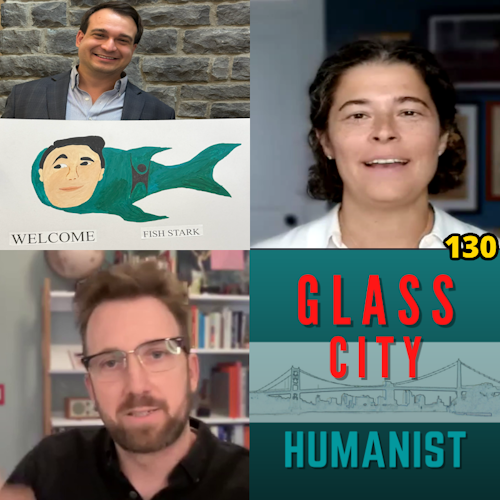
Episode 130: Fighting Christian Nationalism Tour with Fish Stark
The Secular Humanists of Western Lake Erie hosted a speech by Fish Stark, executive director of the American Humanist Association on September 13, 2026 in Toledo. This episode includes his remarks as recorded on that day.
Stark discusses what humanism means as a positive identity rooted in science, compassion, human potential, and human responsibility. He describes humanists as people committed to civil liberties, human dignity, and the idea that public institutions should serve everyone equally. He then explains Christian nationalism as an extreme right-wing movement that seeks to use government to impose a conservative religious framework. Stark describes legal and legislative efforts by the AHA and its allies to oppose these trends.
Next are a couple of clips from the AHA’s National Conference held online on September 19th. Jordan Klepper’s acceptance speech for Humanist of the Year reflects on uncertainty, certainty in politics, and the role of kindness. He talks about humanism as a commitment to reason and intentional compassion rather than automatic tradition.
Rachel Deitch outlines the policy work of the Center for Free Thought Equality, including opposition to voucher expansion, chaplain replacement bills in public schools, and release-time religious instruction. She also describes support for a student bill of rights for secular public education and plans to expand state-level advocacy.





Our Guest
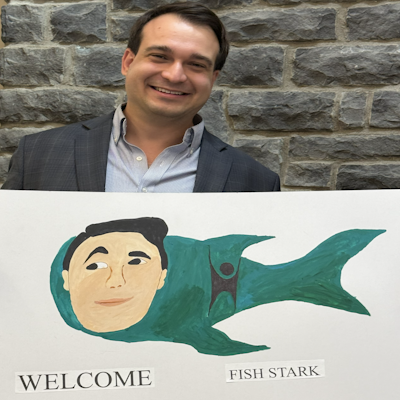
Fish Stark is an organizer, educator, social entrepreneur, and lifelong humanist. Fish has spent his career turning big ideas into bold action in service of belonging, flourishing, and social justice for all people.
Prior to joining the AHA as Executive Director, Fish was the Head of Program + Curriculum at Legends, an educational technology startup, where he led research and implementation teams to create products that helped children build self-confidence, positive mental health, and critical thinking skills.
Fish’s other professional experiences include managing progressive political campaigns, leading a mentorship program in the West Virginia coalfields with the American Friends Service Committee, building a nationally recognized peer-to-peer bullying prevention program, and teaching students from pre-school to high school.
Fish lives in Annapolis, Maryland, where he is President of the Speaker Mike Busch District 30 Democratic Club, is a member of the Unitarian Universalist Church of Annapolis, and serves on several nonprofit boards. He moonlights as an award-winning stand-up comedian and has performed in 13 states.
Fish’s visit to Toledo was part of a multi-state Fighting Christian Nationalism Tour ahead of the November general election.
Extras:
American Humanist Association YouTube Channel
Many of the conference sessions were recorded and will be available soon on the AHA’s Youtube channel
Ben Iten – Chaplains in Schools Full Testimony
Transcript:
Read full transcript here
[0:00] This is Glass City Humanist, a show about humanism, humanist values, by a humanist. Here is your host, Douglas Berger. Our humanist group hosted a speech by Fish Stark, the executive director of the American Humanists Association, and was part of his Fighting Christian Nationalism tour, where he explained what it is, why it’s a problem, and what the AHA is doing to help us resist it. Then we’ll hear a couple of clips from the recent AHA National Conference. Jordan Klepper from The Daily Show was awarded the Humanist of the Year. And Policy Director Rachel Deitch gives us updates on what the Center for Free Thought Equality is doing to defend our religious freedom. Glass City Humanist is an outreach project of the Secular Humanists of Western Lake Erie, building community through compassion and reason for a better tomorrow.
[1:00] Thank you, guys. Can everyone hear me okay? We’re good? Okay. Just if anyone needs me to speak up, let me know. I’m so excited to be here talking to you all. So I just came from Detroit. We had about 75 people at Sunday Assembly there. And I’m going to places like Ohio and Michigan and then North Carolina. There’s some important stuff happening in those states. You know, there’s something going on there that could change the future of the country. And we’re at a really important moment right now. And so my goal, yeah, I’m going to talk for about 30 minutes and then I’ll take your questions until Doug tells me to shut up.
[1:35] You know, my goal is that folks come away from this talk with a clearer understanding of what Christian nationalism is and what it’s doing so that we can articulate to other people the danger that this extreme right wing philosophy poses to our democracy. And that we also come away with a sense of hope because these fights are winnable and I know because we are winning them, a much smaller budget than the Christian nationalists have. And so, you know, but they’re winnable if we do things right. And so I want to give folks a sense of what our strategy has been and the feeling that, you know, because there’s so much fatalism going around.
[2:14] And that, yeah, we face opponents who are, they’re tough, they’re well-resourced, and they’re ruthless. But ultimately, we’re still part of an American majority that believes in a secular democracy. And I want to talk about how resilient that has proven to be even over just the past 18 months, as dark as they’ve been.
[2:33] So I am very proud to lead the American Humanist Association. We do two things. Number one, we build positive identity and community for the tens of millions of Americans who believe science tells us what’s real and compassion tells us what’s right. And we mobilize those Americans to defend civil liberties and human dignity, which are the things that humanists have fought for throughout American history. Um, it’s a dream job. I was an argumentative child. And so now I get to live out my dream of running the American association of people who agree with me. Uh, um, I, a little bit about me. I live in Annapolis, Maryland. Um, before this, I was a executive at a tech startup and then worked in international development. Um, I, on my spare time, I love to perform standup comedy and go see live theater um and i’m a big i’ve got my phone is lighting up with alerts because i am playing fantasy football my team is doing very well zay flowers is lighting up the scoreboard for the baltimore ravens which makes me happy as a ravens fan and happy that he’s on my team, um my opponent in fantasy football this week is my wife i got married to the love of my life two and a half months ago um.
[3:45] Thank you yeah we fought.
[3:49] But the Jerry Falwells of the world will tell you that secular humanists are opposed to the very idea of marriage and the family. And I hope you’ll correct him if you hear that, because I didn’t spend all that fricking money on a wedding for them to lie about me like that. You want to know what they call it when a Unitarian humanist marries a secular Jew? It’s an interfaithless marriage.
[4:13] So you know i i as the head of the aha i’m often in the position of explaining to people what it is that humanists believe, and i like to talk i like to take a moment whenever i talk to talk about why what humanists believe and why because i think our movement a problem with our movement if i may be so bold as to say so is that we often define ourselves by what we don’t believe It’s fine to not believe things, but you don’t organize around not belief, right? Who would buy Nike shoes if the slogan was, just don’t not do it?
[4:48] So as a humanist, I believe in people. I believe that people are inherently worthy without needing to be saved or redeemed. I believe in human potential, the idea that there is no problem people can’t solve and no truth we can’t uncover as long as we live in societies that protect the right to question. And I believe in human responsibility, that the highest good, the highest obligation that we have is to help ourselves and our neighbors live free and flourishing lives. And this is a commitment that humanists have held throughout American history, and it’s how humanists have shaped so many of the things we rely on in America. Right? 250 years ago, it was a young humanist named Thomas Paine who wrote in a little pamphlet called Common Sense, we have it in our power to begin the world over again. And he challenged the idea that a king had a divine right to rule because his bloodline had been blessed by God, which at the time was a heresy.
[5:47] And he said, no, people have the right to govern themselves. And he inspired Americans to start a revolution that cast down a king.
[5:55] And since Paine, we’ve had people who have fought to make that promise of American democracy real. People like Frederick Douglass, right, who challenged the false piety of the slaveholders and said that Americans belong to themselves, not anybody else. And Gloria Steinem, who passed away last week, who led the fight for women’s liberation. and Betty Friedan. And the two of them helped establish things like Ms. Magazine and the National Organization for Women. Planned Parenthood was also founded by a humanist. And then you have folks like John Dewey, who looked at the American school system, such as it was, that left so many kids out and was focused on training the rest of them to become compliant factory workers and said, we’ve got to train kids to be citizens. We have to train them to question. We have to train them to analyze. We have to train them to function in a democracy and created the modern American public school and stripped religion out of it. And you had Jonas Salk, who created the polio vaccine and refused to patent it because he wanted people to live full lives more than he wanted money. And then you have Steve Wozniak, who gave us the little computer we all have in our pockets because he thought the power of a mainframe belongs in all of our homes.
[7:03] So you see the through line here, right? Public schools, Planned Parenthood, personal computers, polio vaccines, The things that we have come to rely on that help us live free and full lives have come in large part from humanists. And it’s because we start with this idea that science tells us what’s real and compassion tells us what’s right, that we don’t have to wait for tradition or a self-justifying authority to give us the answers, but that it is our obligation to work together.
[7:34] Together on behalf of other people. I talk about that because, again, it is a challenge for us that we often define ourselves by what we don’t believe. The truth is humanism is not a reaction to something. We have a legacy and a tradition all our own. We are part of a heritage, and we should start talking about it that way. We played a fundamental role in the building of this country. That’s something to be proud of. And at a time where a lot of people, especially young people, are searching for identity, are searching for a place where they belong, it’s important to define ourselves by our values and by our contributions, especially because we are up against opponents, who have figured out how to weaponize the psychology of identity and the psychology of a belief, to build a movement that is chipping away at our fundamental freedoms. And this is where I go away from all of the lovely rah-rah, here’s how humanists have changed the world, and I get to talk about our friends, the Christian Nationalists.
[8:29] So I want to define what I mean by Christian nationalism because this is not the Bush era compassionate conservatism. This is not a bunch of people who think, wouldn’t it be nice if kids started their day at school saying the Lord’s Prayer? Christian nationalism is an extreme far-right movement that believes the one legitimate purpose of government, is to enact a twisted conservative version of biblical law and that the only people entitled to hold power in this country are people who believe that that is the goal of government. It’s not even that they think, Christians should be in charge of the country. You see how much they hate Reverend Marion Buddy, the Episcopal minister who dared to criticize Trump, right?
[9:09] They can’t even tolerate progressive versions of their own belief system. It is the belief that they have the right to control our institutions and weaponize them for their own ends. Their goal is to seize the institutions that govern us, dismantle the civil rights and civil liberties law that keep them right now from forcing us all to live by their holy book and capture the institutions that serve all of us, like public schools and healthcare systems, and take control of them so that they can dole these things out as privileges to people who believe like they do. And just to be clear, this does not mean making stuff up, right? If you listen to leaders in the Christian nationalist movement, like Doug Wilson, Anybody ever hear of Doug Wilson? Personal spiritual counselor to the Secretary of Defense, right? Seated at the right hand of Pete Hegseth. He’s the guy who is helping foment the strategy to waste all of our tax money on this stupid war in Iran, try and fulfill some kind of biblical prophecy where our gas goes up to four bucks a gallon. Wilson, I think, encapsulated the spirit of the Christian nationalist movement, when he went on a podcast in 2021 and said, empathy is a sin because it causes us to turn away from God for the sake of the neighbor.
[10:36] There’s nothing that tells us to turn away from our neighbor that deserves our reverence. And by the way, there are plenty of religious people who believe that right along with us. Now, Doug Wilson can also be found on podcasts agreeing with other conservative Christian nationalists that homosexuality should be punished by the death penalty, or agreeing with them that women should not have the right to vote, that we should repeal the 19th Amendment and go to household voting. Again, stripping back civil liberties and civil rights law in order to build a country that has no barriers to them forcing us to live by their holy book. It’s the American cousin to Sharia law. And.
[11:16] It is supported by lots of atheists, right? I’m not talking about us in this room. I’m not talking about secular humanists. But plenty of non-Christians are part of the Christian Nationalist Coalition. They’ve formed an alliance with white supremacist bigots. This is why we talk about white Christian nationalism, who believe that when civil liberties are gone, they’ll be able to conduct their purges and treat people the way they want. And with billionaires who believe that with civil rights law gone, they’ll have more power to exploit workers. And with our public institutions decimated and stripped for parts and handed off to the religious right to administer, they might be able to save a few more bucks on their taxes. So that’s how this extreme movement that most Americans, most Christians don’t even support, got the funding and the manpower to capture the institutions of our government.
[12:12] I want to talk about what they’ve been doing specifically, because this movement has sort of three legal and legislative tactics, and it’s important that we understand them so that we can call them out as they are for other people. The first thing they do is they try and flip the victim. They have tried and largely succeeded in the courts to come up with a definition of religious freedom and religious discrimination that fundamentally says they cannot ever be contradictory.
[12:41] That it is religious discrimination to ask them to follow a law that disagrees with their holy book, that it is an impediment to their religious freedom to ask them to live in a society following the same rules as everyone else. Look how quickly we went from them saying at the Supreme Court.
[13:01] Well, my religion says I shouldn’t have to follow anti-discrimination law and serve gay people at my bakery. To then saying, in Wisconsin Catholic Charities versus the Supreme Court, well, because of my religion, I shouldn’t have to pay into unemployment benefits. We can see why the billionaires like this. And now there’s a case before the Supreme Court where Catholic preschools in Colorado are suing and saying, hey, we want to participate in the state pre-K funded program but we don’t want to have to follow the law that says we can’t discriminate against children or their parents. We want to take taxpayer money and decide who gets it based on whether they follow our religion. So that’s their goal, to force the courts in the country to adopt a definition of religious discrimination that says, you can never make me do anything that disagrees with my conservative interpretation of the Bible. That’s danger number one.
[13:59] Danger number two is they want to change the test by which we determine whether something is legally permissible whether it respects people’s civil rights right we used to have something in this country called the lemon test, remember the lemon test it was a it was a heuristic the supreme court would use to determine whether a law was respected the separation of church and state respected the establishment clause the test was does the law have a secular purpose Religious people might like or dislike it, but is there a reason for the law outside of a religious justification? And it said, does the law materially advance or inhibit religion? If it does either of those, it shouldn’t be a law, right? Laws should leave religion alone.
[14:39] And the court in Kennedy versus Bremerton, which was about a hell of a lot more than a football coach preying on a field, struck down the lemon test and replaced it with what they call the history and tradition test. In other words, conduct can be legitimized if it reflects the traditional conditions of the time of the founders. I don’t need to tell you there are a lot of things going on at the time of the founders that contradict the rights we rely on now. A history and tradition test applied to constitutional rights does not protect the right of women to make their own health care decisions, does not protect the right of people to love who they love. This is why the white nationalist bigots are so involved in the Christian Nationalist Coalition, right? Because a reading of the Constitution that looks at it through a lens of history and tradition tests, what was going on at the time of the founding, benefits white supremacists and male supremacists and no one else.
[15:39] And the final thing they do is they try and privatize and capture our institutions. They team up with the billionaires to say, gee, wouldn’t it be way better if rather than public schools that serve every kid equally, we had a voucher system where people could take this money and go and give it to private schools that can legally discriminate based on their religion, that pay terrible bottom feeder, bottom market salaries to unqualified teachers and let the bishops skim a little bit off the top, and return a couple percentages on the dollar to the billionaires in these massive tax cuts that they’re getting? Oh, and hey, what if we did that with adoption agencies? What if we did that with hospitals? What if we took the public services Americans rely on that are designed to serve everyone equally, and we said, nope, they’re going to be administered by the private sector. And by the way, we’ve already won a Supreme Court case that says if something can be administered by the private sector, you can’t stop a religious entity from administering it. And if a religious entity is administering a public service, you can’t stop them from discriminating against people because that’s their religious freedom. And that’s how you end up with a fragmented patchwork of systems that serve Christian nationalists first and turn everyone else into second-class citizens. That’s the leverage that they want to have over all of us. Because their goal, again, is not freedom of worship. They already have freedom of worship. Their goal is social control and dominance over every aspect of American life.
[17:07] So how did this all happen? Because I’m telling you these three tactics, right? And you can see that they’ve made advancements towards that. And this doesn’t just fall out of the sky, right? 35 years ago, they were holding pizza parties for Brett Kavanaugh and his classmates at Yale Law.
[17:25] Mike Johnston, Speaker of the House, was a lawyer at the First Liberty Institute, which won the Kennedy versus Bremerton case. They trained him up out of law school. They spent time electing people to school boards and state representative and city council, who they then groomed up to serve in Congress. They built their bench and they built a culture, right? And if you grew up evangelical and remember the focus on the family, the Odyssey radio shows and the magazines and the left behind books, right? And they built up a culture that served people and gave them community and gave them stories that built loyalty. And then they asked those people, then they asked those people to go and get on the bus and go to the polls with them. They invested in building culture and community while we were wasting our time sitting in auditoriums listening to Richard Dawkins and laughing about how much smarter we were than that. When they were actually doing the smart work of building a movement that could sustain a political machine. Okay, so great. Now we’re screwed, right?
[18:33] Christian nationalism is better funded than we think, better organized than we think, but it’s also weaker than we think. And it’s weaker than we think because it fundamentally contradicts American values and the American consensus. 85% of Americans believe in the separation of church and state, right? Right. There are the majority of religious people, even if they might think you and I are going to hell, they still believe we have the right to believe what we do in the government should not get in the middle of it. Right. A majority of Christians are opposed to Christian nationalism. A majority of Christians are opposed to the so-called anti-Christian bias commission. Right. The Trump administration’s latest attempt to cast Christians as persecuted and cast asking them to follow the law as biased.
[19:20] Because they say, wait a minute, we’re doing fine in America today. Why are we doing this when we should be getting the gas prices down? So just to give you a sense of the fact that there is a little bit of a paper tiger here.
[19:33] Our lobbying team, people sometimes ask me if I do this work full-time, and they’re surprised to learn we have 20 full-time staff at the AHA, lawyers and lobbyists and community organizers who are out there working for all of you. We tracked 125 Christian nationalist bills that got introduced in the last legislative session around the country. And we’re talking in red states like Nebraska and Kansas and Missouri and South Carolina, 125 bills. Only 15 of them ever made it to committee. Of those 15 bills, one passed. one passed them to sign into law. We killed 10 of them. Our lobbyists and our advocates went and testified and met with legislators, and we helped kill 10 of them. Four of them are still in limbo, might get reintroduced next year. They might fade off into the sunset. So it is possible to win these. We have a 10 to 1 record when we went in and engaged on those bills. And in just the last couple of years, just a couple of months ago, we beat the state of Arkansas in federal court. They put up a Ten Commandments monument and they refused to allow comparable monuments from other belief systems. And we said, you can’t do that. Can’t use taxpayer money for that. Can’t favor other religions over others. And a federal court agreed. A Bush-appointed federal judge ruled for us in our lawsuit against the city of Ocala, Florida, and said, yep, not constitutional to use public tax dollars to host a Christian prayer vigil. And we forced the city to settle. And that case is now precedent in federal law. We teamed up with the ACLU of West Virginia.
[21:00] You know, the state of West Virginia in their infinite wisdom. Has anyone here ever lived in West Virginia? I used to live in Charleston. Yeah. Okay. Karen, amazing. So they took $5 million out of the water fund in a state where you can’t drink the water because the coal companies have poisoned it. And they sent it to a private Catholic college in Ohio that only grants degrees in Catholic studies. West Virginians don’t like people messing with their government funds. And I’m sorry to say, but they really don’t like Ohio, So we teamed up with the ACLU of West Virginia. We took the state to court and we got a verdict from a circuit judge that said the money had to be used for constitutional purposes. And just a few weeks ago, we helped beat the city of Quincy, Massachusetts in court. We filed an amicus brief and a case where residents of the town sued their mayor for spending almost a million dollars on two 12-foot tall bronze statues of Catholic saints. And the Massachusetts Supreme Court again said, you can’t do that. Everyone has I have the right to put up a bronze statue Of whoever I want in my own yard But public tax dollars have to serve All of us equally regardless of what we believe Those are fights that we won under Trump.
[22:12] It is possible to win under this administration. We won in a specific way. First, we went in making an affirmative argument that these were not just atheist issues, but that the point is that public institutions belong to all of us equally, regardless of what we believe. Public institutions belong to all of us equally, regardless of what we believe. No special privileges, no favoritism for anyone. That’s not a humanist argument, that’s an American argument. And we did it hand in hand with liberal religious people. We brought that lawsuit in Florida with an Episcopal minister and a rabbi. We joined with 12 other religious groups in that amicus brief to the Massachusetts Supreme Court. We went hand in hand because the thing is, if we split ourselves up, in fact, if we let them split us apart by who we believe made the world and what we think happens after we die, we’re not a majority. We know this. But if we divide this country by who believes in secular government and who doesn’t, and we team up with the, religious folks who believe in liberal democracy, then we are a majority. We are, in fact, an overwhelming majority that no matter how much they’ve rigged the game, we are hard to defeat. And we’ve been investing in building our own bench. Again, that was the infrastructure that they built 30 years ago. So, you know, we have…
[23:39] Adjacent to the AHA. I always have to be careful with my words here. A sister organization called the Center for Free Thought Equality, which is a 501c4. Donations are not tax deductible, but as a consequence, we get to lobby and we get to have a pack. And the Center for Free Thought Equality gets to support its own candidates for school board and state legislature and county council and eventually for Congress. I see you taking out your phone, cfequality.org. And anyone can become a member for free. But if you give the Center for Free Thought Equality money rather than the failing Democratic National Committee, your money goes directly to candidates who have raised their hand and said, I stand with the humanist movement and I want to protect the separation of church and state. So we support 300 of these people across the country. And when State Representative Chris Rabb in Pennsylvania called us, who has been openly non-religious for a long time and said, my congressman’s retiring and I think I’m going to run, we were the first pack to give him any money. And a lot of other packs, the Working Families Party and the Democratic socialists and the unions and the Sunrise movement came after us. We put the first dollar in from the pack. And we were out there on the ground knocking doors for him. And when he won, when he beat the Philadelphia Democratic machine, he thanked atheists in his victory speech and the whole room erupted into cheers.
[24:53] So we’re investing in those folks. And we’re going to, you know, our legal director was just at the University of California, California, Santa Barbara, giving a talk to the law students there. And we had a brilliant 2L at Harvard Law working with us this summer. The university paid a scholarship for her to come work for us. And she was doing research on children’s rights because we want to go after the idea that religious families have the right to deny life-saving medical care to their children. We are working to build our own bench. And when we’re able to do that, we’re able to get our voices heard in the halls of power. Just as an example, right? When my dad, Pete Stark, came out as the first open atheist in Congress in 2007, there was no community around him, right? People either said, that’s nice, Pete, or they said, that’s the end of your career. No, it wasn’t.
[25:44] But now we’ve got multiple openly non-religious people in Congress. We’ve got Jared Huffman from California, who is an open atheist and a humanist. We’ve got Yasemin Ansari, who is openly agnostic. We’ve got Emily Randall from Washington, who’s openly non-religious. And the Congressional Freethought Caucus that we founded in the AHA conference room with four members of Congress back in 2018 is now bigger than the House Freedom Caucus on the far right. 37 members of all faiths standing up to protect secular democracy. And that’s why when Congressman Huffman came out with his book about Christian nationalism, it immediately went to the New York Times bestseller list because we had galvanized a movement of elected officials behind him to say, hey, this stuff is beyond the pale.
[26:33] So we’re able to win because we’re doing the same work of investing in building institutions. And the final thing to know, the final thing to be aware of is, you know how I said the religious right wins because they invest in the church potlucks and, you know, giving money to, there’s a guy named Foster Feist, right-wing billionaire who gave Charlie Kirk $10,000 years ago before Charlie Kirk was anybody to start a YouTube channel because they understood, oh, we have to invest, in creators on the internet who can reach young men and bring them onto our side, and that’s how the young guys who 15 years ago were listening to Sam Harris are all now listening to hacks like Jordan Peterson.
[27:14] We’re trying to copy those same movements of culture building on our side because there’s nothing that says we can’t do the same thing. In the past year, we’ve welcomed 40 new humanist groups like this one to the AHA since the start of our new organizing team in March 2025. And we’ve launched our own fund. Charlie Kirk got his $10,000 from Foster Feist. We’re spending $10,000 a month to find the Charlie Kirk of humanism. And we’re investing in YouTube creators and TikTok creators, making videos about humanism, specifically to reach young people, not just the young men who are getting pulled over to the far right. But I met two young black women in Detroit who came out to the Sunday assembly event because they had seen a video from Drew McCoy, who was one of the content creators that we sponsor, telling them, hey, you got to go out and build community with other humanists. And they signed up for a list and they saw I was giving a talk. That is the way that we build a big enough community to build our own political machine that can resist Christian nationalism. We invest in giving people something to belong to and something to believe in.
[28:17] The last thing I’ll say is, you know, I keep coming back to Doug Wilson’s thing about empathy. And I think, you know, my training is in developmental psychology, right? I studied child psychology at first at Yale, then at Harvard. I started my career working with kids at the Yale Child Study Center. And any good therapist will tell you, you don’t replace a negative thought by challenging it, right? You don’t just negate a negative thought. You replace a negative thought with a positive thought. In other words, we can’t just oppose Christian nationalism. We have to be the opposite of Christian nationalism. We have to show people what the world we are fighting for looks like, not just tear their ideas down. So this year, we launched something called the American Empathy Project. We gave $100,000 out to humanist groups around the country. You guys did one, right? Yep. Yeah. So we gave you guys a thousand bucks. And…
[29:13] And on May 2nd, these hundred humanist groups around the country hosted big service projects. And they had thousands of people come out. It was the biggest mobilization of humanists in America since the Reason rally. And they served tens of thousands of their neighbors. And the AHA got more new members that quarter than any quarter that we can remember. At a time when lots of institutions, from churches to unions to rotary clubs, are declining in membership, the AHA is growing. And it’s because we’re focusing on what we believe and mobilizing people to fight for the kind of vision for a country we want, which helps us make the case about what we oppose.
[29:55] So, you know, it’s exciting to see these groups getting bigger. It’s exciting to go to here in Detroit and Columbus and hear that more people have been joining over the last year and seeing rooms that are full. You know, I had a friend from ACLU West Virginia where we worked to sue the state. She called me a few months ago. I was in a meeting, but I picked up the phone because I just had the sense that it would be important. And she was like, hey, do you have anyone in Mobile, Alabama? Because I’ve got a mom and baby there, nine-month-old baby, and the dad was just abducted by ICE. And they’re worried ICE is coming back. And I got somebody coming down from West Virginia to get them, but we got to get them to the Alabama-Tennessee border right now. We got to get them out of where they’re staying. Do you have someone? And I was able to call our humanist group in Bloxy, Mississippi, which started in 2025.
[30:45] And now has 400 members. And I got the president on the phone, and I said, can you get someone to Mobile, Alabama? And she said, yes. And someone was there in 30 minutes. Mom and baby made it back to West Virginia safely. That’s the kind of thing that humanists can do when we are in community with each other. We can build on our legacy of fighting for civil rights and human dignity. And we ultimately can do our part to be part of the American majority to resist Christian nationalism. That’s our legacy. That’s our tradition. And that’s our obligation. So we’re proud to do our part and you know close well I’ll take all of your questions next especially the impertinent ones.
[31:25] But to finish this part you know the writer Anne Lamott says there are two kinds of prayers one is thank you thank you thank you and the other is help me help me help me, so thank you thank you thank you for being willing to spend some of your precious weekend time here listening to me yap at you right these are not easy topics to talk about they’re not easy topics to think about It’s a lot to drive from Cleveland for this. Um…
[31:48] But it matters that we come together in rooms like this. There was a Harvard political scientist who studied what actually worked during the Trump administration to resist the first Trump administration, to resist fascism. And it wasn’t big lawsuits from the ACLU, and it wasn’t the Women’s March. It was 3,000 local groups like these that were the most effective tools of resistance because they coordinated among each other to get people out to vote, to pass information when people couldn’t necessarily trust the national news networks to resist the worst things that were happening. So participation in groups like these matters. Thank you for being a part of it.
[32:29] Help me, help me, help me. We do all this on the budget of less than one megachurch. You know, in the last two years since I started, our budget’s gone from about $2.5 million to $4 million. That’s part of why we are able to do this, because we were able to hire more attorneys and more lobbyists. all people who make a lot less than they could elsewhere working for us, but we do have to pay them a living wage. And that we don’t have billionaire funders, right? We have thousands and thousands of people who give us five bucks a year or five bucks a month or, you know, or a hundred dollars or a 500 or a thousand dollars if they can. And all of that together is what allows us to sustain the small but really effective team that does this work. So if you are not yet a member of the American Humanist Association, go to humanist.org. We do rely on your dues. And if you’re not ready to do it yet, you can sign up for our email list and just, and if you’re already doing it, then go tell somebody else. Go tell somebody else that if you want to be part of the movement resisting authoritarianism, if you want to be part of something bigger than yourself and something to believe in this deeply divided and alienated time, humanism and the AHA might be for them because we only get better the more we grow. All right, that’s enough out of me. I’m excited to take your questions. Thank you.
[33:57] For more information about the topics in this episode, including links used, please visit the episode page at glasscityhumanist.show.
[34:18] On September the 19th, the American Humanist Association celebrated their 85th, national conference, and it was all virtual this year. They used the hoova or hova, I forget how to pronounce it, platform. And all of it was Zoom webinars and things like that. And so I think it may be because I complained about last year.
[34:44] Um you know i have a very interesting um relationship with these what i call the rubber chicken dinners, where where we get spend a lot of money to get together to say oh you’re pretty no you’re pretty no you’re pretty, but i do think national conferences are important for networking and and, uh exploring whatever values your group has and so i do think it’s important. I just, sometimes they get a little bit overboard, but anyway. So they had one that’s all virtual this year. I think next year they’re going to be in Washington, D.C., where they’ll have a mix of in-person and virtual, which is good. I like that. And so what I wanted to do is play a couple of clips from the conference, from a couple of the webinars that I found interesting. The first one that I’m going to play is the acceptance speech from Jordan Klepper. He is a comedian and one of the co-hosts of The Daily Show on Comedy Central. And he is receiving the Humanist of the Year Award, which…
[35:52] I didn’t think that he would know what humanism was and he knows what humanism was or is. So I think that’s pretty good. So I wanted to play his acceptance speech. It’s probably about eight or nine minutes, something like that. And then I want to play a clip from the policy advocacy seminar that Rachel Deitch did.
[36:15] She is the policy coordinator for the American Humanist Association and the Center for Free Thought, which is our 501c4 organization. And so we’ll play that after Jordan Kleppers.
[36:30] That is such a kind and warm welcome. I will say a tenet of humanism is its rejection of mystical beings pulling the levers of fate, and it instead embraces a brutal rationalism so that we may focus on what is real, what is here right now, so that we may be aware, we may be attentive, we may be above all else present, which is why I’m honored to join you via Zoom. I will say it is good to know that humanism, while not bound by archaic traditions, is still bound by capitalism, because renting a Marriott ballroom doesn’t come cheap, you know? You got to get the big conference room, you got to pay for catering, a projector, someone to turn on the slides with Carl Sagan quotes and clever Charles Darwin visuals. You gotta get a DJ to spin Billie Eilish tunes at the Humanist happy hour. You know, it’s a whole ordeal. You know, perhaps we’d all believe in a higher power if Hilton would throw in just a 15% discount. Regardless, I am humbled to be asked to accept the award for Humanist of the Year. I have to first thank Neil deGrasse Tyson, who I assume said no. I would guess his Zoom writer was just too Hollywood. And that is where I just come and I swoop in. I promise, though, that I will do my best to earn this accolade, but a heads up to all you humanists out there. When you’re handing these things out to comedians, it might mean the end times are near.
[37:59] Just food for thought. Now, the last time Fish referenced it, I was at a humanist event, a gathering, or I think what is known as a coven. I brought my friend Sean along, who, much like myself, had no idea what to expect. Was it going to be some sort of academic lecture or an Elkhorn’s body paint pagan sex club kind of thing? We didn’t know. And as soon as the notes and the lectern came out, Sean, my friend, breathed a sigh of relief, put his edible body paint away, and then he settled in. Now, Sean had asked me beforehand what humanism was. I told him to shut up and read a book, you stupid rube. Frankly, it is hard to define what humanism is. You end up relying on telling people what it’s not. Like, you know, church, it’s not that. Instead of Sunday school, it’s just school, you know?
[38:55] Or, you know, it’s a group of people who are interested in rationality and kindness. So like Canadians, yeah, humanism is sort of like being Canadian. Needless to say, my best efforts, my pal Sean was still very uncertain about this whole humanist thing. And frankly, finding comfort in that uncertainty might just be the best place to start. In fact, I find comfort and uncertainty to be a very powerful state. Now, my day job is over at The Daily Show, where sometimes I’m behind the desk, and other times I’m out in the wide-open chaos of America talking to other people. Now, when I’m out on the road chatting it up, I find the most frustrating quality I find in another person is not their anti-woke take or their flat-earther theories. The most frustrating quality is their certainty.
[39:50] In fact, one of the most telling interactions I had at a Trump rally occurred in Iowa during the first Trump impeachment, when documents and testimony from Trump insiders like John Bolton were blocked by Trump himself. So I asked supporters if there was any legitimate reason for Trump’s impeachment, and a woman came up, and she told me, you can tell he hasn’t done anything wrong because of his demeanor. He would be trying to hide things. So I clarified, if you were blocking witnesses or evidence, you’d be like, you’re hiding something. And then she just doubled down. Yes, he’s like, let them see everything. So I told her, but Trump is blocking witnesses. And this woman paused. She thought, she paused some more. And then she said, I’m sorry. I don’t care. It didn’t matter. This argument we were having over the legitimacy of the impeachment was just for show. It was part of the game. In fact, I appreciated her honesty.
[40:53] We can debate what we want. I mean, that’s politics. Politics is essentially a negotiation over priorities. What we can’t debate is who we are. And when your politics becomes your identity, then there is no negotiation. When you give over your critical thinking to a party, or to a religion, or to an algorithm, you’re lost. Perhaps the bravest response to being questioned by someone like me, the one that I’m hoping to hear, is, I don’t know. Humble with the possibility of growth. And you won’t find that answer on television or Twitter, mediums that reward certainty and volume. The response that worries me, the one that I see more and more, is, I don’t care. Immovable and certain and stuck.
[41:38] Being open to change to this act of becoming is a liability in 2026. Algorithms don’t push questions. They amplify the loudest answers. Every hot take on a subway is either 100% agreed with or 100% not. And I wish there was a space for 52% disagree, but open to hearing more as a subway take. I mean, maybe it’s out there, but it’s not getting pushed into my feed, which is a shame. Being open is a beautiful thing So like my pal Sean Back at the humanist event, He didn’t know what he was in for But he was open to it, So Sean settles into his seat He’s uncertain about the whole humanist thing But he’s willing to hear it out, He listened He chatted with kind people He enjoyed it Then afterwards, Sean, relayed an interesting moment to me While watching the humanist event A man in front of him sneezed Sean waited, looked around as nobody responded then he said.
[42:40] God bless you. The sneezy man did not respond. Sean told me he said he felt time slowed down and the weight of that silence sit on him for those long two seconds. And Sean told me afterwards, the moral of the story is, I don’t think humanists say bless you. And in that tiny interaction lies both the glory and the challenge of humanism. First off, kudos to the group of humanists for their steadfast attention and refusal to lean into knee-jerk traditionalism, or kudos to the group for being too uncomfortable to just say gesundheit. I mean, it is a strange word. It almost sounds too German. I get it. But on the other side.
[43:23] If there’s ever a reason for God to exist, it’s to fill that split second of awkwardness with a moment of grace and kindness. And this is where I struggle. There are the moments where I crave a tradition or a blueprint to walk through life, to automate the little stuff with knee-jerk kindness. And what is the harm in that? Sometimes autopilot belief smooths out the difficult parts because life is exhausting. It’ll wear you out if you have to offer a word of praise for every sneezy atheist who forgot to take their Zyrtec. But, then again, maybe actual kindness is not the automated response of God bless you. Maybe actual kindness has to be an active choice, an act of grace with intent. For me, and for all humanists, that’s the challenge. Not to fall into the trap of non-thinking kindness, automated bless yous.
[44:22] But also, humanists, don’t be a dick and say nothing Choosing not to believe in something isn’t noble It frees you up to be noble, Humanism is a statement of intent But the human has to do the follow-up Because there ain’t no institution So it’s in those post-sneeze moments of snot-drenched silence Where we must do the work to offer something, maybe a hanky or even a bro sorry about the hay fever could go a long way so.
[44:56] Is that the answer i bravely say i don’t know and i promise to keep looking, regardless thank you all for this honor and if you’re if you’re anything like me and you like to hear yourself speak uh i think now we’re going to open it up to some questions, For more information about the topics in this episode, including links used, please visit the episode page at glasscityhumanist.show.
[45:42] So after we just heard from Jordan Klepper, I wanted to play a clip from the advocacy presentation that Rachel Deitch did. She is the policy and political director of the American Humans Association and its 501C4 affiliate, the Center for Free Thought Equality. She leads the organization’s policy development and advocacy efforts at the federal and state levels to advance secular and progressive values. And one of the reasons why I want to show this clip is she talks about the effort that they did in Ohio, to hit back or push back against the chaplain bill that had been introduced, where they were going to allow school districts to replace.
[46:29] Mental health experts with pastors. Who may or may not have had any training. And so we had a humanist chaplain that lives in Columbus, Ohio, who did personal testimony and, really hit back and answered all their questions. She talks about that. And she also is going to talk about their efforts for the coming year, the 2027, where what I really agree with is that they’re starting to focus more on state issues rather than just Washington, D.C., because a lot of this Christian nationalist crap that ends up in the Congress starts in the states. And so we need to defend church and state at the state level, and every little bit helps. So here’s that presentation. So what did we do with this infrastructure this year? Well, we put it to work and we put it to work hard. We worked in 15 states, four issues over and over. We were unrelenting and it showed results. So these are the states we worked in. In 10 of these, we only worked defensively. Our whole focus was what muckery, which is my favorite word for this moment we are in.
[47:47] That is C3 friendly or at least public-friendly, what muckery are folks going to be introducing and pushing in these states, and how can we stay on top of it and push back immediately and push back hard?
[47:59] But we didn’t try to defend against everything, right? We are not experts in all the things. So we looked at where our community, our expertise could have the most impact. And where we landed was protecting young people’s rights and making sure your
[48:13] tax dollars are not going to perpetrate harm against young people. And so we broke this up into defense and offense. What did we defend against? We chose three priority issues. The first, private school vouchers, expansion of those programs. We were reining that in. We defended against efforts to replace mental health workers in public schools, school counselors, school psychologists, with volunteer chaplains. And depending on the state that that bill was introduced in, the definition of chaplain gets really quirky. And third, release time for religious instruction programs. If you’re not familiar with these programs, these are programs intended to lure and coerce children out of their public school classroom in the middle of the school day for religious instruction. And on its face, sure, people should be able to leave campus for religious instruction or other family requirements. This is not that. These are programs, organizations, million-dollar organizations that are being set up to erode classroom time, pull students out of class, and then get those students to coerce and bully their peers to also participate.
[49:26] Let’s talk a little bit, though, about the positive side. What did we fight for? We are fighting for a student’s bill of rights to a secular public education. This is a large project that we are doing with our partners at Freedom From Religion Foundation and American Atheists across the country. And our organization, the Center for Free Thought Equality, secured introduction in Pennsylvania this week. And we are so excited about that. And I will be talking more about that in a minute.
[49:54] Back to defense though for a minute so what did this look like it looked like tracking a ton of bills closely and when i mean when i say closely i mean closely, uh 15 of those bills moved which meant they started to move through the process they weren’t just introduced by one person they either got a hearing or they, um were heard in committee, and we acted on every single one of them and then 10 of those bills were defeated in part because of our advocacy and i don’t say that lightly. Four passed, one is still pending, which we will talk about. How did we do this? Again, advocates. When you think about whose voice matters in this work, it’s the people living in the state. It is the humanists living in the state. And so we worked directly with advocates in the state to submit testimony, testify in person, and just do more basic communication with their elected officials. 1,200 messages went out this year on state-level advocacy alone that were directed to state lawmakers on bills that were moving and that we were really concerned about.
[51:03] Now let’s talk about two case studies. Let’s talk about what this looked like in Ohio. There was a bill introduced to replace mental health workers in public schools in Ohio with volunteer chaplains. The first thing we did is we saw the bill get introduced. We analyzed it. We figured out what bill it was modeled after and what the impact would be in the state. Then we tested it. What I mean by that is, was it viable or was it just noise? We talked with folks in the state to get a better understanding of how far this bill could move. And we understood very quickly that, yeah, it had legs, which then took us to the next component, mapping the state. Where do we have advocates? Where do we have partners, both in terms of statewide organizations, but really our advocates? We worked with local Ohio groups. We worked with a humanist chaplain in Ohio to figure out what they would be willing to do and then how we can support them. And that decided our strategic plan for that state or our state strategy. And then we showed up. We did the work to make sure that those advocates had everything they need. So multiple members of our community submitted written testimony when that bill came up for a hearing in the House Education Committee. We had written testimony, and more importantly, we had a humanist chaplain in the state, shout out to Ben, testify in person in front of the committee against this bill.
[52:32] If you’ve never been to a state hearing, there’s often a lot of different bills being heard that day. They normally limit, they might list limit testimony to a few minutes each for each person. Ben was up there for longer than anyone else that day because not only was he local, not only was he a humanist and had a humanist viewpoint, not only was he a chaplain, he was a parent and he showed up and said, I’m happy to answer your questions. And he got question after question after question. Now, a lot of them were, you know, politically constructed throwaways. But in real time, our team saw members of that committee, committees, minds, maybe not change, but think about slowing down momentum. And in real time in that hearing, and I truly believe this with every fiber of my being because we were watching online as it happened, the questions started to get more thoughtful.
[53:35] Slower, thinking through problems or impacts that they hadn’t actually thought through. And since that hearing, that bill has not moved. So while I can’t say we killed the bill nonviolently, of course, yet we absolutely slowed down momentum. And it was one of the best things that I’ve been able to witness and be part of all year. And it’s something we plan on replicating in other states and helping other volunteer advocates like the folks on this call maybe or on this meeting. Our plan is to make sure you are empowered and ready to do that work with us.
[54:13] Now let’s talk about a win. I mentioned Pennsylvania Students’ Bill of Rights being introduced in the state. That state bill is called the Plural Act, and we are so excited about it. I already mentioned it is part of a national project. We are all, our three organizations, FFRF, American Atheists, are all taking on different states with different strategies in each state to have as much of an expansive impact as possible, and Pennsylvania is one of the states we are leading this work in. It was introduced by representative chris rab as the prime sponsor you might be familiar with him he identifies he just said this last week which i love as devoutly agnostic uh.
[54:55] He was joined by five colleagues uh that we met with all of them uh got them to sign on, and we did the like not attractive but super important work of building coalition in the state making sure that it’s not just a national organization coming in and pushing our agenda right we hear that as a problem regardless of what side of the political spectrum you’re on we worked with interfaith partners ranging from muslim to christian student groups, we worked with educators right administrators we worked with civil rights organizations like the aclu in the state to make sure that this bill when it reached the starting line of introduction was responsive to the needs of the state and we are not done yet. We will be pushing this bill next year with Tara Probst and others in the state as Chris Rabb moves on to Congress, which is the last thing I want to say about this slide. This is a whole other piece of the pipeline we’re building because the intent of the work we do at CFE and AHA is to build champions at all levels of government. And so the work that we did with Chris Rapp in Pennsylvania, our intent, if we do our jobs correctly, will follow him into Congress.
[56:12] We never left Washington. I’m not talking about Washington today, but I want to highlight two case studies of what our work looks like, what your contributions helped accomplish this year. The first is we’ve got 37 members of the Congressional Free Thought Caucus, y’all.
[56:27] Press coverage has noted, but I haven’t been able to confirm this, that it makes it larger than the Freedom Caucus. So when you ask, so what, why are we building a caucus? I would urge you to think about how successful the Freedom Caucus has been in their work on their side. And then we helped work on a counter-narrative to Trump’s Religious Liberty Commission. If you’re not familiar, Trump created a Religious Liberty Commission to provide recommendations to the Department of Justice and other agencies on promoting a very narrow, very regressive, very harmful version of religious liberty. We got together with the Center for American Progress, Americans United for Separation Church and State and the Interfaith Alliance to say, absolutely not. We know the narrative of religious liberty in this country. We know its history. We know its future. And it’s not that. So we worked with these organizations to publish a report, articulating a better, we think, more inclusive version of religious liberty in the country.
[57:23] So what are we building next? And I am so lost on time because I forgot to start my timer, but let’s talk about it. Next year, we’re scaling. First on defense. We worked in 15 states this year. We’re working on 25 states next year.
[57:38] We worked on three defensive issues this year. We’re increasing that to five next year, along with chaplains and vouchers and release time for religious instruction. We’re adding parental controls, parental rights legislation that we’re going to be fighting back against, as well as medical neglect expansion from a religious perspective. But I’m not going to get too much into that today. But we’re scaling up on defense.
[58:03] Offense, we are scaling up on the student’s bill of rights to a secular public education. We’ve already gotten that bill introduced in North Carolina. We have commitment from lawmakers to sponsor or lead the legislation in North Carolina, in Minnesota, in Delaware, in Oregon. And we are very close, I say, to getting written confirmation in Maryland. We’re also expanding two new model bills that our team worked on this year. The first is a Children’s Bill of Rights to be free from medical neglect. This same issue I mentioned that we’re going to be working on defensively next year. We have a model legislation to protect children’s rights to be free from medical neglect or abuse. And then the last bill, the third bill that we’ve got ready to go and we’re working on is to bring transparency and accountability to voucher programs. So not just working on defending against expansion, but actually introducing legislation to pull back these programs.
[59:10] We’ve never done this work alone national partners right i think i’ve given due amplification to the amazing national partners that we work with but that is just a handful we could not do this work successfully if we did it alone which hey that’s the theme of the slide um but when we move together people notice so our organization is willing to work with anyone and everyone whose goals align with us. I want to talk a little bit about religious allies and interfaith work that we do. Humanism is magical. I just loved Faith’s presentation. I had to put the word magical in here. I couldn’t help myself.
[59:48] Humanism is this magical unicorn because it allows us to work very comfortably in secular, atheist, agnostic spaces, and it allows us to work in interfaith, interreligious spaces. And that work is so important, not just for raising the visibility of humanism, but for making sure that interfaith work, is representative of and responsive to the needs of humanists because interfaith partners are doing some amazing stuff and we’re happy to be doing it alongside them. Secular officials, I already talked about. We couldn’t do this work without members of the Association of Secular Elected Officials. They bring the elected office and we bring the expertise. And lastly, local advocates. We would fail at this if we tried to do this work without local advocates. People on the ground, you, know what’s going on in your state. You know the harm and the good that policy does. And so you will always be the best person to speak on any particular issue. I could be the best expert in the world and it means nothing if I am not joined in a meeting and following the lead of folks who actually live in the state.
[1:01:03] So you might have joined this presentation originally thinking it was a presentation about what we’re doing. That was a lie. It’s actually a presentation about what we are asking you to do.
[1:01:16] So I talked in terms of case studies, what we’re doing with advocates. But there are so many ways to plug into this work. Here are three examples. The first is sign your name on testimony we draft. We do the research and the writing. You read it, make sure it aligns with your values, and then sign and submit.
[1:01:38] We have edited testimony alongside advocates. We want you feeling incredibly comfortable with whatever arguments we might be making against that bill. And so we don’t just say, here, do this thing for us and move along. It is a cooperative process to make sure that any testimony or any work that you sign aligns with your values. The second way that we can get you to tap in is meet with your lawmakers. Sit down with them and explain what humanism is. Why does it matter to you? And we will prepare you for every minute of that conversation if you’d like. Or make just one call or write one letter. Pick up the phone to call your lawmaker’s office, write a letter to the editor, and ask lawmakers to co-sponsor a bill we’re working on. These are three examples, three different configurations of the way we’re doing advocacy, but there are so many more. And totally heard that some of you all will find this advocacy lofty, and some of you will say, I’ve done this before, and this is so easy. You’re both right. And the more we do it, the easier it becomes for everybody.
[1:02:48] And i just wanted to put in writing the promise that we are making you if you get involved with us in this work we will provide you the research the model bills the legal expertise the coalitions stakeholder relationships lawmaker relationships, our job is to make you successful in your advocacy and we are here for however much or however little you might need to make that happen.
[1:03:13] All right, my actual asks, though, three ways to start right now. The first is volunteer with us. This QR code leads you to our policy advocacy volunteer form sign-up. Your name doesn’t get added to a general list. Instead, when we need to target your state or even your particular lawmaker, we come to you with specific ask and real options. Hey, this bill is moving. We are going to get a hearing on it. Would you be interested in writing a letter to the editor? Would you be interested in submitting testimony? Would you be interested in meeting with your lawmaker? We can help you do any or all of those pieces. And this form is used, is absolutely critical to our rapid response. Earlier this year, Isabella and our team found out a bill, I think, Thursday evening. And using the volunteer form with us, volunteer with us form, and the responses that we had received, we were able to turn around testimony within 24 hours and meet that deadline because this work sometimes does move quickly. And signing up for this is the quickest way to get involved with our work. The second ask, join the Center for Freethought Equality. It is free. It is free for a reason. We want as many people involved in this work as possible. So if you are in this presentation today and interested in anything I talked about, you absolutely should be a member of the Center for Freethought Equality.
[1:04:42] But you can join either by signing up the membership QR code, which is cfequality.org backslash join. We do an annual meeting, status of CFE, what we’ve built, what we’re building next year for our members. You will hear from all of CFE staff on the huge range of work we’re doing, and we will have a few special guest speakers.
[1:05:06] I will end with one person can’t do everything, but absolutely nothing gets done without one person. That is not my theory of change. It is humanism’s. So please join us. That is my ask. Again, I’m a lobbyist. I have to have an ask. For more information about the topics in this episode, including links used, please visit the episode page at glasscityhumanist.show. Glass City Humanist is hosted, written, and produced by Douglas Berger, and he’s solely responsible for the content.
Transcript is machine generated, lightly edited, and approximate to what was recorded. If you would like perfect transcripts, please donate to the show.
Credits
Written, produced, and edited by Douglas Berger and he is entirely responsible for the content. Incidental voice overs by Sasha C.
The GCH theme is “Glass City Jam” composed using Ampify Studio
This episode by Glass City Humanist is licensed under CC BY-NC-ND 4.0.
