
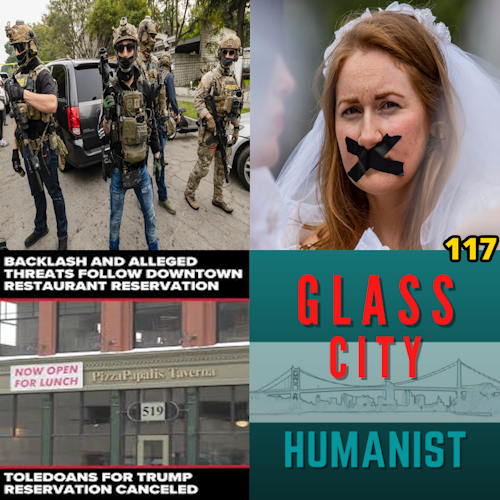
Episode 117: The Streets Of Minneapolis Are Knocking On Our Door
We start by looking at narratives, or stories, and their impact on societal issues, particularly within the realms of politics and human rights. We highlight a concerning a local incident with the group Toledoans for Trump, who faced backlash for reserving a space to meet. We have concerns about the potential harm of silencing differing opinions through social media backlash and boycott calls, emphasizing the importance of defending free speech even when we disagree with the message and that private businesses can and do discriminate based on political views. We are concerned about how much press this incident received when other stories are not heard.
Next we highlight Senate Bill 341 introduced in the Ohio legislature, which seeks to prohibit minors from marrying. There is a connection between such marriages and human trafficking, as well as how they can perpetuate cycles of abuse. Child marriage is also connected to cultural and religious beliefs. We encourage listeners to engage with their legislators to amplify this initiative, emphasizing its significance in protecting vulnerable individuals.
We end the episode by talking about the paramilitary and unconstitutional work of Immigration and Customs Enforcement (ICE) activities and their implications for all our civil liberties. There are serious consequences of ICE’s aggressive tactics, reflecting on past tragedies and ongoing fears within immigrant communities. We stress the urgent need for community awareness and advocacy. By sharing experiences from Minneapolis and local insights, we call upon listeners to support their neighbors and push back against authoritarian enforcement that targets marginalized communities.
01:00 Toledoans for Trump Kerfuffle
09:23 Banning Child Marriage in Ohio
17:55 The Streets Of Minneapolis Are Knocking On Our Door





Extras:
Conservative group that struggled to find a place to meet in Toledo gathered at library
Ohio lawmakers introduce bills to limit school vouchers, ban 17 year olds from getting married
Thousands Flood The Streets Of Minneapolis To Protest ICE
Fear, faith and preparation as ICE closes in on an Ohio community
How U.S. Citizens Can Protect the Immigrant Community From the Deportation Force
Seven Ways You Can Take Action for Immigrants
Toledo is stronger when we look out for each other – Nick Komives
Transcript:
Click Here to Read Full Transcript
[0:04] This is Glass City Humanist, a show about humanism, humanist values, by a humanist. Here is your host, Douglas Berger. We talk about narratives in relation to political events and how the reaction to a business canceling a reservation might hurt all of us. Then we talk about a bill introduced in the Ohio Senate that would address one aspect of human trafficking by prohibiting minors from getting married. And then finally, we examine the issue with ICE and their paramilitary adventures, probably coming to a neighborhood near you. We need to get ready. Glass City Humanist is an outreach project of the Secular Humanists of Western Lake Erie, building community through compassion and reason for a better tomorrow.
[1:00] There’s a word that people should know, especially when you’re dealing with politics and media, and that’s the word narrative. And at the base level, narrative, all narrative means is a story. It’s not attached to any facts or any truths. It is one person or maybe a group of people’s story of a certain situation. It’s their description. If you were a little kid, you would play the telephone game. And so one kid would say something to another kid, and eventually the story would get changed. That’s the narrative, okay? It doesn’t have anything to do with the truth or the facts. It’s one person’s perception of the truth and the facts. And so you have that narrative, people trying to get their narrative across, whether you agree with it or not, that’s what they try to do. And we had a situation here in Toledo recently, is we had a group called Toledoans for Trump.
[2:15] And they had made a reservation at a local pizza parlor to hold a meeting. And people on the left side of the aisle found out about it, and they basically…
[2:32] For lack of a better word, harassed the business owner or the people running the business to cancel the reservation. Talked about boycotts and calling the business and giving them poor reviews, et cetera, et cetera. Now, I personally have a problem with that being that gung-ho about that. Because the Toledoans for Trump, whether or not you agree with them or not, they have just as much right to meet in public that any group has. They have a First Amendment right. On the other hand, a private business has just the same right not to allow them to be in their business. You know, a business has to accommodate most people.
[3:34] Through civil rights laws. You know, you can’t deny service because they’re Catholic. You can’t deny service because they might be African-American and things like that. But political views, yeah, you can discriminate against people. You can say, I’m not going to allow a Trump, Toledo for Trump meaning to be held in my business. They’re free to do that. I have no problem with that. Now, I think that harassing a business and calling for a boycott should only be used if the business owner or the business is actively hurting people. Like, let’s say that they’re providing free meals to ICE officers, for example. Yeah, then I can say we’re going to boycott that business. There’s several businesses that I do not spend money at. For example, I don’t spend money at Chick-fil-A. I’ve never gone to Chick-fil-A. Why? Because they do not support the LGBTQ community.
[4:48] There’s also a list of businesses that I’m aware of in the Toledo area that support anti-abortion efforts. So I just make sure that if I’m able to, is I don’t spend money at those businesses. And that’s another part of it is, you know, and we talked about this in a meeting once, that there might be times where you have to spend money at a business that you would not spend money at if you didn’t have to. You know, maybe they’re the only shoe store in the tri-state region that has your particular shoe and you need it for work. And if you don’t have it for work, you’re going to get in trouble. So you have to spend money there. So I’d rather know these businesses that are doing this, and that way I can make an individual choice myself not to spend money. If I’m going to call for a boycott of a business, it has to be something very, very serious that we have to make sure this business realizes that they’re screwing up immediately.
[6:02] And so when people were calling for a boycott of this pizza place, I was a little hesitant, especially because it involved political speech. I don’t think that that rises above it. Now, yes, if it’s Toledo wins for Trump and they love Trump, they’re supporting fascism. I get it. And if we want to say that, we can. The other thing about this issue that really bothered me was how much press and how much media attention that group got for the whole hubbubaloo. They not only had stories on the local, all three local TV stations, they had articles in the Blade directed towards this issue, all because they were denied a reservation at a pizza place. Now, the other part of the story, and this is the part of the narrative that they don’t want you to know about, is they were able to hold their meeting at the public library. The public library does not have strict rules. The only thing you can’t do is you can’t raise money.
[7:18] You can’t sell things, but pretty much they don’t, they don’t reserve, uh, community rooms. You know, they don’t deny you a community room based on content more than likely. I mean, there’s a set of rules, you know, as long as you follow those rules, you’re good. So the Trump Toledo ones for Trump were able to meet at the West Toledo library.
[7:45] And somebody, a friend of mine Who’s in the progressive community Actually had to post to their friends And tell them to stop calling the library to complain, Because if they do that Then the Trumpians Then will call and complain about Left-leaning groups meeting there And we don’t want that Especially our group, Secular Humanists of Western Lake Erie That’s the place that we meet is in the library. And so if the library got skittish about having anything to do with politicals, that would hurt us or could hurt us. And so, like I said, I was very concerned about the media response to it. And so you just have to really keep an eye out on what the narrative is and know that it’s not always connected directly to the truth or the facts. And so you have to wade through that narrative to find the truth and the facts sometimes. And that’s what the real story is. And it’s important that you do that due diligence and find out what the true story is.
[9:05] For more information about the topics in this episode, including links used, please visit the episode page at glasscityhumanist.show. One of the social justice issues that we here at the Secular Humanists of Western Lake Erie have been focused on the last couple of years is human trafficking. And that is also something that has come up with the discussion about the Jeffrey Epstein files, because it seems like he, well, he was, he was convicted of sex trafficking. And so was someone that worked for him. So it’s been in the news lately. Of course, one of the things that we did was we supported a conference, an international human trafficking conference. It was put on by Dr. Celia Williamson at the University of Toledo.
[10:17] And one of the other things that we’ve done is we’re working with a group called Unchained at Last. It’s an advocacy group based in New Jersey that is going around the country trying to change state laws in many, many states to prohibit people getting married before the age of 18. And one of the reasons why they are advocating against having someone under 18 get married is because that is one of the things that has been used to traffic women. It’s also something to give cover to domestic violence. And usually what happens too is you’ll have parents that get paid off, they get money to have their daughters marry some older gentlemen. And so they’ll do it for money or for drugs or whatever.
[11:21] And so usually the woman that gets married is in a very vulnerable position or powerless to stop it. And so this group, Unchained at Last, is advocating making sure that laws in this country don’t allow somebody less than 18 to get married. Now, currently in Ohio, and they just changed this within the last few years, is they do allow people that are age 17 with parental permission to get married, to enter into a legal marriage contract.
[12:04] The law also includes a prohibition, and this is why it was updated within the last 10 or 15 years, something like that. It also prohibits marriage by anyone other than a man and a woman, even though we know that that’s not enforceable at this time because of the Oberfall U.S. Supreme Court decision. And so Unchained at Last is working with some groups here in Ohio, including the Secular Humanists of Western Lake Erie, to get a bill introduced to repeal that part of that law so that people that are under the age of 18 can’t get married. And they were successful in finding a Democrat and a Republican to introduce a bill.
[12:56] And it is Senate Bill 341, and it was introduced on January the 20th. The primary sponsors are Democrat William DeMora and Republican Louis Blessing III. And it hasn’t been assigned to a committee yet. It probably will be soon. It’s considered juvenile and family law, so it’ll probably end up in the Judiciary Committee maybe. And basically, it just does one simple thing, is it repeals the law that authorizes a person who is 17 to get married. That’s all it does. Unchained at Last has as their goal to have marriage laws uniform in the country where it’s 18 years and older, period. No exceptions at all. And there shouldn’t be any exceptions.
[13:55] And so they are coming, Unchained at Last, their outreach people are coming to visit with legislators in early February. And so what the process is, is they’ll talk to legislators. They’ll try to get some more people to sign on to this bill. Currently, there’s one, two, three, four, five, six people who have signed on to the bill as co-sponsors. And then it will go into the committee. They’ll have, hopefully they’ll have hearings on it. The committee will either change it, make amendments or whatever that they do with it. They’ll also have allow public input so people can give testimony or you can send in written testimony. And then once the committee votes it out, then it goes to the floor of the Senate and then they’ll debate it, vote on it. If it passes, then it will get handed off to the house.
[14:56] The other thing that they could do, too, is maybe if they could find somebody, two people in the House to introduce a similar version, they could speed up that timeline. I think that this is a good idea. I think Senate Bill 341 is actually good for people. It’s good for Ohio.
[15:16] And it would help address some of this issues with human trafficking in some cases. And the other reason, too, that we advocate for this bill or we’re going to advocate for this bill is because many of these state laws and customs about particularly younger women getting married under the age of 18 is either cultural tradition or religious tradition. Um, I, there was a, uh, push in Tennessee to repeal their law that allowed, uh.
[15:57] People under, under the age of 18 to get married and it failed and it failed because of pushback from evangelicals because there’s a certain evangelical sect that go through and want younger women to get married. And typically they get married, married to older men. You also see this in some versions of Mormonism, where you have young women getting married. You also have what’s known as the travelers, the nomadic clan people that travel around the country in motorhomes, and they sometimes do that as well. So it’s not only cultural, but it can be a religious thing. And so this is one reason why our group is partnering with Unchained at Last to try to get this passed. And so we’re going to do our part.
[16:56] So I’ll have a link up in the show notes to the group Unchained at Last and to the bill. They are wanting to know or wanting to get people to talk to their legislators about this bill. And so, you know, we’ll have information about that. So if you want to do that for those of you that are in Ohio, this would be a good opportunity to talk about a bill that could benefit a lot of people. Segments of this podcast are available Tuesdays at 7 p.m. Eastern on W.A.K.T. 106.1 FM in Toledo and on ToledoRadio.org.
[17:57] In the last episode of the Glass City Humanist, I had talked about the murder of Renee Good in Minneapolis at the hands of the immigration enforcement people, the ICE people. And it was taught about how tragic it was and that it was just a calling card of the more aggressive nature of what they’ve been doing recently, what the Trump administration had been doing recently to try to, for lack of a better word, racial profile people and deport anyone who wasn’t white. They claim that they’re getting rid of the worst of the worst, the criminals.
[18:42] We know that that is not the case, that there’s been several known cases of U.S. Citizens being caught up in this and being deported. Basically, it’s an unprofessional crime. Paramilitary group that is doing all of this, that has nothing to do with the law. It’s unconstitutional for the most part. They violate so many rights, the Fourth Amendment, the First Amendment. In this case, we just recently had another person murdered by ICE officers, and they had their Second Amendment violated because they happened to be carrying a, uh, legal firearm and it was, uh, taken off the, off their person before they were, before they were murdered, you know, and you, and you see this, uh, this happening and, and you’re like, you don’t know, you know, it seems like it’s out of control. Like it’s not going to stop. It’s just, it’s very scary. It’s very scary for a lot of people, especially people that are in the middle of it like they are in Minneapolis.
[19:55] And we’ve heard that it probably is going to get bad in Springfield, Ohio. That is where they have a population of Haitian immigrants because their legal status is going to be revoked starting, I believe, at the beginning of February. And so even the governor was talking about that probably ICE is going to show up in Springfield and start doing some of the same things that they’re doing in Minneapolis. And, you know, we have the people, we have people who support what ICE is doing and they’re saying that, you know, they’re just getting rid of the criminals, even though we know the data by the data and the facts that, you know, 70 to 80 percent of the people that they’re detaining have no criminal record. Being undocumented in the United States and crossing illegally is not a criminal offense. Right. It’s a civil offense, but it is not a criminal offense. You know, it doesn’t require you to be put in prison. It doesn’t require you to go before a judge and to be sentenced to prison.
[21:10] The worst that should be happening is that you get deported. They shouldn’t be crashing into your house. If you’re not doing anything, if you’re not committing any crimes, you’re paying the taxes that you pay, you’re staying out of trouble.
[21:29] Then they should leave you alone. You shouldn’t have to worry about it. You shouldn’t have to look over your shoulder. However, there are a lot of people. And of course, the people of Minnesota have been great in supporting their neighbors who fear going out in public because they’re afraid that they’re going to get snatched up because these ICE officers are looking for anybody that looks like they’re an immigrant, that they’re not white. So if they’re brown or black or Or look Hispanic. You know, that’s what they’re going to get. They’re at least going to pull you into a car and take you somewhere. If you’re lucky, they figure out that you’re a citizen. They dump you off. If you’re unlucky, you end up being put in a detention facility and not able to contact anybody.
[22:18] And I don’t know of anybody who would believe that that is what people in the United States should be doing. You know, people say, well, that’s not America. Well, we’ve had a two-tier justice system for decades. So a lot of marginalized groups, this is stuff that they used to put up with all the time. They still put up with it all the time. You know, it just so happens now it’s starting to hit white people. You know, just look at the blow up of this issue because two white people were murdered.
[22:59] And there has been several people of color and people, undocumented people that have died in ICE custody since this whole operation has started. And nobody talks about that. At least it’s not heavily reported or anything like that. And now you have this Hispanic kid, five-year-old kid, who was used as bait to try to lure his mother out into the public so that they could get her. And now he is in a detention facility with his father in Texas. And he’s possibly going to be deported, even though he’s never lived in his country that his father is from. You know, and it’s good, though, that there’s a lot of pushback going, including pushback from the humanist communities. The American Humanist Association, they sent some people to Minnesota. We have a strong Unitarian contingent in Minnesota. They’ve been doing a lot.
[24:11] And the Unitarians have been doing a lot nationally, too. I just saw an article the other day that the president of the Unitarian Universalist Association was arrested for protesting in Washington, D.C. I believe it was yesterday. And so this is the thing.
[24:33] You could sit there in your dark house and fear for everything that’s going on, or you could take action. There’s many different kinds of actions you can take. You know, the easiest one is to contact your legislators and let them know how unhappy you are with ICE’s actions and everything that they’ve been doing.
[24:57] The other thing that you could do is support your neighbors. If you know some people that are fearful or maybe they’ve already had a run-in with ICE, because I know in the Toledo area, there have been sighting of ICE people, ICE officers, not as big as like we’ve seen in Minnesota and other places, but they are around. So you might want to help your neighbors support them if they fear going out to get groceries you offer to get them groceries, the other thing that you can do is let people know when you do see ICE officers in the vicinity just to bring awareness, so that they can’t just hit and run somebody just stop and pull somebody into a car and drive off.
[25:49] Because a lot of times these judicial warrants, and they can pick people up, they can detain people, but you have to give them due process. And they haven’t been doing that. They’ve also been going into people’s houses looking for people.
[26:06] There’s this one pretty famous video that a lot of people have seen. The guy that they pulled out of a house, he had been in the shower and they didn’t even let him get dressed. He had shorts on and slippers on and a house looked like a house coat in the middle of winter because they were looking for people that had used to live in that house. And so they didn’t buy the fact that he didn’t know them. He they assumed that he that he did know them. And so he was kept for a number of hours before being released. Uh there is a oh and it’s also affected animals too because a lot of times these ice people will pull people out of cars and they’ll just leave the car they’ll leave kids in the car they’ll leave animals in the car and i just saw a video today of a puppy dog that was found in a car that had somebody in it that they believe was taken by ice. And the dog had been in this car for at least a month, and nobody knew it. Luckily, there was blankets in there so they could burrow in and try to stay warm. And I guess there was some empty food wrappers and stuff around, so the puppy was able to get enough nourishment to stay alive.
[27:35] And so they were able to find the dog and get it to a vet and take care of it. And as far as I know right now, it has survived. But, you know, that’s just the thing about this whole mess, this whole authoritarian fascist mess, is they just run roughshod and totally ignore the Constitution and how law enforcement is supposed to operate.
[28:06] And there is currently a deal trying to be struck in the Senate that would put guardrails back. I think the big thing about ICE, the big thing for me, is that they’re wearing masks. They shouldn’t be allowed to wear masks. They should have body cameras. And they shouldn’t be taking people off the street. You know, if they want to arrest people, basically what they’re doing is they’re doing fishing expeditions. They’re looking for people that look like they don’t live here or they’re not from here. And then they stop them or detain them in the hopes that they’re actually an undocumented person, because they don’t know exactly who is undocumented and who isn’t. There isn’t a mass database of people that show that they’re undocumented, because when you’re undocumented, you’re here. People don’t know that you’re here. The government doesn’t know that you’re here. They didn’t go to a port of entry and say, hey, you know, I’m Joe Schmo. I’m coming into the country. and then they write you in a ledger. You know, that’s the whole point of being undocumented. And the other thing, too, is the Department of Justice wants local police departments to cooperate with ICE. Well, because it gives legitimacy to what they’re doing.
[29:35] The Lucas County commissioners withdrew from a grant from the Department of Justice that would have been used to help them cooperate more with ICE. And they didn’t agree with ICE’s methods. So they turned down the grant, which is the right thing to do.
[29:59] And I think that there should be a high bar for people for law enforcement when they’re dealing with the public or or trying to enforce laws there should be a high bar that they have to abide by in order to be knowing that they’re properly following the law and that they’re doing their job professionally and correctly and right now that is not happening so I will have some links in the show notes for some actions that you can take, either some like-minded groups like ours are doing them, or there might be an action note from the American Humanist Association. I’ll put a link in there. So if you can do anything, do something to help out, do something, because eventually it’s going to come around to you. You might be outside this whole mess right now, but it is eventually going to include you in some form or another. And so you need to get on that horse and help out where you can now so that it won’t come back to you.
[31:14] And that’s what we need to do as humanists, is we need to help our neighbors. We need to push back against this authoritarian fascism that are trying to take away our civil rights and trying to take away the civil rights of everybody, citizen or not.
[31:39] For more information about the topics in this episode, including links used, please visit the episode page at glasscityhumanist.show. Glass City Humanist is hosted, written, and produced by Douglas Berger, and he’s solely responsible for the content.
Transcript is machine generated, lightly edited, and approximate to what was recorded. If you would like perfect transcripts, please donate to the show.
Credits
Written, produced, and edited by Douglas Berger and he is entirely responsible for the content. Incidental voice overs by Sasha C.
The GCH theme is “Glass City Jam” composed using Ampify Studio
This episode by Glass City Humanist is licensed under CC BY-NC-ND 4.0.

