
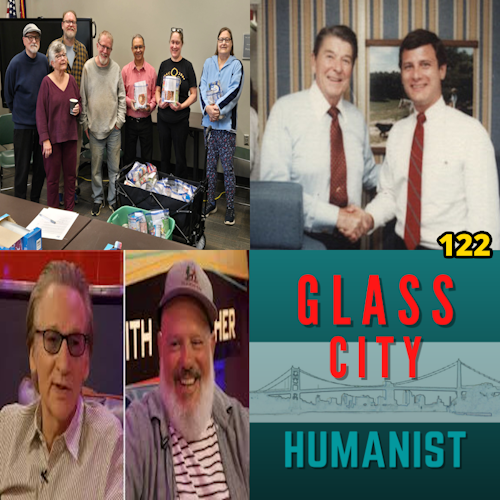
Episode 122: The Slow Death of the Voting Rights Act Is Complete
We give an after-action report on our American Empathy Project sponsored by a grant from the American Humanist Association. Douglas took the lead on this project and he recounts his project anxiety and lack of logistical awareness. He didn’t realize what moving 400 plus cans of food really meant. We had to dial back our goal of 100 kits on the day of the event and completed 50 kits in less than an hour.
Another freethinking celebrity, Bill Maher, took his podcast guest, comedian David Cross, to task for Cross’ young daughter having Trans friends. Maher repeated many transphobic myths like he was a member of Turning Point USA. We listen to a segment from Sam Seder of Majority Report about the interview and we agree how Maher’s skepticism reflects a disregard for the lived realities of many. It is crucial to highlight that listening to and validating children’s identities is not an agenda; instead, it is an essential aspect of affirming their dignity and well-being.
Finally we try to unpack the US Supreme Court case Louisiana v. Calais that finally gutted the last bit of Section 2 of the Voting Rights Act. Many southern states with history of racial voter suppression are trying to quickly redraw their voting maps to eliminate as many Democrat held seats as possible before the midterm election in November. We connect the historical context of voting rights with contemporary struggles against systemic racism, illustrating how far we still need to go in achieving electoral equity.
01:00 Our American Empathy Project After-Action Report
12:31 Children Trigger Bill Maher
27:09 Waving Voting Rights Good Bye





Extras:
Only 50 Kits, But Still An Endless Impact
David Cross is FED UP With Bill Maher’s BS (video)
We Aren’t Paying Enough Attention to What the SCOTUS VRA Decision Means for State Legislatures
Supreme court’s Voting Rights Act ruling cited misleading data from DOJ
Transcript:
Click Here to Read Full Transcript
[0:03] This is Glass City Humanist, a show about humanism, humanist values, by a humanist. Here is your host, Douglas Berger. So how did our American Empathy Project turn out? Find out the highs and the lows of our effort. Another free-thinking celebrity lets his brain fall right out on the floor when he repeats transphobic myths. And finally, we look at the recent US Supreme Court case that finally gutted the Voting Rights Act, a 40-year project by Chief Justice John Roberts, who falsely believes racism is over. Glass City Humanist is an outreach project of the Secular Humanists of Western Lake Erie, building community through compassion and reason for a better tomorrow.
[1:00] As I’ve talked about before, we had a recent service project day that came up on May the 2nd, Saturday, May the 2nd. It was called the American Empathy Project, and it was sponsored by the American Humanist Association and coordinated with some different other free thought groups like American Atheists. And basically what the AHA did was that they offered grant money to groups to do service projects on May 2nd. And I was pleased that our group was able to obtain a grant.
[1:34] And what our project was, as I’ve mentioned before, is we were going to do meal kits. We were going to put together cheap, economical meals that were shelf-stable, that you wouldn’t need anything like milk or butter to make it if you didn’t have it. Basically a lot of the items that we included the ingredients you just have to add water in some cases like for biscuit mix that sort of thing and so we did that and I just kind of want to give my after action report on that project I was very anxious coming into Saturday that on on May the 2nd, when the event was to take place. And the reason why my anxiety kind of shot up was when I initially conceived this project, we were going to do 100 meal kits.
[2:38] Now, what I didn’t consider totally, I looked, overlooked, which I don’t understand why I did, but I think I had rose-colored glasses on, was many of these recipes that we were using had probably three or four ingredients. So you’re looking at at least four cans in a bag. And this was like black beans, chili with no beans, soup, cans of chicken, chopped chicken, that sort of thing. So there’s at least four cans in every bag. Now, what is 100 times four? It’s 400 cans, at least 400 cans. And I did not realize, I did not realize, acknowledged the reality of the logistics of moving 400 cans.
[3:50] We purchased them at local stores. It was all piled into the trunk of my car. And we drove to, we had the meal kit building session at a local library in one of their community rooms. So then we had to lug all those cans from my car trunk into the building. It was not a fun time. That was not a fun part of the experience, trust me. And I should have done a better job of realizing that and trying to arrange more help for that, which I did not do. So that was why I was really anxious about this project because I was thinking that there wasn’t going to be very many people. We had the room for two hours. I didn’t think there was a possibility that we might not get done.
[4:49] I will say that we did not do 100 meal kits because I could not transport 400 cans to this library site and get them in the building. Um, my limit, my physical limitation was, you know, 200 cans for half of it. So we did half Saturday. We did 50 meal kits, which I was happy about. Um, and we will donate them soon to a non-sectarian food, food pantry. Uh, we’ve identified who we want to, uh, donate it to. And it’s just coordinating and getting to know, you know, let them know that it’s coming and if they even want it.
[5:36] And so if that doesn’t work out, then we’ll make sure, you know, we’ll make sure that this gets donated properly. So we did that and it was a good time. People showed up on time, which I was surprised too, again. Most of the people showed up on time. And what really amazed me, though, was that, you know, we had the room for two hours. Were doing 50 meals and we had probably 10, 20 people help out. We knocked out those 50 meals in 30 minutes. It was done. We were finished in about 35 minutes from the time that I started by explaining how we were doing it to when the last bag was complete and.
[6:30] And so then we spent the next 15, 20 minutes lugging all of those completed kits back out to my car trunk. As I’m recording this, yesterday was a Sunday. I finally got the rest of the kits into my house.
[6:46] And then what we’re going to do, what I’m presently doing is going through them all, making sure they’re all correct. I had planned to do that Saturday, but we finished so quickly that there just wasn’t time to do that. I mean, people were bringing in completed kits to me right and left, right and left. So there wasn’t any downtime. So my mom and I are going to go through these. She already went through one tote full of kits. And I’m going to go through some kits and we’ll just check the recipes, make sure everything is there. There’s already some things that I also didn’t realize was when we got substitutions that some of the items were missing and I didn’t do good enough explaining the substitution. So some people put different cans and different bags that shouldn’t have gone there, but that’s okay. I had encountered that or kind of planned for that, that I was going to check all the bags. So we are doing that. It wasn’t too bad. There wasn’t too many. And also, we had the bags that we were using were too small because you’d have four or five full-size cans, 15, 16-ounce cans.
[8:08] And they take up a lot of space, obviously. And we were using one gallon Ziploc bags. And for many of these recipes, that bag was just too small. And we had a limited supply of two and a half gallon bags, but we didn’t bring them Saturday.
[8:27] For whatever reason. They just didn’t get included. So I ended up having to go get some additional two and a half gallon bags, and then we’ll make sure that that works out. So I was very happy. I want to thank the American Humanist Association for funding that project. It was a good project. Would I do it the next time? Probably not. Not meal kits. Maybe toiletry kits, you know, that’s, you know, that just, just the logistics of moving, uh, boxes of, uh, uh, tampons or, or, uh, toothbrushes and things like that is to me far less daunting than moving 400 cans of food. And so, you know, unless, you know, some people come forward later on and say that they won’t really want to help out and we can spread the work out a little bit more than what it was.
[9:27] But like I said, I want to thank the American Humist Association. I really like this American Empathy Project campaign. It’s something that’s been missing from this country for quite a number of years. And I’m not talking about political divisiveness and people not talking to each other. What I’m talking about is certain people.
[9:53] Who for some reason forget about using empathy and compassion when dealing with other people who are not like them. That’s something that’s learned. That’s not natural. It’s not natural to be compassionate and have empathy for people. And I think that we’re missing out on helping people and making a better country, you know, because we all live in the same area. We, you know, we all benefit if we all are doing well and are taken care of. It doesn’t take anything away from me for somebody who has less than I do to get some help, you know, and it doesn’t take anything from them if I, you know, do my thing. It shouldn’t anyway. And I think too much in this country we’ve been going to the extremes where if you are struggling, people tend to blame you for your struggles rather than looking at the system, the world, and wondering what we can do to solve that. And that’s what I like. That’s the main point of humanism, is humans solving human problems. So if we have a lot of wealth inequality, food deserts, hunger.
[11:21] Things like that, we all have to come together as a human society and solve those problems. They can be solved if we have the empathy and the compassion to do it.
[11:36] And that’s why I really like this project we did, the American Empathy Project. If you want more details about, we have some pictures up and a little bit of text on our website, humanuswle.org. You can check it out. And I really appreciate everybody that helped out. And it was a good project. I really enjoyed it. For more information about the topics in this episode, including links used, please visit the episode page at glasscityhumanist.show.
[12:31] Bill Maher is a comedian and political commentator who has a pretty sizable following in the Freethought community because he is a supporter of the separation of church and state. I think he’s an atheist. I think he does say he’s an atheist. He’s a libertarian. He’s all about personal freedoms, having the government stay out of your business. And so he, he gets a lot of fans from people like me who like that. Uh, he did a documentary some years ago called religious, religious or something. I, I can never figure out how to pronounce it. You can look it up. And basically he went around the country and interviewed a Christian nationalists to find out how they, how they thought. And.
[13:29] The only problem I’ve ever had with him is he tends to be smug and arrogant and make fun of people for no apparent reason. And I know some people would agree that we don’t need to do that all the time. And some of the people complain that we’re bashing religious people. And I can see their point on some of the stuff that Bill Maher’s done with regards to religion.
[14:03] Well, he has, obviously he has his political talk show on HBO that he does where he has a panel discussion and then he does like a segment called New Rules and I haven’t really cared for his political talk for some time. I used to watch him. He had a political talk show similar to what he’s doing now on ABC, on the ABC network in the 90s. And he used to bring on people like Ann Coulter and some other conservatives that I really don’t care to hear. With this notion that getting all sides of a story and having both sides talk and make their case. And I just was, it just depended on the topic, but usually I just didn’t want to hear from the conservative side. Then 9-11 happened, and he made some comments which were valid comments about Muslim suicide bombers, and his show was canceled.
[15:17] And so he was like the first Jimmy Kimmel, the first of the Jimmy Kimmels, where the government forces a television network to get rid of somebody that they didn’t like, and that’s kind of what happened. So…
[15:34] So he’s doing this political commentary, and then he has, for lack of a better word, it’s a podcast. It’s on video, but it’s not broadcast on HBO or anything. And it’s called Club Random, and basically he has on single guests, and they chat, and usually they’re smoking weed sometimes or drinking alcohol or whatever and talking about issues and just having a chit-chat. So the other day, I caught some clips of an interview that he did with comedian David Cross. He’s one of the creators of Mr. Show. He was on Arrested Development, and he’s done some other comedy bits. I think he’s a funny person.
[16:25] His political views, he’s progressive, liberal, political viewpoint. And again, Bill Maher is a libertarian, but he could be a libertarian curmudgeon, put it that way. He’s all about personal freedom, but he has some very opinionated views. So he’s interviewing David Cross and they’re talking about it. David Cross is a father. He has several children and they’re discussing his kids. And I’m not sure exactly because I didn’t watch the whole the whole interview. So I don’t know how this this happened, but they started talking about trans kids. And David Cross made the comment that one of his children has black friends and trans friends. And that triggered, seemed to trigger Bill Maher. And he’s like, trans friends? And they get in this whole big discussion about whether or not an eight or nine-year-old knows that they’re trans. And Bill Maher seems to have the idea that parents are doing this to their kids. Making them trans now that’s just a common anti-trans argument.
[17:50] From evangelicals, from Christian nationalists, that’s the religious people. But you don’t have to be religious to be anti-trans. There are some people in the free thought community, Richard Dawkins, one of them, that are also anti-trans. So that’s like a common everyday occurrence. So what I want to do is I have this segment from this podcast called The Majority report with Sam Sater. He used to do Air America for those that are progressive that know about that from, I think that was in the 90s.
[18:29] And he has this podcast. I tend to watch it occasionally, depending on who the guests are and what the topics are. And they were talking about this interview, and they played clips. So this clip of the Majority Report will have clips of the Bill Maher-David Cross interview, so you can hear what Bill Maher is saying.
[18:51] And I wish I could play the whole segment, but that would be unfair to Majority Report. So hopefully I’ve whittled it down to the gist of it so you can get a sense of it. And then I’ll have a link in the show notes for the full segment because they put the full segment up on YouTube. They’re full. Majority reports full segment on this issue. And I agree with Emma and Sam’s take on this completely, 100%. And Bill Maher is wrong, completely wrong. And it’s one of the reasons why I just don’t like Bill Maher and I don’t support him, even though he’s one of my like-minded people. I just think that, you know, I’m of the idea that we are all, we all deserve basic dignity and worth. And if you can’t do that, then you are wrong. If you cannot use proper pronouns, if you’re just so incensed with calling somebody what they want to be called, you’re a bigot. It’s just clear, simple as that. You’re not protecting children. You’re a bigot.
[20:12] And so this is a prime example of what I’m talking about. And I just wanted to play this segment. It’s quite long, probably about five or 10 minutes.
[20:23] This segment is quite long and, and please stay for it. And I, cause I think it’s very important to hear it. Here’s Bill Maher, uh, uh, talking to David Cross. Is this the one about the trans? Uh, but okay. Yeah, here he is. Bill Maher is so worried about little children that he doesn’t have. You need to be checked. People need to be checked. I think they’ll be… Including your little girl. Okay. She needs to be checked. I don’t know what… Fuck that bitch. Fuck that little bitch with her black friends and trans friends and not even understanding. She doesn’t know. Wait, she has trans friends in third grade? Yeah.
[21:01] Yep. Okay. They know they’re trans in third grade. I knew one of her friends I knew when he was a, girl how old uh i i think just turned nine and uh and is just the coolest kid uh i don’t you know i think boy to girl girl to boy uh girl to boy um girl to boy okay and she has another very close friend, who’s not in the school, but who’s boy to girl, at three, at three years old. A girl to boy, you know, I mean, I knew somebody who said to me, actually more than one person who said to me, a woman, said, you know, I was what they called a tomboy. If I was alive now and acted the way I did then, that’s what they would have done to me.
[22:00] Well, nobody’s doing this to her. Okay. Well, I don’t know. Can I just pause to say as somebody who, yeah, I cut off all my hair for like two years and wanted a stud in one ear, only wore a LeBron James, no, it wasn’t LeBron James, it was Shaquille O’Neal Lakers jersey, and was a real tomboy for quite a while.
[22:20] I did not get a lot of pressure to change my gender, and I didn’t end up doing that. It was a phase because I was allowed by my loving mother to show, like, to experience that kind of thing and experience my gender performance. Oh, your mother did that to you, allowed you to cut your hair and wear a boy’s shirt. Yes. Yes. That last I checked, LeBron James is… It was Shaquille O’Neal at the time. Shaquille O’Neal is a boy. Yeah. And a man. And you were allowed to, and your mother did that to you. Yeah. Yeah. To quote Veep, not doing anything is doing something. You know, they’re doing that to you. That made me think of it a whole different way. But it’s just how he opens this act talking about kids. He has no idea what he’s talking about whatsoever, but speaks with the utmost authority. To a father. He has zero, zero understanding. The idea of kids going through a phase or ultimately not it being a phase and allowing them to express themselves, he perceives this as some parent is pushing an agenda on the kid. His perspective on parenting is so twisted, and it’s even more twisted based upon the fact that he does not have a kid. It’s crazy. It is. You got to check these kids. Yeah. Go ahead. Yeah.
[23:45] To the way I did then, that’s what they would have done to me. Well nobody’s doing this to her she well i don’t know literally nobody is doing this to her uh she is or he is uh either eight or i think nine okay then somebody is doing something because eight or nine year olds you know you’re doing can’t do anything they’re responding to the child, and the child says i want boys clothes i want to be addressed as a boy and the parents are going out in buying boys’ clothes like they would if she was a tomboy. And the only difference is, is referring to this kid in the way that the kid wants to be referred to.
[24:37] And that’s what they’re doing. Yeah, social transition. And there are numbers on trans-affirming care for kids that just show how infinitesimal this kind of thing is. Lancet had numbers on when they looked at younger kids when they were socially transitioning and beginning that kind of care. That 98% continued care as teens, according to Lancet. And then there was also a pediatric study about the very notion of detransitioning, where they looked at kids who had socially transitioned and after a five year period, what they how they ended up. Ninety four percent continue to identify as their socially transitioned gender. The remaining six percent, you can have that.
[25:21] Half of them stopped care and identified as non-binary. So that’s three percent. And the other less than three percent, they decided, yes, I’m going to remain as my birth gender. But that was heavily weighted when analyzing this in pediatrics with kids who were under six years old before they had undergone any bodily changes.
[25:41] Any of these hormonal changes, the detransitioning part where kids are exploring their gender identity. Yes, that tends to happen when they’re much younger before any of the medical interventions that he’s talking about have even occurred, let alone even if they’re in the time when kids are experiencing puberty. A lot of this stuff is just hormone blockers and and and other and hormone treatments or I should say puberty blockers and hormone treatments that like aren’t the drastic medical intervention that he’s talking about and are used on cis children very frequently, which Bill Maher doesn’t say shit about. But this is also it also reveals the fact that this has nothing to do with protecting kids or any of that stuff, because there is no physical intervention that’s happening at this point. It’s just simply going to buy you the clothes you want and I’m going to respond to you in the way that you want me to. Yeah, she her.
[27:09] At the end of April, on April the 29th, Wednesday, April the 29th, the United States Supreme Court ruled 6-3 in a case called Louisiana v. Calais that struck down a Louisiana congressional map that a group of voters who described themselves as non-African American had challenged as a product of unconstitutional racial gerrymandering. They left in place a ruling by a federal court that barred the state from using the map, which had created a second-majority black district in future elections. Although Wednesday’s ruling did not strike down a key provision of the Federal Voting Rights Act as Louisiana and the challengers had asked the court to do, Justice Elena Kagan suggested in her dissent, which was joined by Sotomayor and Kenji Brown-Jackson, that the majority opinion by Justice Samuel Alito had rendered the provision all but a dead letter. And that was from the SCOTUS blog, which is a very knowledgeable.
[28:15] Accurate, non-biased news site that talks about Supreme Court rulings. And then the SCOTUS blog entry also said the decision was the latest and presumably final chapter in a long-running dispute arising from Louisiana’s efforts to adopt a new congressional map in the wake of the 2020 census. The first map that the state adopted in 2022 had one majority black district out of the six allotted to the state. A group of black voters who comprise roughly one-third of the state’s population went to federal court where they alleged that the map violated Section 2 of the VRA, which prohibits discrimination in voting. And it says the map that Louisiana drew in 2024 created a second majority Black district, leading to the election in November of that year of Cleo Fields, a former member of Congress who had represented another majority Black district during the 1990s. What this was is the U.S. Supreme Court majority decision basically says that you cannot gerrymander your congressional districts based on race at all for any reason.
[29:28] And most people would be saying, well, yeah, you shouldn’t be allowed to do that. Well, let me explain something. And as the SCOTUS blog points out, black voters comprise roughly one third of the state’s population in Louisiana.
[29:48] And yet they only had one black majority congressional district out of six. That means that the other five at the time were white majority voters.
[30:03] And so the map that was created in 2024 gave them a second black majority congressional district. So it would have been four to two, which is technically at least one third. Right. I don’t know. My math is terrible. But having a second majority, black majority district seems a bit more fair than only having one.
[30:40] You know, and I get that. I get that you shouldn’t gerrymander based on race. I get that.
[30:47] However, if you’re going to gerrymander at all, it should be at least fair, right? And it’s not. So basically what the Supreme Court is now going to allow in many southern states since this ruling have rushed to do is you can gerrymander based on politics. They don’t have a problem with political gerrymandering. So if the Republicans want to create multiple Republican districts, they can now. And same with the Democrats in Democrat majority states. They can get rid of current Republican districts that they can gerrymander them out. Now, personally, and as a part of my principles, I oppose gerrymandering anyway, for any reason. You know, gerrymandering is when you manipulate the data and manipulate the lines of the congressional districts for the advantage of other people, for other groups, for whatever group is doing the map drawing. You know, there is a more fair and neutral way of drawing congressional maps than what they can currently do now.
[32:14] But I will say, if you’re going to gerrymander based on race, which is what Louisiana is doing, whether they specifically say that or not, then the number of congressional districts should match the population based on race. So if you have six districts and you have a black population of one third, you should get at least two congressional districts that are black majority. At least.
[32:48] It would be better to have three, but that would be 50 percent. But this Supreme Court case, and it’s a culmination of 20 to 30 years of conservative attacks on the Voting Rights Act that led by Chief Justice John Roberts. Because when he worked for the Department of Justice, I think it was during either Nixon or Reagan, that was his jam, was doing everything he could to dismantle the Voting Rights Act.
[33:24] Here’s a better way of explaining what’s going on, okay? Kind of give you an analogy. Uh, one of the jobs I had years ago was I worked in customer service for a pharmacy benefit manager that acted, it was based, basically an HMO, if people are familiar with HMOs. And so you control costs, quote unquote, control costs by having burdensome rules and regulations so you can deny claims to people so that you don’t spend any money. I, yeah, I’m I had a ethical problem with working and working that job at times because of that. And so I would get phone calls and it was a pharmacy manager, benefit manager. So basically the phone calls I would get from people would be when they would go to pick up medications and it wouldn’t be covered for whatever reason.
[34:30] Um, most of the time it wasn’t covered because it was, um, needed pre-approval, uh, pre-authorization and they didn’t get it. The other reason would be we had this thing where they kept tabs on how often you had your medication refilled and you had a certain, um, it was a buffer. So you could get your medication refilled seven days early, but then that would change your refill date minus seven days. Well, people that are getting their medication refilled early are getting it refilled early because they either lost the medication or they’re taking too much or something. And so they’re running out. So instead of going back to their doctor to have the prescription redone so that they have the proper amount, then they just keep getting it earlier and earlier. And pretty soon you wipe out that buffer.
[35:31] And so you go the next time, seven days, which is now probably 21, 24, 28 days early, and the insurance won’t pay for the medication. All right. So basically what I was told to tell people and do this as nicely as possible is I would explain to them, Mr. Smith, we are not keeping you from getting that medication. You can still obtain that medication. We are just not going to pay for it.
[36:09] Now, technically, that is the case. And if they don’t get their medication, that’s on them, technically. But ethically, that is kind of how this Louisiana Supreme Court case, you know, we are going to discriminate you against you in gerrymandering your congressional districts because you’re a Democrat or because you’re a Republican, not because you’re white or because you’re black. So because we’re doing it because you’re a Democrat, then that’s legal, even though most Democrats in Southern states are black people. So in the end, the end, the outcome is that you have discriminated against black people. You’ve just dressed it up, or how they used to say, put a lipstick on a pig.
[37:07] And that worked the same way with my customer service job with the pharmacy benefit manager is those people were using their insurance to get their medication because they couldn’t afford their medication any other way. And so if the insurance wasn’t going to pay for it, they weren’t going to get it. And we were keeping them from getting it, even though technically that wasn’t the case. So that is the gist. And so somebody will say, well, it is unfair to gerrymander away from white people, you know, to create these all black or black majority congressional districts. And all I can say to that is that the civil rights laws and the Voting Rights Act were created in the 1960s to address systemic racism. Hundreds of years of racism.
[38:08] Where people were enslaved. Then we had a civil war. And then they were freed. And then they were freed. Then Jim Crow came in and discriminated against them again. Even though they were free, they weren’t slaves. They still were second-class citizens. They got less resources. Their schools were crappy. They didn’t have generational wealth because they couldn’t own property, because they didn’t have any money. That got passed down from people within the family. And it was all by design. This just wasn’t happenstance. It wasn’t the fact that they were inferior people. That’s what some white supremacists would say. No, it was a systemic system set up to discriminate against black people. The GI Bill didn’t apply to black veterans in some cases. Mortgage agency that gave mortgages to guys returning home from the war, they didn’t give those loans to black people. Black people couldn’t buy a house that was eligible for those loans.
[39:26] And, and that was in like parts of the new deal didn’t apply to black people. So there, and a lot of times they did that to get Southern legislators to sign off on some of these things, like the new deal stuff. And, uh, uh, during the depression, well, yeah, we want to help out people, but we’re not helping black people because they’re lesser than we are. They don’t deserve it. And you see that with the SNAP benefits. They think that a majority of black people use SNAP benefits, so they punish poor people for using it. It’s your poor choices. So it’s all about control. This case, this Louisiana case, was all about control. It’s not about and so the court was the court has said in the past that racism is over the racism that that brought forward these these laws are over so they’re not needed anymore and just because we elected a black president racism didn’t go away you know the election of donald trump is proof of that.
[40:40] The things that he’s been doing is proof of that. You know, how could you go from electing the first black president of the United States, to then electing the most white supremacist racist president the United States has ever seen since before the Civil War? You know, at least Woodrow Wilson was subtle in his racism when he segregated federal agencies.
[41:07] You know, look that up. Google that. But here we have an administration led by Donald Trump who was sued for racial discrimination in his housing business, his rental business. We see a repeat of this stuff. And it’s just so telling that all these southern states are clamoring now to go back and redraw their maps for the upcoming election so that they can get rid of the black majority congressional districts that exist currently in their red states. So I hope that the Democrats do the same thing on their end. But what we really need, though, is we need to end this gerrymandering stuff completely. And I think there ought to be a law, a national law against it. And that if they do it, if they do, if they draw congressional districts, it has to be fair. It has to be independent of the politicians. And it has to address the population centers and not the politics.
[42:27] For more information about the topics in this episode, including links used, please visit the episode page at glasscityhumanist.com. Glass City Humanist is hosted, written, and produced by Douglas Berger, and he’s solely responsible for the content.
Transcript is machine generated, lightly edited, and approximate to what was recorded. If you would like perfect transcripts, please donate to the show.
Credits
Written, produced, and edited by Douglas Berger and he is entirely responsible for the content. Incidental voice overs by Sasha C.
The GCH theme is “Glass City Jam” composed using Ampify Studio
This episode by Glass City Humanist is licensed under CC BY-NC-ND 4.0.

