
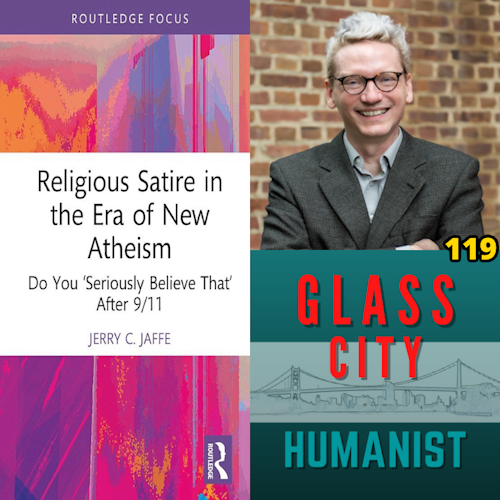
Episode 119: God, Laughs, and Hypocrites: How Stand-Up Comedy Became America’s New Pulpit with Dr. Jerry Jaffe
Our guest is Dr. Jerry Jaffe, a Toledo native and professional stand up comic who has written a book titled “Religious Satire in the Era of New Atheism” He will introduce you to some of the ideas and examples from his research. Focused on the context of the post-9/11 American culture phenomenon, sometimes referred to as the New Atheism – as embodied by public intellectuals such as Christopher Hitchens, Sam Harris, and Richard Dawkins – Dr, Jaffe documents the rise of comedic satire in relation to evangelical beliefs and religious dogma. Drawing on the author’s own experience of stand-up performance, he examines the comedy of figures such as Mark Maron, Bill Maher, and Ricky Gervais and presents material from interviews with comedians including Lewis Black, John Fugelsang, and Leigh Ann Lord.
We also discuss the tarnishing of New Atheism because several members turned out to be problematic individuals with some holding transphobic views and others being accused of islamophobia.
Dr. Jaffe discusses islamophobia in comedy and how it is better to ‘punch up’ rather than ‘punch down’. He also argues that many comics in the US don’t satire Islam because comedy works when it is relatable to the audience. He also explains it is better to make fun of the powers that be in a religion rather than the adherents.
01:00 Origin of a comedian
14:00 Personal favorite part of the book
19:38 The fall of New Atheism
31:16 Why don’t we make fun of Islam?
41:28 Future writing plans





Our Guest

Dr. Jerry Jaffe has over 30 years of experience teaching college classes, specializing in acting and comedy. He has directed or performed in over 100 shows. Before moving to the Cleveland area, Jerry lived and worked in Japan and New Zealand, teaching, acting, and directing there.
Many of his articles on the theatre have been published in various academic journals, including “‘I needed to go to this tabernacle of ignorance’: Marc Maron’s critique of the Creation Museum” (Bulletin for the Study of Religion, Vol 42, No 3 (2013)); and he co-edited the 2008 book, Performing Japan: Contemporary Expressions of Cultural Identity.
In 2025, his newest book came out, Religious Satire in the Era of New Atheism (2024).
He also performs stand-up comedy, in the area and around the country.
Extras:
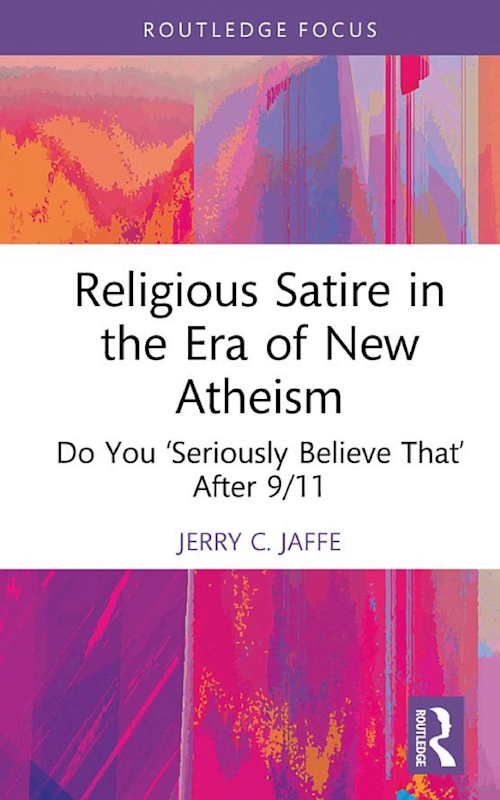
Religious Satire in the Era of New Atheism (also available through online retailers and by order through your local bookstore)
Transcript:
Read full transcript here
[0:04] This is Glass City Humanist, a show about humanism, humanist values, by a humanist. Here is your host, Douglas Berger. Our guest is Dr. Jerry Joffe, a Toledo native and professional stand-up comic who has written a book titled Religious Satire in the Era of New Atheism, which presents a contemporary account of religious satire since the 9-11 attacks, as evidenced by the modern art of stand-up comedy, and how it coincided with the rise of the new atheists. Glass City Humanist is an outreach project of the secular humanists of Western Lake Erie, building community through compassion and reason for a better tomorrow.
[1:00] My guest today is Dr. Jerry Jaffe. He has over 30 years of experience teaching college classes, specializing in acting and comedy. He has directed or performed in over 100 shows. Before moving to the Cleveland area, Jerry lived and worked in Japan and New Zealand, teaching, acting, and directing there. Many of the articles on the theater have been published in various academic journals. His current book that we’re going to be talking about today is Religious Satire in the Era of New Atheism And it presents a contemporary account of religious satire as evidenced by the modern art of stand-up comedy So Dr. Jaffe, or if you don’t mind if I call you Jerry, thank you for being with us My students call me Jerry and that’s fine And we don’t have to get bogged down in minute details But some people say Jaffe and some people say Jaffe and I’m in the Jaffe camp Jaffe. Okay. That’s not a problem. Rhymes with coffee and it’s twice as delicious. That reminds me of that old comedy bit. You don’t have to call me Cyrus.
[2:06] Anyway, I know I’m old. Well, we both are. So like we said that your book is Religious Satire in the Era of New Atheism. What drew you to write a book about this topic? In the world of academic research, sometimes books take years to percolate because you’re doing research on different topics. So I say that so that I can skip over the minute details. There’s a couple of big things. And I would say the first big thing is that in the middle aughts, years after September 11th, there was a number of successful authors in the field of what came to be called new atheism, Dawkins and Hitchens and others. And I’ve read all of the top books in this field over those years. And, um, they really resonated with me.
[3:03] Meantime, I’m, of course, a huge comedy fan, so I’m watching a lot of stand-up and also movies and whatnot, and I slowly started to congeal in my brain that comedians who were overtly attacking religion, or not even attacking religion, just doing religious satire, Bill Maher and Ricky Gervais and others we could mention, topics and strategies and interests really aligned and overlapped with what the new atheist authors were writing about. Like at the Venn diagram would be like way overlapping. And I think that was the light bulb moment. Oh, here’s something I could study and write about. The similarities, differences, overlaps between religious satire after September 11th and what the so-called new atheists were writing about. Of course, they themselves never like identified as new atheists. That was like a pop culture umbrella term that some journalists developed, but now they are known as the new atheists.
[4:08] And as we mentioned in your, your bio, you do acting and you teach acting and, and standup comedy and you, you do standup comedy. Yeah. Um, how long have you been doing that and what, did you stumble into it or was it, or did you find out that it was like a calling that you had? Yep.
[4:27] So it will make more sense to answer the question about acting first. I saw a puppet show in second grade that came to my school and the lights dimmed and we watched, um, puppets do Jack and the Beanstalk. And that was probably one of the like five biggest moments of my life because I was so entranced by like the magic of, I mean, now the magic of theater, but I didn’t know that when I was seven years old, it was just magic was happening. And from then on I did plays in school and in high school and then I went to University of Toledo in the 80s and um.
[5:04] You know, this is what I say about my major, because I also, as a college teacher, advise students and young adults are worried about their major or how to pick a major. My freshman year in college, I changed my major five different times, including going like undecided. So I’d pick a major, undecided, pick a major, go back to undecided. But all my freshman year, I was taking theater classes for fun. And so when I got my transcript at the end of my freshman year, I realized that if I became a theater major, I would be on time to graduate. So it really is a case of like theater found me. Like I was doing it for fun before I realized, oh, this could be a career or a vocation. So it was kind of a calling because I was just doing it naturally, being in plays and taking acting classes. So…
[5:56] At that time, the mid-80s, you mentioned being old. I don’t know how well you remember the mid-80s. Mid-80s was the first comedy boom, what they call a comedy boom. There’s an explosion of comedy clubs all over the country. And I think cable networks were evolving at that time. And comedy was actually cheap programming. So it was easy to have. In fact, there’s Comedy Central and Comedy Channel and other, like HBO, would show comedy. Yeah, the Ha Network. Yeah, I remember all that. So there was a ton of comedy on TV. And I think being able to watch a lot of comedy, including comedians who weren’t famous necessarily. I remember seeing Stephen Wright, his first appearance on The Tonight Show, which is famous in comedy history. I was just a kid watching, because I loved to watch comedy. I didn’t know who Stephen Wright was. So anyways, you could see people like that if you watched all these shows.
[6:53] And I started doing comedy. Well, I was in graduate school, so I went to Brown, which is in Rhode Island. But Boston is a big comedy city, and they’re about an hour apart, maybe 90 minutes, depends how fast you drive. So I was doing comedy. Kind of coincidentally, I once did a show with Stephen Wright in Boston back in the late 80s, just because he was an unannounced guest at an open mic. So I was just doing five minutes as a doofus, and suddenly they go, and here’s Stephen Wright. So I like to say I performed with Stephen Wright. It is technically true, but I was doing, so that’s in the late eighties, I was doing comedy, which I did for a couple of years on a kind of like a level of a hobby. And I learned one important thing as I met the, say the older guys, the professionals who were always nice, welcoming, but, and had advice. And that’s when I discovered standup comedy is not a great career choice.
[7:49] There’s only a few, you know, Seinfelds and Chris Rocks. Most professional comedians are road comics who travel the country in their car for relatively low paying gigs. I mean, you get as much as you can. Some are paid better than others. But you could be like a professional on the road and do a weekend and make four or five hundred dollars.
[8:10] And and then you have to do that every week for it to be a career, like to be able to pay all your bills or whatever. So I actually like made the conscious decision. I think I’m going to go back to school. Actually, I’m going to travel. That’s when I started traveling. I finished my master’s degree. I moved to Japan and taught English. And I did some theater over there and eventually went back and did my PhD in theater at Bowling Green. And I didn’t do comedy again until I moved back to the U.S. And I’ll just say while I was in New Zealand teaching at the University of Otago, which is in Dunedin on the South Island, a beautiful place. I dream about it every day. They um i taught some comedy classes and some of my students at that time this would have been the mid-aughts like 2007 2008 started doing stand-up comedy i met some kiwi stand-up comedians too like professionals and then one of my students there got a sitcom for a year in new zealand like on new zealand television so seeing my students like explore comedy reignited in me the desire to do comedy. And in 2008, I moved back to the United States. I took this job in Cleveland that I had for 17 years until recently.
[9:22] And I had it in my mind when I moved back that I would start doing comedy again. So it was actually 2009 is when I restarted doing comedy. So usually if people ask me how long have you been doing comedy, I use like 2009 as my benchmark. I don’t go back to the 80s and talk about that unless people ask like you kindly have.
[9:43] And, um, I’ll tell you, I say this, sorry, I, as all my students know, I never stopped talking. So I apologize for the long answer, but I will say this. Um, one, I live in Painesville, Ohio, which is outside Cleveland. And it’s kind of outside Cleveland. Like if I go see a play in Cleveland, it’s almost an hour drive, depending on parking and crap like that.
[10:07] So there was no comedy clubs like within a five minute drive of where i am but in 2009 a comedy club opened near me and they had a paper did a big cover story and that they were going to have an open mic and that club is called bogeys and i’m going to say the comedian who started it is called kirk bogus and who knows what would have happened if he didn’t start that comedy club in 2009, but it changed my life because it made my dream of like, oh, I want to restart comedy possible. And so I had a place I could go that was near my house and I could get started in it. And then the other thing I’ll say is as an actor and a playwright, you know, you audition or you write plays and try to get them produced and it can take years. I’ve had plays staged, but sometimes it’s years after you write them. What I wanted to do was comedy. You could do creative writing. You can write a joke today and go on stage tonight. And, um, the gatekeepers are much fewer. Like you just sign up for an open mic and you can go up and maybe your joke bombs or maybe you stink, but you know what? You still like have some creative control and can just go do it. So I think that really appealed to me at that time, 2008, 2009.
[11:18] Yeah, I, I am a big fan of comedy, uh, have been for a long time. I was probably one of the few, uh, 10 year olds that stayed up Saturday nights to watch SNL. Nice. And, uh, so, you know, Johnny Carson’s show. I remember watching Drew Carey’s first, uh, time on the Tonight Show. Okay. Yeah. Yep. And stuff like that. And, you know, some of my heroes are like, uh, uh, Bill Hicks and, and, uh, Mitch Hedberg and quite a few of those. So, yeah, I’m, I, I guess I’m different than you are because I’m too scared to actually perform because I don’t think I could do it. I know I couldn’t do it, but, but I appreciate the art form and, and how, how people get up there and how jokes are composed and the timing and things like that. So there’s quite a few of them that today I follow on, on social media. Well, we do need people in the audience. So thank you for being an audience member. Um, not everybody has to be on stage. I have with students and with some private students, but mostly with college students.
[12:29] Um, coached many people to do their first performance on stage. And with my, in the, when I’ve done this with students, I have a whole semester to get ready. I teach them joke writing. Then I teach them improv. Then we practice being on stage. Then they practice their set and I give them notes and help polish it. So by the time, and then I’ve had classes where the final exam was doing standup in a bar.
[12:55] And, uh, it was always a great time. The students would bring all their friends and teammates and family members. And the audience was very supportive. But the students were well prepared. And when you’re an acting coach and one of your students do well, you know that they’re talented and they’re working hard. I’m just grateful to be a part of it. So when the students have done these stand-up shows through my classes and most of them thrive, I’m proud of them. Like, wow. Like, I’m just glad to have been nearby them while they had these great experiences.
[13:33] So whenever you’re ready, I can get you up there. That’s what I’m saying. Yeah, probably it’s something on my bucket list. We can make it happen. Maybe I might have to get like extremely drunk. I don’t know. It’s been known to happen. Yeah, it’s like one of those things where I have to get extremely drunk and all the lights have to be out. One of those things. Woody Allen used to turn his back to the audience if they weren’t laughing. Oh, if they weren’t laughing? Yes. So you could just tell your jokes to the wall. Don’t even look at the audience.
[14:03] All right. So once again, your book is Religious Satire in the Era of New Atheism. Do you have a favorite moment in the book that you like to refer back to when you’re talking about it to people? Thank you for asking that. Again, I feel like I’ve written a lot of book reviews, especially of academic books. And I say that because sometimes these types of books are almost like Frankenstein’s Monsters. Like the author has a topic and they’ve been researching it for years. But each chapter is like a thing they research. So… How well it all comes together, who knows? And I’m not saying I did it any better, but there is an element of that. Like each chapter’s a topic I found interesting, right? And then later I’m trying to make a narrative out of it.
[14:47] And as it’s a little bit of a ramble, but I will say with that in mind, there’s a couple of things that stand out to me. First of all, if someone were to say, give me two or three pages to read. I want to see if I like your book. Before I read the whole thing, give me a sample. I would refer to them to the section on parody religions. So I have a chapter in the book that is about how comedians, just in the course of telling jokes, will become characters for just a little second. They’re called act-outs. Like a quick example, Seinfeld has a joke he does about why do the pharmacists have to be so far above us? And then he acts like a customer. I have my prescription. Right? So these are called act outs. Well, sometimes comedians do that while they’re doing satire with religious figures. They’ll be like, what would God say if he was here? And then they act like they’re God. What would Jesus say if he walked in right now? So those are acting out religious figures like God, Jesus, or others. So I have a whole chapter on that basic theme.
[15:52] In that chapter, there’s a section on parody religions when comedians, stand-up comedians, and some sketch comedians I include as well, and others too, but essentially invent their own fake religion in order to commentate on the nature of religion. So, for example, John Oliver made his fake evangelical religion about seeds, because evangelicals have this theme of, like, you send me money and then God will repay you, and they call that seed or seed money. And so he did a whole thing where he, first of all, he found out that he could basically incorporate himself as a church. So he, according to reporting, he incorporated a church. And then he did this whole character where he was him, but him as like begging the audience to send him money. And it was the Our Lady of Perpetual Donation. I have the name written down, but Our Lady of Perpetual Exemption is what his church is, not even just a fake church. And so I go through many examples of that. The Church of the Flying Spaghetti Monster. I talk about that for a page.
[16:59] John Safran, an Australian comedian, did a whole series called John Safran versus God. And that was very entertaining. He travels the world and talks to religious people. And he’s a little more friendly about it than Bill Maher was in his film. Although I do like Bill Maher’s film. But John Safran’s more like, really? Like, hey, tell me about what’s going on here. And so on. But he would do sketches and monologues in between this travelogue. And he did this skit where he went to the center of Mormon religion and life in Utah and went door to door asking people if they wanted to hear about atheism.
[17:38] It’s the door-to-door atheism skit. And you can just go on YouTube and search the words I just said, door-to-door atheism skit. And it will be the first thing that comes up. I share it every Christmas on Facebook. So if you go to my Facebook feed and go to December 25th, you’ll find it there. But I go through a few examples of things like that. And on the one hand, it’s fun. I think people enjoy these topics. And I tried to make the book fun to read because I know it’s academic and that’s not what everybody wants to read. Because it can be too deep or too thick or too niche. When I pitched this book to an editor, I said, I want to write a book that everybody can read. Every comedy fan could read. Every person interested in religion or new atheism could read it without having to have an academic background or a PhD. I use a minimal, there is some, but I use a minimal amount of jargon. And I use a lot of examples. And that’s how I pitched it to the editor. So the idea is like, I just said about parody religion and I listed to you three or four examples, there’s probably 10 or 15 examples just in the section on parody religion, which I hope makes it fun to read. But it also is a good example of what the book’s about, like the religious satire. And most of these examples are happening right in the mid-aughts. And the things they’re talking about are the same things that the New Atheists are talking about. So it also exemplifies the theme of the book.
[19:00] That’s probably the one thing. If there’s one thing I would tell people about to get them interested in the book, that would be the part.
[19:17] For more information about the topics in this episode, including links used, please visit the episode page at glasscityhumanist.show.
[19:38] But one of the things that I wanted to ask about, and I ended up not asking about it because we had already had some tough questioning from the audience as well, is – where did I write it? Oh, here we go. You know, in your book title, you talk about new atheists, and that’s your framework that you use, like Sam Harris and Richard Dawkins and Christopher Hitchens. Yep. Are you bothered that some of those gentlemen have turned out to be not so great human beings many years later? And would you frame it that way today if you started the book today?
[20:20] Okay. So you have asked two questions. And the second question is easier to answer. Would I frame it that way? And the answer is, I’m going to say probably yes. But something I discovered, because I worked on this book for like 12 years, it sounds insane. The book is so thin, you know, took you 12 years to write this. But when I started working on this book, I published a section of it. So I use that as the kickoff date. There’s an essay in an academic journal. And I say, on that day is when I, this project started sort of happening for real. And that was 12 or 13 years ago. So what I noticed as I was doing my research and writing, I’d write a page, write a section, send it off to the editor, whatever. Is when I started this book, it was like current events. Like it was still, I mean, even new atheism was still a hot topic when I started writing this book.
[21:12] Hitchens was still alive, I think, when I started writing this book. And as each year went by, my book became more and more historical because it was about a period in history, you know, like the mid aughts. And so the book became almost about capturing a zeitgeist, like what was the culture like, a flashpoint. And so I think.
[21:32] It would be the same framing and the same basic book if I wrote it now. It just has become a history study instead of like a contemporary study. So I think, and I think the framework is valid. Like it’s still the case that the Venn diagram of new atheists and religious satire in the mid-aughts has a big overlap. Yeah. And again, you place it in that time period after 9-11. Yes. When people thought that that was like off the table and then here come these guys talking about atheism in these books. And so, yeah, I mean, I agree with that. It’s just that, you know, just the way that some of them turned out. The first half of your question. Yes. In fact, okay. So one of the like lesser tier new atheists is P.Z. Myers. He wrote the book, The Happy Atheist. And he kindly appeared on my podcast, The Comical Heasen. And we talked about creationism and humor and his career. So if anyone’s interested, go look that up. It’s free on all your podcast platforms. But I will say, and I don’t want to speak for someone else. So if he hears this and wants to amend it or put an asterisk, I total respect. But he said that he, because he used to hang out with those people. He would go to movies with them and socialize.
[22:54] And he said that more recently he just had won’t let himself be called new atheist because he doesn’t want to be sort of branded because of the thing that you’re bringing up about that’s just a questionable questions that have been raised behaviors that might be, socially frowned upon in certain circles okay so i do totally get what you’re saying, and so there’s a kind of question inside your question of how do i feel associating myself with the brand new atheists um given that the brand you know is seen as tarnished, to put it kindly by the way you know a little tarnish you could rub off yeah well i’m just You know, I, I just want people to understand that again, you know, it took you 12 years to write this. So when you started it, it was great. Yeah. And just in the course of history. So, so, but I, now I’m going to try to answer your question. So again, if you want to edit out the previous seven minutes to get to the answer to your question. Okay.
[23:55] I think when you write a book, it’s super helpful to have a good editor. And my editor one day was looking at some drafts and sent me a list of questions. He said, here’s like, This is four or five, but he said, these are questions you probably need to address, at least to yourself, possibly in the book, but at least to yourself. And he didn’t bring up exactly what you asked, but you’re going to see why it’s connected in a second. He said, one of his questions was, are you going to address Islamophobia in this book? And someone brought up Islamophobia, I think, at the lecture as well. And…
[24:31] What a great question for an editor to ask, because it’s opened up so many adjacent questions and also specific comedians and new atheist writers and thinkers are all inside this question. And I decided that I couldn’t really address it in the book because it’s its whole own topic. There should be just another book written, Islamophobia and stand-up comedy and new atheist authors or new atheist thinkers. So I have like a page in the intro. where I bring it up. I give an example of a comedian, which is Jeff Dunham, who clearly does Islamophobic humor.
[25:09] But then I say, I know this is like a hot point culturally and an important one. I’m not dismissing it. But I don’t think I can cover it. And one of the reasons I don’t think I can cover it is because baked into the controversy, I’m speaking specifically of Islamophobia in stand-up comedians and some new atheist thinkers, is a kind of he said, she said. Because someone will say to the Hitchens or to Harris, you’re Islamophobic, or to Bill Maher, you’re Islamophobic. But they’ll say back, we’re not Islamophobic. We’re just making the point X, Y, Z. And now if you’re like the journalistic objective, trying to be objective, it’s like you’re hearing two sides of the case with no foundation on which to evaluate, which is to say, to address it correctly, I would need to write a whole book in which I created the foundation and studied it deeply. And now I say all that to say similar, it’s a kind of parallel answer. You know, Dawkins has brought up comments that have been considered transphobic, for example.
[26:16] And I do not agree with his, transphobic adjacent or transphobic explicit comments. They’re not comments I would make or even agree with if someone said them to me. I just don’t know how to judge the situation. He tweeted things. Other people, which they have the right to do, disagree with those things. He had some of his honors stripped from some societies. And again, maybe that’s appropriate. I’m not even judging the societies for doing that. I’m actually saying it’s so complicated that to me to have an honest opinion about it, no, it’s worse than that. It’s deeper than that. I don’t like the word opinion. Anyone can have an opinion. To have an honest evaluation of the situation that has like depth and nuance to it, I’m not capable of doing. I’d have to write a whole third book that is just about, you know, the decline of new atheist thinkers in the, by 2020 or something. So I don’t deny that there’s controversy, nor do I wish to associate myself with the worst of it. In almost every case, I am on the opposite side.
[27:28] As both a teacher, a theater artist, and human being, I conduct myself as an ally as best I can. And part of that includes being willing to make a mistake. Not to make a mistake. Yeah, well, everyone makes mistakes. Being willing to admit mistakes. Oh, yeah, I phrased that wrong. I said that wrong. And to apologize for your mistakes. but I guess the short answer is I just don’t know enough. I know enough to know that it’s tarnished and I know where I feel on the issues.
[27:56] I’ll add another thing. This is part of the probably nuance, like pop culture doesn’t care about the nuance I’m about to make. The people in question and the comments they’ve made, none of them are new atheists because none of them ever called themselves that. It’s not a movement. It’s not like a group of artists got together in a cafe in Paris and created surrealism. Surrealism was an artistic movement created by artists who got together and made a club. And there’s a capital S Surrealism. These people were writing about what concerned them and the aughts, the way they wrote. And they had an audience and they sold a lot of books. Sold a lot of pancakes. I bought a lot of their pancakes.
[28:38] And then other people, journalists and others started calling them new atheists. So it is kind of like a weird nuance that like new atheism does and doesn’t exist. It’s like the duck rabbit. Yeah, they did. They did have some people, some fans that did adopt it and try to make something out of it. But yeah, but I probably am one of them. I mean, yeah but it was not a good thing it didn’t turn out to be a good thing and i have interviewed pz myers before oh nice and i follow his blog and yeah yeah he doesn’t want to have anything to do it but the reason why i was mentioning that in in the first place is because you know when i learned about your book and and you reached out to me about it and i saw the title that was what popped into my head. Right. And I’m like, I’m like, does he know about any of this stuff? And then talking to you and it’s reading parts of the book and everything, you know, it just so happens that, that the title that you picked just happened to be interpreted differently now than it did when you. Oh, I had a friend of mine when the book came out and didn’t really know much about my research. Maybe they, they know I was working on the book or I was an academic who did research or something and looked at the title and because the subtitle is do you seriously believe that after 9-11 which is from a joke by lewis black.
[30:06] So he did a comedy routine after September 11th in which I will say it’s open to interpretation. It was not Islamophobic in the way that Jeff Dunham, but he did make jokes about what’s going on with Islam or these terrorists. And he was saying, do you seriously believe that to the kind of like to the terrorists? But a friend of mine looked at the title and it said, New Atheism, I love it. Do you seriously believe that? And thought I was asking, do new atheists seriously believe like what they say, especially like years later?
[30:39] So I accidentally, the book’s title, like the nuance of it has changed as well because of what you’re talking about, I think.
[30:51] Segments of this podcast are available Tuesdays at 7 p.m. Eastern on W.A.K.T. 106.1 FM in Toledo and on ToledoRadio.org. If you have a Spotify account, you can view a video version of the podcast and share a comment or two.
[31:16] You know you mentioned about the islamophobia and um i kind of wanted to touch on that uh gentleman that was at that meeting was asking why comedians were not making fun of islam because they feared being murdered by the adherents that they don’t fear from christians, And I really liked how you handled that because that was kind of a touchy situation. But could you expand on why there aren’t large number of U.S. Comedians making fun of Islam or jokes about the prophet? Okay. So first of all, let’s say the proposition that that guest was suggesting that it was out of fear for life and limb. We can’t say that that’s a zero because we can’t go and survey every comedian or comedy writer in America but we, We do see comedians and comedy writers parody or tackle Islam. So I don’t think that the fear of reprisal that the gentleman was describing is as ubiquitous. I think it might be in there. Like if there’s a percentage, it might be a percent. So I’m not going to call it a zero percent. But I don’t think it’s a major. I don’t think it’s 51% of the reason is because people are afraid.
[32:44] Um i think again it’s in the mix i think other things that are in the mix which probably affect more people’s thinking than that is first of all people creative writers writers, tend to write about what they know so i was i’m jewish i’ve written jokes and told stories on stage about being jewish i’ve never written a joke or told a story on stage well i almost lied about being a Christian, right? That’s not my upbringing or worldview. Now, I actually do a one-person satire show on religion. And I will say like 90% of the heavy lifting is towards evangelical Christianity. And yes, I do not regularly worry about life and limb when I do these jokes. I won’t say I never worry about it. There are violent Christians, by the way. So to just say that, oh, you can just do Christian jokes without worrying about life and limb is actually not true either. On top of that, there is, besides the writing about what you know about, there’s also a factor which is, in comedy, we call it punching down.
[33:58] So this has to do basically with social status. And wherever you are on the ladder of society, if you do jokes making fun of people weaker than you are, I don’t mean lesser in any moral or ethical sense, but I mean like in the ladder of status.
[34:14] So undocumented workers are low in the status in America right now. So if a person goes up who is just an average American that they themselves haven’t lived that life, and they’re just making jokes, roasting and making fun of undocumented workers, and that happens, but that’s punching down. That’s someone making fun at a weaker part of society. And it’s a debate in comedy, should you do that? But I think most professional comedians try to avoid that. What you want to do is punch up. Make fun of the powerful. You make fun of the president. You make fun of your teacher. Make fun of the people who have power over you. So, generally speaking, because of Islamophobia and because of the way Muslim Americans and Arab Americans were treated in the aughts after September 11th, they became targets themselves. So, if average middle-class white American comedian goes up and starts making fun of just Muslims, that could be construed as punching down. I think that’s at least as much of a factor. You know, satirists want to make fun of the powerful, not the weak. If you’re making fun of the weak, you’re not a satirist. You know, in Nazi Germany, they had comedians who made fun of Jews.
[35:41] So that’s, first of all, that’s true. And second of all, that’s an example of why I think comedians should think carefully about punching down. Some comedians I know right here in Cleveland will say, hey, if it gets a laugh, that’s my job. And I’m like, there’s lots of ways to get laughs, you know, go on stage naked. We’ll laugh at you. I promise you, but you’re not going to do that. Right. So just because you get a laugh, that’s not an excuse for punching down in my opinion. Um, it doesn’t mean you can’t do jokes about topics, but now you’re on a fine line. So like when I, you know, do my satire show and I’ve seen other comedians do this, so I’ve learned it from the best. I’m not making fun of Christians and I’m not making fun of America. I’m saying, here’s a hypocrite who said something ridiculous, and I’m going to make fun of this idea and this hypocrite. And if the hypocrites I point out are leaders, like pastors, ministers, politicians, then it’s punching up. That was the one part of the Bill Maher film that I liked the least. He would go up to people on the street and kind of like ask them about their religion and then challenge them.
[36:49] And what do they know? I mean, they’re just normal dudes and dudettes living their lives. They don’t know theology. They don’t know the history of the Bible. So to me, those sections were punching down in the Religulous film. All the rest of the Religulous film, I found very entertaining. And when he interviewed leaders and kind of, you know, took shots at them, I thought that was hilarious. That’s satire. But there’s, you know, four or five clips where he’s talking to normal people and trying to make them feel uncomfortable. That’s what I mean by punching down. There are, in America, right now, Arab-American comedians and Muslim-American comedians and international comedians from other countries as well doing jokes about Islam. So it’s not like there are no jokes about Islam. But when that population does those kind of jokes, they’re talking about their worldview, their life experiences, and things like that.
[37:50] So it’s not like there’s no humor or criticism going on of Islamic ideas or terrorists. But it’s actually, for me as an audience member, more compelling when Arab-American or Muslim-American or Palestinian-American does jokes and commentary and satire about their world. That feels like something’s happening. I was in a comedy club. I’ll just say in Ohio because there’s no point in naming which one. Like around 2011, comedian, white man, very professional headliner, totally experienced. Ended his set, like an hour-long set, with like a 10-minute rant, like yelling and spitting and screaming about attacking and killing Muslims. And it was still close enough to September 11th that it like landed. And the audience like was on his side, like cheering and yelling and clapping and laughing. And I was there like, oh, I can’t believe I’m watching this. And again, he was getting laughs. So someone going to come to me and say, well, he got laughs, so it’s okay. No, no, I don’t think it is okay. I think you’re, uh, you have freedom of speech. Of course, you can say whatever you want on stage. I love it, but you have to take responsibility for what you’re saying. And, um, I think that guy was at least in that 10 minutes of his life in the same category as comedians in Nazi Germany doing jokes about Jews.
[39:20] Yeah. And the other thing too, to, to, uh, point out is that, you know, what’s funny in one period of time doesn’t stay funny. Uh, the prime example is Eddie Murphy’s movies. Sure. The first two movies that he did, the comedy movies. I tried to watch the first one, one day recently. And I was like, Ooh, Ooh. Right. Ooh. But I remember watching it the first time I was just laughing. Yeah. Yeah. Also the, I mean the, uh, you were not you personally, but you don’t know what I mean. We’re younger then. So, you know, like 18 year old watching that in the eighties, you know, that’s like amazing even like comedy album of the decade, maybe. Well, I had the album too. Yeah. I used to listen to the album. I was like, man, I can’t believe I listened to this. Hey, I would put in my top 10 list of comedians who, I’ll say inspired me, if not influenced me, is Sam Kennison. And Sam Kennison was raised a minister. He was from a family of ministers. He preached. You can look into it. It’s super interesting. But just to say, then his comedy, if you know Sam Kennison, is so unique, revolutionary even.
[40:38] But he played this character that was known as the Beast. and the Beast was like his anger just taking control of his body. And a lot of his anger was directed towards ex-girlfriends and ex-wives and things. And I mean, it blew audiences’ minds. People laughed and fell over if they laughed so hard. I think because people can still get emotional about relationships, it probably still plays even. But I can’t deny there’s like some DNA of misogyny in there that is not the
[41:07] same in 2025 as it might have been when he first did it on Letterman or something like that. So similarly, I don’t know how well it’s aged because of the misogyny elements.
[41:28] Do you have any plans for another book or different research topic in the future? Oh, thank you. That’s a great question. I do. The editor and publisher who did this book, I’ve already been working with them on my next book. So there’s an area of philosophy called phenomenology. And the college professor in me could talk about this for 20 minutes to two hours. So I’m trying not to do that. I’m just going to say it’s phenomenology is interested in the kind of psychology of what it’s like to live your life moment to moment.
[42:05] And this question is sometimes used when we study art because art is an experience. So you go like, what is that experience? Like you approach a painting, you see a painting, are you, you’re in the audience watching a play. So you’re living your life. What is that moment? So I want to write a book that details and studies all of the like in the moment existential elements of a comedy club.
[42:29] So that is, I’ve done a couple of lectures about it already and I’ve been talking to my publisher about it. So, you know, that’s in the works, but I’m sure my goal is to not take 12 years. When my book, when this satire book came out and one of my friends asked me, how long did it take you to write that? I said, oh, about 18 months. Unfortunately, that 18 months was spread out over about eight years. So if I could just do the 18 months in 18 months, I could write the whole book in less in two years, but that’s, it’s not that easy, unfortunately. All right, Jerry. Well, I really appreciate your time joining us today. Um, as, uh, we wrap up here, how can somebody get your book or maybe see you perform? Oh, thank you very much for saying that. Um, the, the, fortunately for me as both a human being and an academic, the book was published by Rutledge and Rutledge is a major publisher. So that always looks good on your resume. But what’s good for people who might want to read the book is it makes it easy to find. Everybody has it. You could go to Amazon. You can go to Barnes and Noble. If you go to your local bookstore, you’d probably have to order it. I doubt they’d have it on their shelf, but it’s orderable through any bookstore.
[43:45] There’s a hard cover, paperback, and eBooks are all available. Because it’s an academic book, the hard cover’s like weirdly expensive because the publisher expects like libraries and researchers to buy it. They, I tried to pitch them like, no, if you make this affordable and do a little bit of marketing, I bet people would buy this book, but they didn’t do either of those things. But, um, the paperback is a normal price, about $15, depending where you get it. And the eBooks, the similar, like 10 to $15. So it’s, uh, you don’t have to spend $50 to get it. Go ahead, by the way, please spend $50 to get it. My royalties are based on a percentage. So if you buy the expensive version, I get a bigger kickback. Uh, but it’s easy to get, just go to Amazon, put in Jerry Joffe satire or, uh, you should be able to find it. And then I will tell you too, that if you do a Google search on your name, you will start getting ads for the book in the Google results. I both apologize to the world for that. And I’m also excited that AI is taking care of me. Or I even think I saw one in Facebook. One came up, but it was for Rutledge in general, but your cover was one of the covers. Okay, sure. So I thought that was interesting. Well, that’s good to know because I don’t know what it’s like for like people who aren’t me to search for it. Because my computer already has my search history in it, if you know what I mean.
[45:09] So an innocent person, who knows? And I will say I do stand-up comedy. I do have a podcast I do. I do have a YouTube channel. The podcast YouTube channel is under the brand The Comical Heathen. So if you put The Comical Heathen Jerry Jaffe into your search engine, I have my own website. That should come up and the website is primarily about the podcast so it has a full archive um in addition to pz myers and other people probably the most quote-unquote famous person i had a chance to interview i was lewis black and that was very kind of him um i have some kind of behind the scenes lewis black stories that are kind of funny too but he got a delivery in the middle of the interview so i heard the delivery whole delivery take place and then yeah the reception wasn’t good and he asked me to call him back on a different phone number, which is to say I have Louis Black’s private phone number.
[46:05] Yeah, I’ll have all the links to all that stuff in the show notes when this gets published. And again, Jerry, I really appreciate your time today. Oh, thank you. I love it.
[46:16] And I did. I really enjoyed the topic and the way you presented it. You know, even if the title was a little off putting it first. I know what you mean. Yes. The title I would change if I could go back three years. Right. And so good luck on all your future endeavors. Thank you very much. and thanks for including me. It’s been a blast and I look forward to more activities with your organization. Right, because you do get our emails and everything. Yeah.
[46:50] For more information about the topics in this episode, including links used, please visit the episode page at glasscityhumanist.show. Glass City Humanist is hosted, written, and produced by Douglas Berger, and he’s solely responsible for the content.
Transcript is machine generated, lightly edited, and approximate to what was recorded. If you would like perfect transcripts, please donate to the show.
Credits
Written, produced, and edited by Douglas Berger and he is entirely responsible for the content. Incidental voice overs by Sasha C.
The GCH theme is “Glass City Jam” composed using Ampify Studio
This episode by Glass City Humanist is licensed under CC BY-NC-ND 4.0.
