
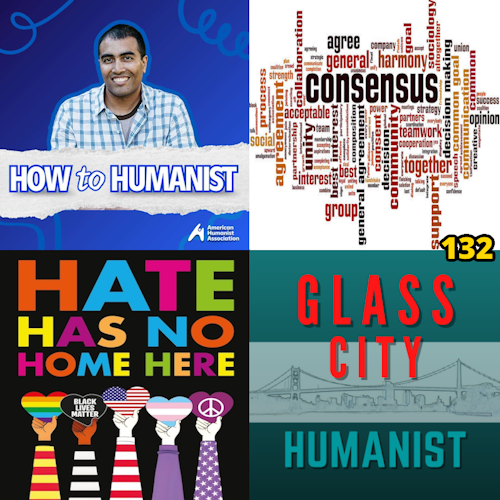
Episode 132: An Old White Dude Fact-Checks the Friendly Atheist
Hemet Mehta, aka The Friendly Athiest, has called for humanists to support digital creators who can introduce humanist values to younger audiences through social media. In a recent podcast interview, he made the statement that humanism is moving beyond being defined by “one or two older white dudes.” Doug argues that humanism in the United States has never been defined by a small number of figureheads. Humanism developed through consensus, groups of people establishing shared principles, while recognizing that humanists may follow different paths within the movement.
We then look at a recent court case involving an Ohio public school teacher who sued after being told to remove a classroom poster featuring LGBTQ+ and trans pride flags. The court ruled that managing the classroom was part of the teacher’s official duties and that the teacher did not have a First Amendment right to disregard the school district’s direction. We oppose the state law behind the dispute, but we explain why we consider the ruling important so it doesn’t open the door to Christian nationalists wanting to inject religion in their classrooms like John Freshwater did back in 2008





Extras:
How to Humanist: #38 Start Making Humanist Content Today with Hemant Mehta of “The Friendly Atheist”
Federal district judge rules against Ohio teacher who put up ‘Hate Has No Home Here’ poster
Ohio Supreme Court Upholds Dismissal of Science Teacher (2013)
The John Freshwater Saga Is Now Officially Over!!! (2014)
Recommended Reading about Humanism:
Creating Change Through Humanism By Roy Speckhardt
Justice-Centered Humanism By Roy Speckhardt
Humanists in the Hood: Unapologetically Black, Feminist, and Heretical: Humanism in Practice by Sikivu Hutchinson
Elle the Humanist by Elle Harris, Douglas Harris
Jen Hancock’s Handy Humanism Handbook by Jen Hancock
The Philosophy of Humanism, Eighth Edition
Humanism as the Next Step by Mary Morain and Lloyd Morain
Transcript:
Click Here to Read Full Transcript
[0:02] This is Glass City Humanist, a show about humanism, humanist values, by a humanist.
[0:09] Here is your host, Douglas Berger. In a recent podcast interview, the friendly atheist Hemet Mehta claimed that humanism was moving to a place where humanism is not defined by one or two older white dudes. I happen to be an old white dude, and I fact-check his claim and see if it’s true. Then we look at a recent court case where a public school teacher tried to claim a First Amendment right to put up LGBTQ-friendly posters in their classroom. I explain why the teacher losing the case was actually a good thing. Glass City Humanist is an outreach project of the secular humanists of Western Lake Erie, building community through compassion and reason for a better tomorrow.
[1:00] Welcome to another episode of The Glass City Humanist. I’m your host, Doug Berger. And what I want to talk to you about today is how we present humanism to the masses. How we find other humanists in the world, help people identify themselves as humanists. And what that means is that some people don’t like labels, okay? And so they have a set of values or they act a certain way. And when you try to label it, they get upset or they don’t like it. They rather not have the labels or they want to label themselves, which most of the time I don’t have a problem with that.
[1:48] But what I do have an issue with sometimes is when people don’t want to label humanism for one reason or another. Back when I first got involved in the humanist movement back in the 90s, we had some conflict with some local Unitarian churches in the area that I lived in because they had this theology where they wanted to build a big tent. And so basically, they accepted everyone for any reason that wanted to come to church and pledge to be in their church. The only people that they discouraged from joining were atheists and non-theists, because they claimed that the atheists and the non-theists were bashing people with religion, making fun of people’s religion. And I get that.
[2:44] When I first decided I was an atheist, I was kind of militant about it. And I never went around and said, you know, hey, you know, religious people are idiots. And, you know, because as long as they weren’t bothering me, you know, I kind of accepted that, that Thomas Jefferson quip, you know, that as long as they’re not picking my pocket, I don’t care. So, you know, as long as they weren’t infringing on my rights to live the way that I want to live, I didn’t care if somebody was a Christian, if they were a Buddhist or whatever, if they were some kind of spiritual, spirituality.
[3:23] I’ve told this story many times You may have already heard it, I gave a talk about my Columbus group When I was in my Columbus group I was president of the Columbus group And I got invited to a local Unitarian church To give a talk after a service one night One day I think it was a Sunday.
[3:43] And so I’m telling them about humanism, about the group, and kind of touching lightly on what humanism is and everything like that. And I had this gentleman that was observing my talk and asked a question. And he’s like, how do you know you’re right? How do you know what you think is correct? And I was like, well, you know, we use the scientific method to find truth in the world. And I said, we’re not always 100% correct. We don’t think we are. We don’t come out of the gate that we believe that we’re 100% correct. I said, our views and our consensus, you know, we operate based on consensus, can change based on new information. And so he went into this long story about how these people in Dublin, Ireland, were getting their milk delivered to their front porch. And it was being, and when they would get it, it would spoil. It was spoiled.
[4:48] And so they started blaming leprechauns for spoiling their milk. And this guy, he claimed to be a Buddhist, said that they, the scientists came in and said, well, it can’t be, it can’t be leprechauns because leprechauns don’t exist. And he said, so we’re going to run, we’ll run some experiments. So he set up a time-lapse camera and filmed this front stoop. And the next day the milk was spoiled and he didn’t see any.
[5:26] Leprechauns on the recording. And he said, well, there, there you go. We know it’s not leprechauns. And the, this Buddhist guy was telling me, he says, you don’t know, you don’t know all the answers. You can’t know all the answers. You know, there’s other ways of knowing things. And, and it just, it kind of degenerated from, from that conversation. You know, when people move the goal, it’s moving the goalposts and, and things like that, you know, you can do, you know, science isn’t 100% effective. I get that. But we do the best that we can with the information that we have. One of the things, there’s some podcasts, well, let me backtrack again a little bit. At the last conference, the last national conference, not just one that we just had, but the one in 2024, Hemet Mehta, who goes by the moniker, the Friendly Atheist, that’s his brand. And it’s, he’s had a blog for that and a podcast and he does, uh, other digital content around that. And, uh, I’ve interviewed him, I believe at least once here on the, on our podcast.
[6:40] And so he challenged the humanists at the humanist conference to support content creators, digital content creators, with put money behind it and get them to get the humanist message out to the people that use social media.
[6:58] Younger people, basically. Because.
[7:04] I fully acknowledge that humanism is a little bit dog-eared in years, average.
[7:13] My group in particular, we have particularly older people in their 40s and 50s. I would love to have younger people, but there’s different ways are reaching younger people. One of those is like TikTok, Instagram, you know, doing videos and things. And a lot of older humanists like myself struggle with that. So he said, you know, there’s younger people out there that aren’t officially humanists, but still agree with our philosophy and our values. Let’s fund them and get them to create digital content and try to get our message out. I love that. I love that idea. A little disappointed that I wasn’t involved at the beginning, but that’s okay. The AHA has sponsored this podcast in the past, so I’m not worried about it. And I reach a different audience. And usually these digital creators, they’re not going through the nuts and bolts of a philosophy. I tend to do that sometimes when we talk about the 10 commitments. And I don’t go as deep as some people, some, uh, people that have blogs and things that they write books and they’re talking about can’t and, and ethics and things like that. Um, and you know, I’ve read a, read a few books like, uh, Roy Speckhardt’s books, uh, humanism of chain or change in humanism, or I forget the title right now, but I’ll have the links in the show notes.
[8:40] And so these content creators then.
[8:44] What they’ll do is they will create this content that will be enveloped in humanist values, humanist ideals, and then they’ll introduce that to their people that, partake in their content.
[9:00] And I think that’s a great idea. I love that idea. I think we should do that. Great. You know, more power to them. We need to get our message out there. We don’t have the bucks like the He Is Us campaign that we saw on TV. Where they get a Super Bowl ad. You know, we don’t have that kind of money, but we do have, they had a donor donate several thousand dollars and then the AHA also spent several thousand dollars and they, paid some influencers and some digital content people to do content for the AHA and humanism.
[9:38] So the AHA then also started their own podcast, finally. Well, years ago, probably 10 years ago, they did have a podcast. And it kind of like a lot of, they call it pod fading, is when you do a lot of podcast episodes and then you just kind of lose interest, lose steam. And I think the people that were hosting it moved on to other things. And so they decided to start another podcast. And it’s called How to Humanist. And it is hosted by Che Leon. I think, I hope I’m pronouncing that correct. And she works for the communications department at the AHA. So she works with the PR people and the marketing people. And she is a good host. I like her style.
[10:33] She is new to humanism. I mean, she knows she has the values and the outlook. She just didn’t know what the label was. And now she does. And she’s very excited about it. And she’s had some really good guests on. Not always to my taste, but I’m sure for younger people, you know, they’re right into it. And she interviewed Hemet Mehta earlier this month, where the title of the episode was Start Making Humanist Content Today with Hemet Mehta, the Friendly Atheist. And it was published on November the 9th.
[11:09] And I didn’t get a chance to listen to it initially, but I did see they did a promo thing on social media, on Facebook with an image. And then they did a pull quote from him, from Hemet talking.
[11:31] And the Polk quote that they used was And so we are, again, for better and for worse We’re moving to a place where humanism is not defined By one or two older white dudes, That was the Polk quote that they used to promote the episode, I had a problem with that The way that it was presented um i and i can tell you up front right now that in context, it kind of makes sense but it’s still i still have a problem with it and i’m going to play like a clip to put it in context i’m going to play like about two minutes, of the episode um and then and then we’ll talk about it but I’ll tell you why I have a problem with it. Humanism, the humanist movement, the modern humanist movement has never been, uh, homilgated or, or there was never a Pope or dogma attached to it by two old white dudes ever. There’s never been that. There’s been people that influenced humanism.
[12:46] And they’ve been white men because the modern humanist movement got started in the early 20th century, and then you had the Manifesto I that was written in the 1930s. But you had people like John Dewey, Corliss Lamont, Paul Kurtz. They were influencers. The book that Paul Corliss Lamont wrote, Philosophy of Humanism, was how I got introduced to humanism, the philosophy, when I first heard about it. I read his book. He passed away in the 90s, in the late 90s. So his book is, they did do a rewrite where they removed some of the sexist language, like the he’s and him’s, and tried to make it more inclusive. And that was his daughter headed that up. But I think it’s the eighth printing was the last one that he actually had input on. So it’s, you know, it’s 30 years old. It’s kind of dated. The Roy Speckhardt books are a little bit more modern and deal with a lot more information if you’re looking for a book. And again, I’ll have those links up on the show notes.
[14:09] But the whole history of the modern humanist movement, at least in the United States, has never been based on the views of old white dudes or even just two old white dudes. Humanism operates as a consensus. And for those that don’t know, a consensus means a group of people. They get together. They decide what is important and what isn’t important. They create the labels. They create the definitions. They define it. They say what it is. And then the best part of a consensus is you can either agree with it 100%. You can agree with it 50%. You can agree with it, 20%.
[14:58] Um, if you don’t agree with it at all, you could probably still come along. Uh, but you know, you might not appreciate it where you’re going, you know, and you might not appreciate the road that you’re taking if you don’t agree with the consensus at all. So, you know, you always find something in there that you can agree with, and then that gets you, that progresses you further there. And I also fully believe in labels, all right? Because you have to know what you’re talking about. Everybody has to be on the same page. So if you’re talking about humanism, it’s a very good idea to be specific about what you’re talking about.
[15:48] You know, it’s not saying, you know, this is what it is and it can’t be anything else. But if you’re in a group and you’re talking about humanism, you know, like myself, I’m more of a value worldview person. I know some people that are more into the philosophy, heavy into the philosophy and the studies and things like that. That’s great. And then you have some people that are just non-religious, and that’s what they do. And there’s Unitarians. That’s another branch of humanism. It’s a slightly different, what they call it now, congregational humanism. And then there’s my brand that I like is secular humanism. And then you have people that don’t like to put qualifiers on it. Humanism is humanism. See, it’s all based on consensus. So that’s why I disagree with that pull quote. Outside of context, definitely, I disagree with it. But when you put it into context, it’s a little bit different.
[17:01] And so what I wanted to do is play it, play the clip. It’s about two and a half minutes. And then we’ll come back and I’ll talk further about that. It’s such a great point about finding that digital space for community, especially like if you’re disabled, if you are a community that needs protection. But then also like we have people that have started local groups through American Humanist Association that are posting TikToks to help others find them. Elizabeth Egwood is just phenomenal at posting on TikTok. And the people are just coming out in droves and these TikToks are performing very well. And they’re finding for the first time that that there are people that are other like minded people like them near them that they wouldn’t have otherwise known about. And how do you find that community? Let’s say you live nearby a moderately big city. If you wanted to start a group for whatever niche you are in, how do you do it at this point?
[17:53] The answer is try to get the word out in any way you can that you’re comfortable with. So if TikTok works for her, great. People are going to find it because that’s how these algorithms work. But if hosting an event page on Facebook does it, great. If Meetup works, great. Put it everywhere because you’re going to find different people in different areas. And there’s not just one place where you can go to to find this stuff anymore. And so we are, again, for better and for worse, we’re moving to a place where humanism, it is not defined by one or two older white dudes. The way people are learning about it and finding out about it is because there are a thousand people out there talking about whatever it is they want to talk about. And you connect with this one or that one, and you don’t know who that person is.
[18:43] And that’s fine. That’s great. We want as many voices out there as possible. And the people who are super talented at it. And this is what we were talking about earlier. I hope there’s a way to amplify those voices somehow. But the answer is in a good sense, in our neck of the woods, we’re not reaching people because there’s one or two figureheads at the top who speak for all of us or who are thought to speak for all of us. There are more voices out there and you can find them wherever you are if you’re looking for it. And so we want that. That is good for everybody because there is no one humanism that defines everything that is going to fit for everybody. The AI story was interesting because I think it reached people who otherwise would not think about humanism necessarily, but they heard about that story. Okay. Well, now it was in context that quote came towards the end of it. And, uh, Hemet says that, uh.
[19:47] I hope there’s a way to amplify those voices somehow, but the answer is, in the good sense, in our neck of the woods, we’re not reaching people because there’s one or two figureheads at the top who speak for all of us or who are thought to speak for all of us. There are more voices out there and you can find them wherever you are, if you’re looking for it. And so we want that. That is good for everybody because there’s no one humanism, that defines everything that is going to fit for everybody.
[20:19] So he does understand consensus, the consensus of humanism. So I’m not sure why he said that we’re moving to a place where humanism is not defined by two older white dudes. It’s never been defined by two older white dudes. I even served on the committee that wrote the third manifesto or that helped. I didn’t write it. I was on a committee that read over the third manifesto that’s now considered the affirmations. And again, I’m just talking about humanism in the United States. There’s an international humanism, and they have the Amsterdam Declaration, where they had a group of international people from the U.S. And the rest of the world get together and say, this is what humanism means. This is what it should be. This is our goal. This is where we want to go. This is the progress we want to make. And we did that in the United States with the manifestos. They did that in the U.K.
[21:21] Everywhere that there’s humanism, they decided what it is and what it stands for, okay? And so you can see the threads in all of this. You know, it’s non-religious. It’s science based on science, the scientific method, critical thinking. You know, they all have these parts. They all have these foundations, but there’s different ways of getting down that path. You know, like I said, I’m a secular humanist, so I’m going down one path. I have friends here in our group that are congregational humanists. They go down another path, but we’re still going to the same place. And I think that’s what makes humanism, that’s what I like about humanism, is there is no pope. There is no dogma. There aren’t two old white dudes telling us what to think and what to do. And I wouldn’t put up with it. I wouldn’t be in this movement for 30 plus years now if that was the case. I know some atheists had problems with the new atheists. There’s a lot of people, a lot of non-religious people that had problems with the new atheists. And those were old white dudes telling people what to think. And we saw how that ended. That didn’t end well for them.
[22:46] They’re no longer influential anymore. In fact, some of them are out in Siberia somewhere being exiled because of some comments that they made in the past. So that’s the thing. I like the podcast, How the Humanist. Shay is a great host. The episode with Hemet is a great topic. It’s great. It even got me thinking about trying to do TikTok for Sholei. I’ve never done TikTok for Sholei. I did TikTok for this podcast, and I’ve done TikTok for my other podcasts that I do, but never for my group. So maybe it gives me something to work on for the coming year, because we would like to attract some younger people. But repeating again, my conclusion is humanism, modern humanism in the United States has never been defined by two old white dudes. It’s never been defined by old white dudes. It’s always been defined by a consensus of people gathered to decide where they wanted to go. And I like it that way.
[24:08] For more information about the topics in this episode, including links used, please visit the episode page at glasscityhumanist.show.
[24:29] Another story that I wanted to talk about today happened recently. And when did that come across? November the 12th is when the Buckeye Flame website posted about it. But basically what happened was there was a school teacher in the Little Miami School District in suburban Cincinnati. And they had a hate has no home here poster up in their classroom. And the school district got a complaint or they spotted it. I don’t know. But they ordered the teacher to remove it because it included images of LGBTQ plus and trans pride flags alongside other flags. And so there’s House Bill 8 that was passed in the state legislature where they had to remove, they restrict public school teachers’ ability to speak about LGBTQ, plus people and history without parental notification. The teacher sued the school district. His name is George McIntyre, sued the school district for violating his First Amendment rights. He believed that he had a First Amendment right to put that poster up. And the district judge, the U.S. district judge, ruled against him and ruled in favor of the school district.
[25:58] In the ruling, Judge Matthew McFarland said the district did not violate McIntyre’s right to free speech because managing his classroom during the school day relates to his job responsibilities, not private citizen speech. McIntyre could disagree with the board’s judgment, but the First Amendment did not give him a right to disregard its direction when speaking pursuant to his official duties. And so the Buckeye Flame and a lot of other people, a lot of other progressive people took exception to that ruling. They disagreed with it because they thought it was anti-LGBTQ. And unfortunately, I’m going to have to differ with those people.
[26:44] I don’t like the ruling. I don’t believe in House Bill 8. I think it should be rescinded as soon as possible. Hopefully we get some new people in the legislature that they can undo it because it does attack LGBTQ plus people unnecessarily. But I have to agree with the judge that the teacher has to listen to the school board because it pertains to their responsibilities as a teacher. They are not a private citizen. Now, stay with me. Hold on.
[27:27] Back in 2009, 2008, 2009, 2010, something like that, because I posted about it in 2010 or 11, something like that, there was a teacher in Knox County, Ohio. His name was John Freshwater. And he was a science teacher. And he got in trouble for prophetizing in his eighth grade science class. In his case, he got in trouble with his school district for doing kind of what this social studies teacher did in a little Miami school district.
[28:08] He put up religious displays in his classroom. He had his personal Bible on the table, on the desk for everybody to see. And he was told several times by his supervisors not to do it and to remove the religious displays. And so eventually he refused to do it because he thought he had a First Amendment right to have this religious material up and they ended up terminating him from his job. So he sued in court, federal court, state court, I mean. And in 2013, the state’s highest court upheld Mount Vernon City School District’s dismissal of John Freshwater. The court’s decision came after the district’s Board of Education voted in 2008, to fire the teacher on four grounds, an incident in which Freshwater shocked a student with low-level electrical current through a Tesla coil, his failure to adhere to the established curriculum, issues with his role as supervisor of the Fellowship of Christian Athletes, and disobedience of orders. He had sought a hearing before a state referee who heard testimony from more than 80 witnesses, 38 days over 21 months. The referee sustained the termination on two of the grounds, failure to adhere to the curriculum and disobedience of orders.
[29:34] In its 4-3 decision, the state Supreme Court upheld the termination solely on the disobedience charge. Because there was ample evidence of insubordination to justify the termination decision, the court said, it needed not reach the constitutional issue of whether Freshwater impermissibly imposed his religious beliefs in his classroom. Freshwater had argued that the district violated his First Amendment free speech rights based on the content or viewpoint of his curriculum-related materials, with his students and his use of supplemental materials. Court papers show that Freshwater gave religious handouts to his students, showed videos on creationism and intelligent design, displayed religious materials in his classroom, and referenced the Bible. Administrators repeatedly advised Freshwater not to display religious materials and have particular religious discussions in class. Freshwater not only ignored the school District’s directive, he defied it. Chief Justice Maureen O’Connor said, after he was directed to remove the items, freshwater deliberately added to them, incorporating an Oxford Bible, Jesus and Natharist, into the classroom. He then refused to remove his personal Bible from his desk and refused to remove a depiction of former President George W. Bush and Colin Powell and others in prayer from his wall.
[30:54] O’Connor said the court recognized that this case is driven by far more powerful debate over the teaching of creationism and intelligent design alongside evolution.
[31:07] And then we had, in 2005, it was the Kitzmiller v. Dover area school district decision that said intelligence design couldn’t be taught. Here, we need not decide whether Freshwater acted with a permissible or impermissible intent, because we hold that he was insubordinate, and his termination can be justified on that basis alone. The state Supreme Court said, Freshwater is fully entitled to an ardent faith in Jesus Christ, and to interpret biblical passages according to his faith, But he was not entitled to ignore direct lawful edicts of his superiors while in the workplace. And so, basically…
[31:48] If the court had ruled for the teacher in Cincinnati that the school was wrong in having them take down that poster, I’m afraid that it would have opened up the classroom to people like John Freshwater to inject their religious beliefs. Now, people would say, well, no, that’s different, Doug. That’s religion in the school. That’s been adjudicated. But again, he was saying he was exercising his First Amendment rights. And that’s what that teacher in Cincinnati was saying, is that they had a First Amendment right to put that poster up. John Freshwater said that he had a First Amendment right to put up those posters about Jesus.
[32:32] In fact, when it went to a federal court later, they ruled that the school could not order him to remove his personal Bible from his desk, but the other stuff had to go. So they upheld his termination, but except for that part, his personal stuff was fine. But when he then crossed that line and prophetized to his kids, that’s when they upheld it. So again, why I don’t like the ruling and I don’t like the fact that they had to take that poster down and I don’t like the attack on the LGBT community. I think that this court case, this court decision right now is for the best. It’s for the best for the long haul because I don’t want any religious zealots, using that. And they will. If that teacher had won, you can bet that First Liberty would be at the front door for their client to try to get Jesus posters put up in public schools.
[33:40] And I don’t want to see that. So, you know, if you want to yell at me for having that particular hot take on that case, that’s fine. And I’ll have the link to the Buckeye Flame article and also some of the John Freshwater stuff that I wrote 15 years ago. Was it 15? 15 years ago. Eventually, he tried to go to the U.S. Supreme Court and they turned him down. So he took it all the way that he could and he still lost. The same with Coach Dave Dabenmeyer. He tried to profit ties to his students and he got fired for that. And he tried to sue for First Amendment and lost. So I don’t like I just don’t like that case where the teacher’s argument is they had a First Amendment right to put up the poster.
[34:31] And so I think at this juncture right now, that court case, that ruling is in the best interest for everybody.
[35:15] Glass City Humanist is hosted, written, and produced by Douglas Berger, and he’s solely responsible for the content.
Transcript is machine generated, lightly edited, and approximate to what was recorded. If you would like perfect transcripts, please donate to the show.
Credits
Written, produced, and edited by Douglas Berger and he is entirely responsible for the content. Incidental voice overs by Sasha C.
The GCH theme is “Glass City Jam” composed using Ampify Studio
This episode by Glass City Humanist is licensed under CC BY-NC-ND 4.0.

