
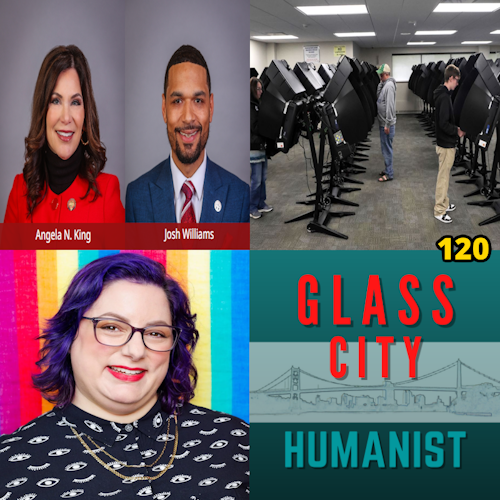
Episode 120: How the SAVE Act and Drag Bans Are Connected
We start this episode talking about the SAVE Act currently being debated in the Congress and how it is meant to make voter registration and voting harder for those who will have trouble getting the higher level of documentation needed to be eligible.
We rebuke the narrative that the act is needed to stop the flood of undocumented people voting since there is not a flood as the data has shown and the SAVE Act itself will do far more damage to our democracy, and affecting our elections, than a small random number of people who are not eligible to vote.
Douglas draws on his experience as a precinct poll worker to rebut the argument that requiring a photo ID is better than the current comparison of signatures in a poll book. How would a poll worker know the ID being used is real?
Then we shift focus to yet another proposed anti-LGBTQ bill, notably Ohio House Bill 249, which seeks to criminalize drag performances, especially in the presence of minors. We express our disappointment not just in the law itself but in the surprising support of such a bill from two members of marginalized groups who are the ones who introduced the bill. The episode brings to light the troubling reality where individuals from historically oppressed communities are complicit in the persecution of others, invoking religious justifications that distract from the essence of human rights and dignity.
Finally we show a compelling clip from Amanda of Yesterqueers, who connects the proliferation of anti-LGBTQ legislation, the overturning of Roe v. Wade, and the SAVE Act. This connection emphasizes the broader context of how marginalized communities are often pitted against each other in cultural wars, which serve to distract from more pressing socioeconomic issues. Drawing these connections reveals a disturbing trend where the struggles of LGBTQ individuals, particularly trans people and drag performers, are framed as threats to societal norms, rather than highlighting their right to express and exist free from harassment.
01:00 The SAVE Act and how elections actually work
23:17 Ohio House Bill 249: The Drag Ban
43:56 How the SAVE Act and Drag Bans Are Connected





Extras:
Shedding Light on the Incidence of Illegal Noncitizen Voting
Voting By Noncitizens is a Non-Issue
House Bill 245 Introduction Testimony (2023) [starts at 35:41]
House Bill 245 (2023) Committee Activity
Another Ohio city attempts to ban drag from their local Pride festival
House Bill 249 (2025) (passed the Ohio House on 3/25/2026)
Drag queens testify against Ohio performance ban
Transcript:
Click Here to Read Full Transcript
[0:01] This is Glass City Humanist, a show about humanism, humanist values, by a humanist. Here is your host, Douglas Berger. I think most people would agree that proposed laws like the Save Act would do far more damage to democracy than the tiny, tiny number of non-citizens accused of voting. It’s always disappointing when members of marginalized groups gang up on other marginalized groups, and it is very, very extra disappointing when they use religion to justify it. And then finally, we get an explainer why all of this anti-LGBTQ activity and the SAVE Act are related. Glass City Humanist is an outreach project of the Secular Humanists of Western Lake Erie, building community through compassion and reason for a better tomorrow.
[1:00] As I record this segment, there’s quite a bit going on in the news. A lot of it’s not good. We still are continuing with some kind of war, although they don’t call it a war with Iran. Then we have in the Congress, they are arguing over the SAVE Act and also paying for TSA workers in the airport. And what I wanted to talk about was the SAVE Act. The SAVE Act is a bill that would make it tougher for people to register to vote and also make it tougher for people to vote. And why would it make it tougher? Because it would require more detail, more detailed and more documentation in order to prove you are who you are and whether or not you’re a citizen.
[1:57] And you and most people would say, you know, we don’t want non-citizens voting and non-citizens are not allowed to vote in federal elections for sure. Some municipal locations did have voting for people that were undocumented. They could vote for, let’s say, like dog catcher or for library levies and things like that. in my personal opinion is if you pay taxes, you should have a vote. You know, it’s taxation without representation is pretty much the whole reason why the Founding Fathers broke with Britain. And so to deny somebody the right to vote because they’re not a citizen, even though they pay taxes, to me, that’s inherently unfair. But that’s my personal opinion. And the other thing to also remember, too, is there aren’t a large amount of undocumented people voting, registering to vote, or voting in this country. The Cato think tank, the Cato organization, did a study for the last 20 years and found maybe 1,500 cases out of billions of votes cast of illegal people that were not eligible to vote voting.
[3:23] In fact, it is more likely that somebody who would normally be eligible to vote would commit voter fraud, such as voting twice. We’ve had quite a few cases of some voters voting twice, particularly if they’re snowbirds. And snowbirds, those are people that live in the northern latitudes of the country and have a winter home in the southern part of the country. And then they vote in both places. They vote in their main home area and they vote in their winter home area at the same time. They’re not supposed to do that. It’s illegal.
[4:09] It used to be able to catch them quite easily because many states shared voting registration data. Let’s say Ohio would update its voter registration and it would send this data to a third party who got data from other states. And then they would cross tabulate the data and see who popped up duplicates. But they did away with that because the conservatives in the state didn’t trust it and wanted their own thing. But that’s another story. So the SAVE Act, what it would require is it would require a photo ID. The other thing too is that many states have gone to what’s called a real ID. Here in Ohio, we had to do a real ID if we wanted to fly on an airplane, for example.
[5:05] And so we had to have a birth certificate. If we were a married woman, we would have to have our birth certificate and our marriage license to prove that the name that didn’t, that matched our social security card, but didn’t match our birth certificate was still us so that we could get a real ID.
[5:26] And if you didn’t have that, then you had to take your passport to prove citizenship and then you would get a real ID. Well, you can’t use a real ID to vote, to register to vote or to vote. So you have to do all this again with all this material. And for a lot of people, it is kind of impossible. What it does is it institutes a technically a poll tax, which is which is unconstitutional under the 24th Amendment, because, you know, you’re not getting this information. The if you try to get a copy of your birth certificate or your marriage license, you have to pay money for that. If you want to get a passport, I think it’s one hundred and sixty dollars to get a passport. Now, a lot of people also approve of the need to have a photo ID. Up until recently, within the last 10, 15 years here in Ohio, you didn’t need a photo ID. And I’ll tell you why. And this is the information that I come from because I work as a precinct election official during the elections. I’ve been doing it the past two or three years now.
[6:44] And what happens is when somebody comes in to vote, we have what’s called a poll book, P-O-L-L book. And that is a list of all the registered voters. It has your name, address, date of birth.
[7:01] It doesn’t have social security numbers because we don’t hold on to those, at least on the poll book. And then it also has your signature. Because when you register to vote, you have to sign a paper saying a test that, hey, I’m a citizen and I live in this area and I want to vote. So when you come in to vote, and this happens whether you show a photo ID or not, even though here in Ohio, you are required to show a photo ID now, we check you in, we look up your information, see if you’re eligible. If you’re eligible to vote, but we have you sign the poll book. Now, when I first started voting after I turned 18 was before it went all digital. And the poll book was a physical printed paper book with everybody’s names on them and a copy of your signature. And you would sign the book. And then the poll worker, which would be me, would look at the signature that you signed with the signature that we had on file to see if they matched.
[8:12] And if they match, then you are who you are. You get to vote. Now, some people think that you have to have a photo. Well, the argument they make is that you’re not vetted. Anybody could vote as you. If you just sign, if you just know how to sign somebody’s name, we ask people, even people with the, even people that give us a photo ID, we still ask them their name and their address. Us, to repeat their name and their address to us, even if it’s on the card. I also, me personally, I look at the signature that’s on the back of the license or the state ID card or whatever ID card I look for a signature, and then they sign the poll book. That’s how it works. Now, when you send in a absentee ballot by mail, the ballot fits into one envelope, And on the cover of that envelope is how you identify yourself. You put your name, your address, and you sign it.
[9:22] And then you put it in a second envelope, which is like a privacy envelope, and that is, you know, or it has the address to the Board of Elections. That’s how you mail it back in, or you take it to a, when we used to have drop boxes, you could drop it off. You could take it inside to the Bureau, the Board of Elections office before the election. So what would happen then is that when they went to count the absentee ballots, they would take this envelope, take the ballot envelope out, look at the name, the address, and the signature, verify it with the information that we have at the Board of Elections. If it matched up, then they would say, we can count this vote. So then they would open the envelope, take out the ballot, and scan it, because that’s what it’s a scan form, and scan it in and count the votes. That’s how absentee ballots work. You have to include your last four digits of your Social Security number as another identifier on your absentee ballot. So that’s how that works that way.
[10:36] So one of the things that I’ve been doing recently is I’m still on social media. I’m still on Facebook, usually because of the group stuff. You know, I have to keep promoting the secular humanists of Western Lake Erie and the activities that we do. And a lot of that’s through Facebook. But so I read some of the feeds. And I, for some reason, I’m getting a lot of conservative candidates for various state offices that I’m seeing their posts. And what happens is they’ll say something that I either know for sure is wrong or I suspect is wrong and I’ll look it up and prove that they’re wrong. And then I will respond politely to their post explaining why they are wrong with links and proof, etc. up.
[11:28] And I do that respectfully and nicely. I don’t, I mean, it would be easy to call them a name, call them a butthead or something and do that. But I don’t normally do that. And it’s not for that candidate, because I know that candidate’s not going to change their mind, but it’s for the people that read the comments to that candidate. Maybe it might change somebody’s mind. You know, that’s the same thing, the same reasoning that I go when I respond to Christian nationalists that post stuff that I know is wrong, because it could be the people that are reading these comments or reading these posts that don’t know any different, that might be on the fence, might change their mind. So that’s why I do it.
[12:10] So we had this candidate, he’s running for the Secretary of State of Ohio. The Secretary of State is the one that runs the elections. Um, unbeknownst to, uh, President Trump and some of the more extreme Christian nationalists, MAGA leaders, states run elections. That’s according to the constitution. So in order, so if you’re going to be the secretary of state of Ohio, you’re in a pretty powerful position to run the, the primary and general elections each, each year. And so this gentleman who is running as a conservative, rather extreme Christian nationalist conservative, has been posting about voter fraud and how we need the SAVE Act and that we need to have photo IDs. He also has an idea or a plan that he wants to do, if he gets elected, to go through all the business filings. The business, because that’s the other thing a secretary of state does is when you start a business in Ohio, you have to register with the state. You register with the secretary of state. That’s what our group did when we incorporated as we registered with the state.
[13:31] And so this guy wants to go through all these business filings and root out the ones that are run by undocumented citizens and cancel those registrations because he doesn’t believe that undocumented people should be able to own a business. They also shouldn’t be able to own property. He also feels that way as well. That’s how extreme he is. So he’s been posting these posts about voter fraud. And the other day he came out with this post and he thought that, you know, we have to, he wants to have photo, he wants to require a photo ID to also file an absentee ballot. That’s the one you mail in.
[14:14] Now, on the surface, you can see how impractical that is because that’s the whole point of mailing in a ballot is that you’re not going to be there in person. So how are you going to show a photo ID? He’s talking about including a copy of your photo ID. Now, why would you do that? How would you, you know, it creates more questions than answers, for one thing. For one thing, there’s no reason to do it. There’s no voter fraud. Voter fraud is not a thing. It’s just one of those scare tactics that conservatives use to try to get you to agree with their policy, first of all. And so he was talking about that. He said he thought it wasn’t fair that people that submitted absentee ballots by mail didn’t have to show photo ID if everybody else had to show photo ID.
[15:07] And so I explained how the voting process worked, because obviously he did not understand how it worked. And I explained that people come in, they vet the absentee ballots with the signatures just like we do on Election Day.
[15:24] And he made the comment then, the return comment, that poll workers are not handwriting experts. So basically, he’s saying that that is not a good way to vet somebody is by signature. Actually, it’s pretty good because you can tell if the signatures are similar. They’re not going to be exactly the same, obviously. And then he went on to talk about how he didn’t like signing the current poll books because he writes left-handed. And he said that the tablet to sign on wasn’t made for his type, for left-handedness. Well, what people sign when they come to a polling location in Ohio is they sign an iPad tablet. And so it is not biased towards any particular handedness. It’s not left-hand biased. It’s not right-hand biased. It’s just a tablet. It’s like people that go to a doctor’s office and they check you in and they want you to sign that little block with the pen to put your signature to agree to treatment. That’s similar to what we use, but we don’t use a pen. You can use your finger. We have a stylus you can use.
[16:45] People, I do it. I do it. I vote early, so I have to do the poll book. I have to sign the poll book. And my signature when I sign a poll book is very similar to how I signed my voter registration. And that is a form. So in most cases, you’re signing a paper form.
[17:09] And so, yes, I’m not a handwriting expert, but you can tell if something’s way off. And so I pointed that out. I said, no, we are not handwriting experts. But the other thing to remember, too, is on Election Day at the polling place, at least and that’s here in Ohio, it might be different where you’re at, we have bipartisan check-in tables. That means that at each place that somebody checks in, you have a Democrat or a Republican, or you might have an independent non-party person and another party person. Not very often, but sometimes. And so when somebody is checking in, everybody at the table is watching this person check in. So if I’m checking in somebody and their signature and we see the signature, my partner might say, hey, wait a minute, hold on, that doesn’t look right. And then we can call over the location manager too.
[18:16] And if you’re a voter and you think somebody shouldn’t be voting, you can also challenge them. You can go to a precinct election official and challenge a voter. So it’s not like people coming off the street saying, hey, I’m voting. That’s how these conservatives want to classify this, that people just run of the mill coming off the street. And so the other point that I wanted to make to him was about this thing about photo ID. I agreed that I am not a handwriting expert, but I’m also not a photo expert either. I said, how do I know that the photo that you’re showing me on your ID is actually you or that it’s actually your ID? Because IDs can be faked.
[19:09] You know, it’s not as easy as it used to be, but if you’re just using it to vote, it doesn’t have to be very sophisticated. What we use is the barcode on the back of the license. That can be faked. And that brings up the data. So you could steal somebody’s ID that you know is a voter and put your picture on it and not be that person. But you know how I could probably catch you is because your signature won’t be like that person. unless you have their exact signature and you practiced it. And even if that’s the case, it is not a big deal. It really isn’t. Yes, it’s a crime and it should be prosecuted if it’s caught, but it’s just one person. In order for something like that to have a fake person with a fake signature to vote, you have to have a lot of people do it in order to affect an election. Like you would have to have literally thousands of people do that. And on the scale of criminality, that is so far down the list, it’s not even funny. That’s why the instances of voter fraud are so minuscule.
[20:30] The biggest voter fraud that used to exist was ballot stuffing back before the 1970s and into the 1970s when he used to do the paper ballot. And you might want to check this out. President Jimmy Carter, when he was running for office in Georgia, he was running for, I think it might have been the state house or state senate. He ran into this where there was one polling location in this town where they stuffed the ballot box, and he had to go to court in order to get the votes thrown out.
[21:10] And so the SAVE Act is nothing more than an attempt to suppress voting. And they’re trying to suppress voting by targeting people who don’t have the proper documentation, even citizens who don’t have the proper documentation, who can’t afford to get the proper documentation by using that poll tax. And so they’re trying to slice away enough voters in order to affect elections. See, that’s the way that they do it, by having thousands of people be sliced away who can’t vote or who decide not to vote because it’s too troublesome to get the proper documentation to register that they don’t vote, that affects the election far more than supposed cases of voter fraud or illegal, how they say it, illegal aliens voting. This SAVE Act would do far more damage to our democracy, than 1,500 undocumented people voting if that’s the number that they come up with.
[22:30] And so that was just very interesting that I had to explain how voting works to somebody who wanted to run elections in Ohio. And so that tells you something. That tells you what we’re dealing with in the upcoming election. For more information about the topics in this episode, including links used, please visit the episode page at glasscityhumanist.show.
[23:17] I know it sounds like a broken record, but when you live in a state that is run by Christian nationalist conservatives, this comes up pretty much every legislative session, anti-LGBT bills and laws and policies and things like that. And the latest that actually passed the Ohio House of Representatives was a House Bill 249, which would criminalize drag shows in public if there are kids around. It was, this bill was specifically directed towards drag performers and transgender people, because those are the people that these good Christians that run our state have demonized.
[24:12] And so House Bill 249 had a lot of opposition to it but it still passed it in fact it passed out of committee I believe it was on the 25th March 25th passed out of the committee on a party line vote and got voted on the floor of the House of Representatives and passed on a party line vote the same day. See how quickly they can move on legislation when it deals with the cultural war type stuff that doesn’t apply to anybody else. It doesn’t make groceries cheaper. It doesn’t reduce the price of gas or anything like that. You know, they’re able to work pretty quickly. One of the disappointments is that this bill was introduced by a woman, Representative Angela King And a black man Representative Josh Williams From the Northwest Ohio area And so it was very disappointing That members of Two marginalized groups And.
[25:18] Would introduce a bill that would criminalize the actions or the free expression actions of another marginalized group. That’s how these evangelical Christians work, is that they are so hung up on sex and genitals and children that they pass the, you know, they try to get these bills passed and try to make it tough for people like drag queens to live their lives the way that they want to.
[25:53] And because there’s already laws, there’s already laws against obscenity, there’s already laws against public nudity, and there’s also laws against having obscene material in front of children.
[26:08] And so we don’t need a separate law directed at drag performers. And so this is not a new bill. It is actually a redo of a bill that was previously introduced last legislative session. And back then it was House Bill 245.
[26:34] And this one, and it has a history to it. It was, again, introduced by Representatives Angela King and Josh Williams, and it was premeditated. They brought it up because of a supposed incident that happened at a pride festival in Salina in Mercer County. Very red area, very Trump-supporting area. But they had enough people, enough LGBT people in the area to have what they call a small town pride festival. And supposedly there was a video that made the rounds, the outrage rounds on social media of a drag performer performing in front of children. And children were giving the performer dollar bills, tips, giving them tips. And supposedly this happened at the park, the Salinas City Park, where this pride festival was going on. And there was also supposedly vendors that were selling novelty items in the shape of male genitalia.
[27:58] And these evangelical Christians were just aghast by that, so much so that this minister put up this video, which may or may not have been from that thing. And this happened, supposedly this happened, this incident happened in 2022. So then in 2023, they attempted to get this small town pride festival canceled because of it. And went to the city of Salina to complain, and the city would not cancel their permit to have their 2023 event. And the reason that they gave for not giving, you know, not taking away their permit was that they didn’t want to get tied up in a First Amendment federal case about it if they got sued. Right.
[28:54] So that’s why the evangelicals then talked to Angela King, and she introduced this bill to ban drag performance in public so that then the city could ban the small town pride and not worry about a lawsuit. What I wanted to do is I wanted to play a clip of the way it works in Ohio is the legislators that introduce the bill, when it gets to a committee, the first hearing, they introduce the bill to the members of the committee. So they stand at the podium and talk about their bill. And so Angela King and Josh Williams both spoke in this committee. At the time, in this session, it was called the Criminal Justice Committee. I believe that’s what the name of it was. It’s since been renamed to just judiciary.
[29:48] And Josh Williams was the co-chair of the committee. And I believe Angela King was a member of the committee. What I want to do is I want to play a video clip of Angela King giving her proponent testimony, introductory testimony for this bill. And I want you to note when she starts talking about that incident in the park. And I need to point out that she was not in attendance at the time. She did not actually view this supposed incident that happened. Okay. And then we’ll come back and we’ll talk about it.
[30:28] To those who believe that this is a solution in search of a problem, we’ve seen obscene performances taking place where minors are present here in Ohio.
[30:53] The catalyst for this bill actually came from my own community. I was appalled to watch a video of a family-friendly event held in our city park, where adults were dancing provocatively for children, who were then rewarded with cash, handed to them by young children. One of the performers, dressed in a skimpy thong leotard, twerked and gyrated on the concrete. The same adult, then seated on the ground with his legs spread open, raised towards the sky, gave a view of his crotch area for all to see, including small children.
[31:38] Adult novelty sales were also available at this year’s event, including giant pillows and stress balls in the shape of male genitalia. All of this was fully available to the children attending this family-friendly event. We need to ask what message are we sending our children by allowing events in public spaces where they’re encouraged to throw money at adults dancing in a sexual and provocative way?
[32:09] Ohio families should feel safe taking their children to a city or community park without their child being exposed to performances and adult novelty items. As legislators, it’s of extreme importance that the state protect Ohio’s children from exploitation and robbing of their innocence. We already prohibit children from strip clubs and exposure to pornographic materials. And in the same way, House Bill 245 protects children from obscene performances in public spaces. Adults can have their day, but it needs to be done behind the doors of a private establishment where minors are not allowed. Chair Abrams and members of the committee, thank you for the opportunity to testify on this very important piece of legislation. It’s my hope that you too place a high value on the protection of children’s innocence and favorably report House Bill 245. And at this time, I will turn it over to my joint sponsor. Thank you. So yes, Representative King was near tears as she’s talking about children being exposed to obscenity, the obscene twerking of a drag performer. And that’s the other thing I want to note, too, is they’re trying to update the obscenity law in the state.
[33:37] And they claim they aren’t targeting drag performances. But yet when they talk about drag performances, they only talk about them being automatically obscene. They believe that they’re obscene on the face of it, rather than going through a due process and examining what they’re doing. Is there nudity involved? Is there genitalia hanging out or anything like that? They don’t do that. And so that is, so she’s near tears. She’s almost crying. So I don’t know. I don’t know if she’s just being a very good actress or she’s visibly upset. More likely she’s visibly upset the fact that children might be exposed to a drag performer performing. So the Buckeye Flame, they did some good articles. And I recommend Buckeye Flame if you’re looking for good Ohio-based LGBT news. And they did a story about the current bill that 249 had just passed. And they did an article about it, but talking about the history of it. And I wanted to read this part in the article about it. And it talks about that video.
[35:01] And it says this mayor, the mayor of Salina, had written a letter to support House Bill 249. And in that letter, the mayor, Jeffrey Hazel, mentions this viral video, supposed viral video.
[35:23] And so Buckeye Flame writes, while Hazel did not provide the video he’s referencing, It is most likely a video Sean Mayer, pastor of Athea Christian Church, shared in 2023 with a Facebook group called Defend Salina. It showed clips from a 2022 drag show in Salina. The children in the video hand the bills, the money, to performers. The video does not show children tucking dollar bills into performers’ clothing. That was one of the accusations. Hazel also referenced a 2023 video where he said a drag performer twerked, thrust his hips, and gyrated on the ground where he revealed a tight-fitting thong. And Angela King, in her initial introductory testimony in the full, if you look it up, she mentions that same situation of thrusting the hips and gyrating on the ground.
[36:23] And so, Buckeye Flame continues, a similar performance was in the 2022 video, and each of the moves Hazel describes appear for a second or less as part of a longer dance routine. Some of the moves used by the performer, such as high kicks, flips, and using their leg to gain momentum and stand back up, are used by cheerleading squads, including Salina High School. During a Salina Cheer Team’s showcase on February 20, 2025, high school athletes thrust their hips, spread their legs, and use almost the same moves as the drag performer during a cheer showcase.
[37:05] And then they also note that the council president, Jason King’s sister-in-law, Representative Angie King, stood next to neo-Nazis protesting against the Pride celebration that year. This is 2023. It noted Small Town Pride president Kyle Bruce in a statement sent to the Buckeye Flame. Let this be a reminder that those who are in support of HB 249 have opposed our Pride event since before there was a drag show in 2020 and have continued to oppose it this year when there was no drag show, Bruce said. These people are attempting to mask their blatant homophobia and transphobia by presenting their side as the ones who are protecting the children. Yet they are the ones who fill their kids with hate towards a group who does them no harm.
[37:53] And so then I wanted to turn to Representative Williams. And in his letter to the committee for this current bill, he doesn’t talk about that Salina Park incident, but he talks about the case of Rachel Glynes, who is a transgendered woman who was charged with indecent exposure after women and young girls complained of Glynes’ presence in the women’s locker room at a Xenia YMCA. Glines was eventually found not guilty as his body fat covered his genital area. Due to this section referencing private parts, which is undefined in the revised code, a conviction was not possible.
[38:45] Had the section said private area, which is defined in the revised code, our justice system would have been able to fully prosecute guidelines. As defined in section 29.07.01, private area means the genitals, pubic area, buttocks, or female breasts below the top of the areola, wear nude, or covered by an undergarment. And then again, when he’s talking about drag performances, he’s already automatically assuming that they’re obscene. Because in his next paragraph, he writes, Another goal of this legislation is to update the weak and outdated obscenity laws in our state. Last updated in 2004, these laws were targeted at individuals who produced, published, advertised, and exhibited obscene content and performances to juveniles. While these activities were rightly criminalized, the criminal code does not address an increasingly common form of obscenity, those who willfully engage in an obscene performance in front of a child. House Bill 249 seeks to close the gap in our obscenity laws and ensure that children are not exposed to obscene content. And the problem is with Williams’ characterization is that obscenity can only be defined through a criminal court case.
[40:11] And what Representative Williams forgets is that it requires due process to determine what is obscene and what is not obscene.
[40:19] He believes he knows what’s obscene. when he says that it’s a common form of obscenity, those who willfully engage in obscene performance in front of a child. It has to go through a court system, which means that law enforcement has to get involved. There has to be a summons, and then you go to court. And then the state has to prove that your activity was obscene. And there is a particular way of going about doing that.
[40:50] So it’s not obscene just because it exists. And that is the problem with this bill, is it’s going to criminalize drag performers for simply existing. It’s going to criminalize transgender people simply for existing. Because it’s going to label the fact that you’re wearing clothing different than how you were born, it’s going to label that obscene. They’re talking about how, well, you know, Shakespeare stuff won’t be that, or you can watch Mrs. Doubtfire and blah, blah, blah. But that’s not the point. The point is that it’s going to be another vector for Karens to call the cops on people that are just living their own lives and doing them actual no harm. And it’s just going to be another method for them to remove you from the public, to jail you, to harass you, because you are not right with God. And Representative Williams is a black man who has been in a marginalized group since birth, and he signs on to this stuff. It’s just disappointing. It’s disappointing that Angie King is signing on to this stuff. You know, I expect this stuff from a Christian white man, a rich white man, who doesn’t give a rat’s behind about anything.
[42:17] But then to see a woman and a black man ganging up on another marginalized group because of religion. And that is just sad.
[42:32] So I just want to make you aware about this. And again, and let me be very clear, that someone who is a drag performer, and most drag performers that I know are professionals. They tailor their performance to their audience. They are not going to perform an obscene. They’re not going to have an obscene performance in front of a child. Whatever or however that’s defined. You know, they’re not going to take off all their clothes. They’re not going to have kids putting money in a G-string or anything like that because that’s the other claim. And again, I’m very disappointed in Representative Williams. I really am.
[43:56] I wanted to wrap up this episode with a, I want to share a clip that I found on Facebook. I follow this website called Yester Queers, I think is what it’s called. And the person that runs it is named Amanda. and she gives history about LGBT and queer people that you might not know about. Like she did a very excellent job explaining, what was his name? Count von Steuben, I think it was his name. He was the guy that rescued Washington’s army at Valley Forge by teaching them drill, Prussian military tactics and things like that. And he had, supposedly there was a story going around that he had been drummed out of the Prussian army because he liked young men. There was a rumor going around that he liked young men. So she unpacks all that kind of history stuff. And so the other day, a video came up in my feed, and I want to play the clip for you, where she’s talking about why it is a problem for you to support J.K. Rowling and the upcoming new Harry Potter series on HBO Max.
[45:25] And so she tries to connect that with overturning Roe v. Wade and the SAVE Act, which I talked about earlier in the episode.
[45:37] And so this is Amanda from Yester Queers. And again, I recommend you check out that site because it’s amazing. It’s excellent history. It’s good stuff to know. I want to talk about Harry Potter. Actually, that’s not true. I don’t want to talk about Harry Potter at all. But the IOC banning trans women and intersex athletes, the Ohio drag ban, the Missouri drag legislation.
[45:58] The 500 other anti-LGBTQ plus bills currently working their way through state houses, the overturning of Roe v. Wade and the SAVE Act are all connected. So, yeah, I want to talk about the real life consequences of supporting any new Harry Potter projects. For those who don’t know me, my name’s Amanda, and I’m a public historian of queer history. I know that Harry Potter is a beloved franchise, especially for queer people who saw themselves in a young boy who was abused and reviled by his family of origin before getting whisked away to a magical world where he discovered secret powers and people who love him and the ability of good to triumph over evil. I understand the emotional connection that fans have to this world and to these characters. But this world was created by a poison pen because J.K. Rowling uses the wealth and influence that she gained writing the Harry Potter series to endanger trans people. And every time someone goes to the Wizarding World at Universal or buys one of the video games or shares a trailer that keeps the franchise relevant and trending, J.K. Rowling makes more money. Money that she uses to fund anti-trans hate groups. We cannot separate art from artist when it comes to J.K. Rowling because she is still alive and actively causing harm.
[47:05] Harm to which we contribute every time we support her work. People should be boycotting J.K. Rowling and Harry Potter in the same way that we boycott Chick-fil-A or Target or any other individual or corporation who uses their considerable influence and cash to support reprehensible positions. But maybe the fact that Harry Potter’s popularity is actively making trans people’s lives worse is not a good enough reason for you to give up new iterations of your favorite comfort franchise.
[47:31] I think that’s messed up, but I’m going to leave that alone for right now because it’s not just about what J.K. Rowling does with her money. When we continue to support Rowling and other similarly repugnant people and organizations, two things happen. The first, as I said, is that our hard-earned dollars directly contribute to the destruction of marginalized groups. But the second thing is that people in power learn that transphobia, homophobia, racism, misogyny, whatever, are not deal breakers for most people. And so they lean in. And that is how we inadvertently contribute to shifting what’s called the Overton window. The Overton window isn’t a perfect model, but it works for the purposes of this conversation. The basic idea is that political ideology exists on a spectrum and that the sweet spot for policy and legislation is in the middle because the average voter is turned off by extremism. Well, if your party wants to do things that are extreme and unpopular, like, say, outlaw abortion, you have to shift that window until the thing you want to do seems like the moderate and reasonable choice. We see this with things like prohibition, where the country went from laughing at the idea of banning alcohol to the 18th Amendment passing with a 68% supermajority in the House and a 76% majority in the Senate.
[48:38] Christian groups turned alcohol consumption into a battle for American morals and the health of American families and shifted the Overton window until most reasonable people thought that banning alcohol was the right thing to do. Do you see where this is going? Trans people and drag queens are an easy target because they are a very small but highly visible group. But every time a state passes another drag ban or another athletic league demands genetic testing for women and not for men, we are shifting the Overton window. It is infuriating that transphobes talk about how much they care about the freedom and safety of women and girls. while actively working to create a world in which we are less safe and our lives are more controlled by restrictive and discriminatory legislation. They’re coming for drag queens and trans people, especially trans women, first. But if history is any guide, they won’t stop there. Because most of what they’re trying to do has already been done to Black women, to Indigenous women, to Latina women, to other women of the global majority, and to queer women. You should care about what’s happening to trans people and to drag queens because they are human beings who deserve to live peaceful and dignified lives. But if you can’t manage that, you should at least care because you’re next. Please do not fund your own marginalization by continuing to give your money and attention to that absolutely unapologetic transphobe. That’s it for today. Thank you for listening.
[49:58] For more information about the topics in this episode, including links used, please visit the episode page at glasscityhumanist.show.
[50:23] Glass City Humanist is hosted, written, and produced by Douglas Berger, and he’s solely responsible for the content.
Transcript is machine generated, lightly edited, and approximate to what was recorded. If you would like perfect transcripts, please donate to the show.
Credits
Written, produced, and edited by Douglas Berger and he is entirely responsible for the content. Incidental voice overs by Sasha C.
The GCH theme is “Glass City Jam” composed using Ampify Studio
This episode by Glass City Humanist is licensed under CC BY-NC-ND 4.0.

