
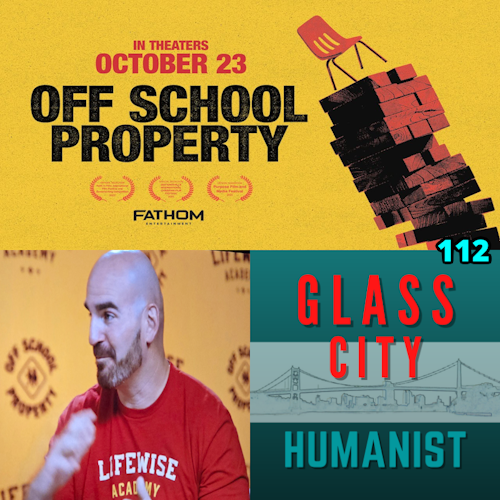
Episode 112: Lifewise Film Taints The Public Schools With False Propaganda
We closely look at the recent documentary “Off School Property” produced by Lifewise Academy, an outsized Christian nationalist provider for Released Time Religious Instruction where children are removed from a public school, in the middle of the day, and transported off campus to be indoctrinated in Christian beliefs.
The film simply lies about history and claims to be a solution to children who have emotional problems using volunteers barely vetted for the program and who have no professional training in child behavior. The film also claims that the Holy Bible is the linchpin of human civilization.
Several historical inaccuracies presented in the documentary, such as the portrayal of public schools’ origins and the impact of significant Supreme Court rulings on religious instruction in schools, oversimplifies the complex history of education in America and suggests that the rise of secularism was the primary driver behind the supposed removal of the Bible from the classroom. We highlight landmark cases, including McCollum v. Board of Education and Zorach v. Clausen, that illustrate the delicate balance between religious freedom and the necessity for inclusive public education.
Contrary to LifeWise’s assertions, we find many of the founding fathers had a much more complex relationship with religion and did not intend for the Bible to be central in public education. We argue that leveraging their historical figures to support a particular religious narrative is a misrepresentation meant to legitimize their agenda and that it fails to recognize the foundational principle of a secular government meant to serve all citizens regardless of their faith or lack thereof.
The goal of the film, simply, is to sell their product of indoctrination to parents who fear for their children.





Extras:
Off School Property: Solution to Separation of Church and State
Abington School District v. Schempp
The Founding Myth: Why Christian Nationalism Is Un-American
Off School Property, LifeWise Academy, Christian nationalism, misinformation, propaganda (Secular Left podcast episode on this same topic with audio clips from the film)
Transcript:
Click Here to Read Full Transcript
[0:04] This is Glass City Humanist, a show about humanism, humanist values, by a humanist. Here is your host, Douglas Berger. We review the recent documentary put out by LifeWise Academy called Off School Property. You get a front row seat as it tries to sell its Christian nationalist product through fear, emotional manipulation, and misinformation with the real goal to indoctrinate children and to dismantle our public school system. Glass City Humanist is an outreach project of the secular humanists of Western Lake Erie, building community through compassion and reason for a better tomorrow.
[1:00] On October the 23rd, LifeWise Academy, the Christian nationalist education provider, a release time education provider, released a documentary called Off School Property, A Solution to the Separation of Church and State. And it is a slickly made produced documentary that is documentary just because that’s the format that they used what i call it is an infomercial if it was on tv um basic propaganda.
[1:42] And and if you’re familiar with this technique what you do is when you’re doing an infomercial You start off by identifying a problem, and then you suggest a solution. Then you suggest a product for that solution, and then you include testimonials. And the LifeWise film follows that format. Now, I’m going to talk about the general gist of the film and some of the topics that it talks about. Now, I’m not going to show any clips. I’m not going to do any audio clips. I did do some clips and talked about some of the points in my other podcast that I host, my personal podcast, Secular Left. And I’ll throw a link to that program if you want some of that information as well. Because I just want to talk about the concepts that they talk about and why the film is misleading at the best intention.
[2:52] And in the worst intention, they’re just outright lying about things in order to push their product, which is disrupting the public school day to have kids trot off to Bible class. Now, the first thing is that when LifeWise goes into a public school district and they’re trying to set up a program, they talk about teaching kids character and how kids are inherently disruptive and have behavioral problems and they need the Bible to learn character issues. Well, in this movie, they talk a lot about the Bible, but they don’t talk hardly anything about the curriculum. They don’t talk about the character thing. Just the fact that they’re taking kids out of public school during the school day.
[3:49] And taking them off-site to study the Bible. That’s the whole goal of their program. In a nutshell, that’s what they do. The rest of the stuff where they talk about helping people with behavioral problems and trying to get them to be better students for their regular studies, that’s just all window dressing that they put on to make parents feel better, and make school districts feel better for them coming in. So, like I said, what I’m going to do is I’m just going to go through some basic concepts that they talk about and explain why it’s either misleading or false.
[4:34] Now, the first thing that they talk about is they set it up that they do like a timeline and they’re saying that public schools were formed in the 1600s and it was meant for kids to learn the Bible. It starts out, they talk about it, it says, to their great surprise, not only was the Bible a part of early American education in the 1600s, but it was the driving motivation for literacy. In those days, education was shifted into drive and moving forward with biblical instruction. Later on, as the United States was founded, education became state-run, and the rise of science and secularism began to put pressure on the state to remove any sign of religion from public school day. Eventually, a series of lawsuits in the mid-1900s sealed the deal. One famous atheist, Madeleine Marie O’Hare, brought the final case to the Supreme Court, officially banning Bible reading and prayer in the public schools. Well, if you are a person of history, if you know your history, you know that that simply was not true.
[5:53] Madeleine Murray O’Hare and the filmmaker, his name is Nate Lundquist, he got it wrong twice. He called her Madeleine Murray O’Hare. And so I don’t know if that was intentional or they just botched it in the chat GPT creation of the script. I don’t know. That’s my speculation. But she did not ban prayer in the Bible from public schools. What the court case was, was Abbey and School District v. Shemp. And what it did was the U.S. Supreme Court voted 8 to 1 to prohibit school districts from mandating prayer and Bible reading in public schools. Kids can still pray. They can still read their Bible. They just can’t have a teacher or other administrator telling them what to pray and what Bible to read.
[6:56] The other thing is that public schools have been state-run for longer than, you know, and you can tell that they’re making some of this stuff up because they don’t give details. But yes, in the 1600s, a lot of the colonies started up schools, common schools, for kids to learn the Bible. So they’re able to read it. But the Puritans, for example, did that because they wanted the children to learn how to read the Bible. Because in the Puritan, in their religion, in their sect, it was important for the person to personally interpret. You had a personal relationship with God. And so the ministers that typically would interpret Bible, the scriptures for you, were less important than in some religious sects.
[7:54] But then they decided that a lot of the colonies in the early America decided that it would be better to have a centralized common school for everybody to learn to read and write and do basic arithmetic so that they could be basic productive citizens in their colonies and in their states. And to use tax dollars to pay for it so that it was free for everybody. Because if you also know that a part about history is that a lot of the education opportunities in early America were behind a paywall. You had to come from a wealthy family to go to Harvard. Well, you still do. But, you know, if it was basic rudimentary education, just a basic read and write, if you wanted to do anything more than that, you had to pay for it. And so you had to, your family had to be wealthy or you had to do an apprenticeship, you know, like a blacksmith would take you under your wing and you learn blacksmithing, that sort of thing.
[9:05] And by the 1850s or 60s or so, public education became a big deal for everybody, and it became godless at that point. It wasn’t important to read the Bible, and so it was not focused on. It was reading, writing, arithmetic. McGuffey readers came about about that time.
[9:34] You know, some of the more interesting educational concepts like kindergarten started around that time, and it was a scientific, rational thing.
[9:48] Idea of education that overtook the United States, and so leading to what we now know as our modern version of public education. And ever since that time, you know, we’ve had Christian nationalists and other religious extremists that keep trying to shoehorn their religion into the schools. So there was, my mom is in her 80s, and she was telling me that when she was attending elementary school, there was a period at school where they would go into a room and be taught the Bible in the public school building. And then there’s been important Supreme Court cases since the 1940s. One of the first major ones was in 1948, McCollum v. Board of Education found that religious instruction classes held in public school buildings during school hours were unconstitutional. That led then to Zorach v. Clausen, which was in 1952, which said that if the school district sanctioned a religious education class, release time religious education class, that was held off school campus, did not involve any tax dollars, and was not taught by the state, that that was cool. That was fine with them. That didn’t violate the First Amendment.
[11:18] And so the fact that Nate in the film talks about how it was the rise of secularism and science that derailed Bible reading in school is just not true. There was a trend going that way because they wanted to be inclusive of everybody. See, that’s the main thing that these Christian nationalists seem to forget or want to gloss over, is what they propose to do with this Bible reading is not generic, basic religion. They are promoting a particular religion. In the case of LifeWise, it’s the Southern Baptist tradition with the King James Bible. You know, if you want the kids to learn a Bible, which Bible are you going to teach them? There are several different Bibles. In the 1840s, I believe it was, there was a really bad riot in Philadelphia.
[12:24] Several Catholic churches were burned. People were killed. And you’ll never guess what they were rioting about. They were rioting because Catholic people in the city wanted their Bible taught in the public school. And the Protestants who had their Bible being taught in the public school rejected that demand, and they attempted to basically battle these Catholics and burn their churches down. See, we don’t want to see a repeat of that. And so it’s just better to keep the state out of religious matters when it comes to children. Not to mention the fact that we have mandatory attendance policies. So these kids, when they’re in public school, they are not allowed to leave. The parents have to choose to, you know, has an overview of the curriculum. So it’s not like the kids could say, well, I don’t want to learn that.
[13:30] So if you get a religious zealot parent wants to send their kid to LifeWise, that poor kid is going to LifeWise, whether he wants to or not.
[13:49] For more information about the topics in this episode, including links used, please visit the episode page at glasscityhumanist.show.
[14:10] The other thing that I wanted to mention, too, in the LifeWise movie is that, like classic Christian nationalist apologist propaganda, they like to trot out the Founders, the Founding Fathers, Jefferson, Washington, Franklin.
[14:32] Adams, Madison, the whole front line. And trot them out, try to paint them as religious, pious religious people, and we need to do what they intended. They intended kids to learn the Bible in public school.
[14:56] The problem with that is that it is historically inaccurate. Now, in the film, Nate interviews this, I think he might be Hindu. I’m not familiar with the guy. I’ve never heard him talk before. And he was talking about how Jefferson, in Jefferson, Thomas Jefferson’s original draft of the Declaration of Independence, where the line goes, we hold these truths to be self-evident that all men are created equal. In the original draft he had written, we find these truths to be sacred and undeniable, and then it goes on. And so he said, see, that just proves that they wanted religion in the public schools. They wanted religion to be part of the government. And what is the problem with that is, first of all, people like Jefferson, he was a gentleman. He owned property. He owned slaves. He owned property.
[16:04] And like him, men like him that were wealthy, they were nominally religious. You basically had to pretend that you believed in God or went to church or were pious in order to function in society. But what they believed, what many of those people believed, like Jefferson, was that religion was a substitute for morality, and that was for the other people. That was for lower class people, the peasants. Religion was for them and it was to be used to control them to keep them in line so they weren’t rabble rousing and threatening their wealth.
[16:52] Yes. Andrew Seidel, in his book, The Founding Myth, talks about that. And Andrew is a constitutional scholar and he did a lot of research on it. And so when I read about that and I checked it out, it makes sense. It makes sense. And it kind of reminded me of Karl Marx’s famous line where he talks about religion being the opium of the people in that it whitewashes or salves all of the injustices that they have to endure, but it’s used by the elites to control the people. You know, it’s almost like how you do opium, is you take the opium and you just don’t feel anything. So these elites support these religious institutions, and then that salves the people’s problems. And so then they’re not threatening their wealth. And that’s exactly how the founding fathers did it. And so the other thing in the movie that they don’t explain, that never gets explained, is then why, if they were so much into religion, then why was that line changed?
[18:11] And they never get into that. They never explain it. They never even offer any suggestions why that happened. I pretty much probably know why. And one of those reasons was because they wanted the thoughts in that document to apply to everyone, everybody of any kind of religion or no religion, believe it or not.
[18:37] And so if there was any religious words or imagery in the Declaration of Independence, it was as a window dressing only.
[18:49] And you also have to remember, too, that they were fighting a king who believed that he ruled by divine right, that he had been put in place by God. And if you know your Bible, the Bible says that if God sets up a government, you have to obey. So declaring a revolution against a divinely inspired king is anti-Christian, anti-Bible. So the Declaration of Independence was anti-Bible. But you don’t hear Christian nationalists here in the United States talking about that. They kind of whitewashed that. But they hang their hat on that declaration, even though that wasn’t the government. Because then years later, after the Articles of Confederation didn’t work out and they created a new government with the U.S. Constitution, the U.S. Constitution is intentionally godless. They intended to leave God out of it, and the mentions of religion in it are prohibitions of the government, like no religious test. And then you had the First Amendment that Congress can make no laws favoring one sect over another or establishing a church. Many of the states in early America had established churches where tax dollars went to these churches.
[20:17] After this U.S. Constitution was made, a lot of those states stopped doing that. And so today there are no established churches in any of the states.
[20:38] For more information about the topics in this episode, including links used, please visit the episode page at glasscityhumanist.show.
[20:58] The final part of the LifeWise movie, after they go through the history, and then they talk a lot about the Bible. They even go to the Bible Museum. Why, I don’t know. And they talk about how important the Bible is. And so when they are talking about it, they talk about how the Bible and God made everybody equal. Because according to Christians, people are made in the image of God, so everybody is inherently equal. Right? And so then they talk about inequality, and they try to blame evolution for inequality. Now, I would like somebody who knows about these things to make that make sense Because that does not make any sense, So I fully believe that everybody is basically inherently equal Everybody does have inherent dignity and worth, But just for example, if we accept their premise that the Bible or that everybody is creating the image of God so everybody is equal.
[22:26] Then that just adds more proof to the idea that any inequality that we see or experience today is due to a social construct. That it’s not.
[22:45] You know, if Mary and Joseph were created in the image of God and they both should be equal, then Mary should be getting paid the same amount of money as Joseph, should have the same rights, the same everything that Joseph gets. But that doesn’t happen. The same with Joseph is black and Mary is white and Mary gets far more privilege than Joseph. That is a social construct. That is people in society deciding that that’s how it should be. And if that is not correct or should not exist, then society can come forward and say, no, we’re going to change it. We’re going to make sure that everybody is treated equally. It has nothing to do, even if you believe that the religious thing about people being equal because you’re in God’s image, even if that were true, that still would not presume that evolution causes inequality.
[23:57] Because, again, evolution, all that is, is adapting to your surroundings, and the people that can adapt then pass their genes on to the next generation, et cetera, et cetera, et cetera. You know, we know that racism isn’t genetic. We know that sexism isn’t genetic. Anti-trans treatment is not genetic.
[24:24] Those things are all learned. Bigotry is Learned, Racism is learned. Setting up racist, systemic racist institutions, that is something that people do and that can be taken down. Anything that you build can be demolished. So you don’t need to believe that you were created in the image of God because the fact that people are unequal because of the society and the way the society is set up, that doesn’t require you to be a believer, a religious believer, that God is so great. Because again, if you were created in the image of God, and God’s all-powerful, then he would have done away with all the inequality by now, right? 2,000 years, you would think?
[25:31] And so that’s how we logically take a look at these things and show that. So that was the other thing that kind of came to mind while I was watching this movie, and they were talking about that, is that they just have a warped sense of the world. The other thing that they talk about is the mental health status of the children in public schools. And there are some issues in some places with the mental health issue of children. And one of the things that a lot of the public school districts do is they hire professional mental health people to help with that, counselors and things like that. But they think that LifeWise would help with that. And I don’t see it. I don’t see learning the Bible is going to help a child with anxiety or who’s being abused at home or has food issues, not getting enough to eat. You know, it’s just, that’s just, you know, I’m sure that they’re, they have good intentions on that part. But what they do is they try to use that as proof that they, that the school district has to have them. So I watched this movie, like I said.
[26:49] On October the 23rd, it was released to 700 theaters where I saw it at in Perrysburg. There was they were having three showings. Three different theaters, and there was not too many people in mind. And that’s the other thing, too, is is LifeWise is not as popular as they like
[27:12] you to think that they are. That’s why they did this slick infomercial is because they’re trying to generate more people to sign up because more people that sign up, more money, more revenue goes to the national office, even though they’re sitting on $35 million of donations from different right wing groups. And then and then, of course, then they had the testimonials, which were very personal. Some of them kind of tragic. Um, this, uh, they talk about this boy who tended life wise and then got baptized and he’s talking about God and then he dies in a car crash. It’s like, you’re not prepared for that. And that’s that emotional manipulation that Christian nationalists like to do in their propaganda is they just tell you these tragic stories and, and they’re like, and their takeaway way on the people that are talking about this boy is at least he was with God or he was right with God before he died. Oh, boy.
[28:18] I mean, not to laugh about the death. I’m not laughing about the death, but the reaction of the Christians to that is, you know, they’re like, yeah, it’s tragic, but he was with God. Oh, okay. So they had that. And then the final 30 minutes or so was Nate and Joel in a two-shot, what we call a two-shot, where they’re on screen together.
[28:41] And Nate does a testimony, like a standard Christian testimony, like, you know, I was done, I did this, I joined LifeWise, it was the greatest thing, and I want the kids to learn the Bible, will you help, give your life to Christ, da-da-da-da-da. Then Joel comes on and talks about, we need money, and shows a QR code and all that stuff. And then the way they have the film set up is then they expect people, while they’re playing the credits or getting ready to play the credits, have people talking and asking questions. And then they do a Ferris Bueller moment where then the music fades out and Joel and Nate are playing Jenga. And they’re like, oh, are you guys still here? You still talking? Great. Well, we’ll still be here too. And then it fades out, and then the full credits start, and that’s the movie. It was like an hour and a half or so. Um, it wasn’t terrible. Like I said, it wasn’t a terrible movie. It was very professionally produced and, uh, very good propaganda for their group. But like I said, it misleads. It lies about some things. Now you don’t have to go see the movie.
[29:59] And I hope, I hope you enjoyed this review and, and discussion about it. Check out, uh, some other details that I talk about in my personal, uh, podcast. Secular Left if you want more on the film. And thank you. Glass City Humanist is hosted, written, and produced by Douglas Berger, and he’s solely responsible for the content.
Transcript is machine generated, lightly edited, and approximate to what was recorded. If you would like perfect transcripts, please donate to the show.
Credits
Written, produced, and edited by Douglas Berger and he is entirely responsible for the content. Incidental voice overs by Sasha C.
The GCH theme is “Glass City Jam” composed using Ampify Studio
This episode by Glass City Humanist is licensed under CC BY-NC-ND 4.0.

